


Court’s decision
The Bombay High Court allowed a Criminal Application under Section 482 of the Code of Criminal Procedure and quashed the order dated 16 September 2021 passed by the Designated PMLA Court issuing process against Advocate Kishore Dewani in a money laundering case.
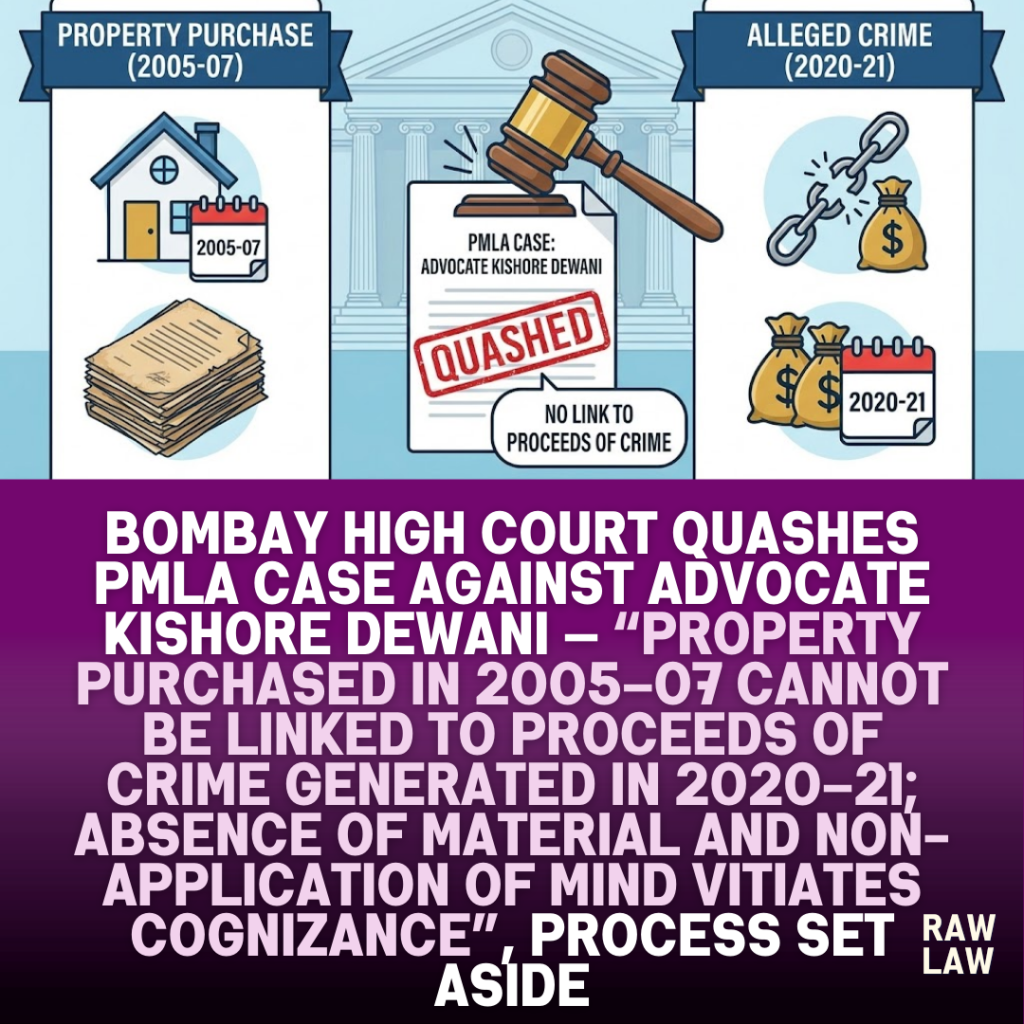
Justice Ashwin D. Bhobe held that the essential ingredients of Sections 3 and 4 of the Prevention of Money Laundering Act, 2002 were not established against the applicant. The Court found no material connecting the land purchased between 2005 and 2007 to proceeds of crime allegedly generated between 2020 and 2021. The complaint and process were quashed qua the applicant.
Facts
An FIR dated 21 April 2021 was registered for offences under the Prevention of Corruption Act and the Indian Penal Code concerning alleged illegal collections from bar owners during 2020–2021.
Based on this predicate offence, the Directorate of Enforcement registered an ECIR and filed a complaint under the Prevention of Money Laundering Act, 2002. The applicant was arrayed as Accused No. 11 in PMLA Special Case No. 1089 of 2021.
The prosecution alleged that proceeds of crime amounting to approximately ₹4.70 crores were collected in cash between December 2020 and February 2021 and subsequently layered through shell companies before being integrated into a trust account.
The applicant’s alleged role related to transactions of M/s Premier Port Links Pvt. Ltd., including land purchased at Dhutum Village between 2005 and 2007 and certain shareholding and loan transactions involving entities linked to the principal accused.
Issues
The principal issue before the High Court was whether the complaint and material on record disclosed the ingredients of the offence under Section 3 of the Prevention of Money Laundering Act, 2002 against the applicant.
A secondary issue was whether the Designated Court had applied its mind while issuing process and satisfied the test of “sufficient ground for proceeding.”
Applicant’s arguments
The applicant contended that the prosecution’s own case was that proceeds of crime were generated between December 2020 and February 2021. However, the land transactions attributed to him occurred between 2005 and 2007, long before the alleged generation of proceeds of crime.
It was argued that there was no averment that the applicant had knowledge of any tainted funds or that he was involved in concealment, possession, acquisition, use, or projection of proceeds of crime.
The applicant emphasized that even assuming funds were transferred to a trust account since 2013, the property acquired in 2005–2007 could not logically be connected to proceeds generated years later.
Enforcement Directorate’s arguments
The Enforcement Directorate argued that the applicant was a director of the company and had facilitated financial transactions, including loans of ₹2.20 crores from an entity allegedly linked to the principal accused.
It was contended that money laundering is a continuing offence and that a person need not be an accused in the predicate offence to be prosecuted under the Prevention of Money Laundering Act.
Reliance was placed on the Supreme Court’s judgment in Vijay Madanlal Choudhary to argue that dealing with proceeds of crime at any stage could attract Section 3 liability.
Analysis of the law
The Court examined Section 3 of the Prevention of Money Laundering Act, 2002, which criminalizes knowingly assisting or being involved in processes connected with proceeds of crime, including concealment, possession, acquisition, use, or projection as untainted property.
The Court emphasized that the existence of “proceeds of crime” derived from a scheduled offence is a sine qua non for invoking Section 3. It referred to Supreme Court precedents including Vijay Madanlal Choudhary and Pavana Dibbur, which clarified that proceeds must be derived from a scheduled offence already accomplished.
The High Court observed that while money laundering can be a continuing offence, the property in question must have some nexus with the proceeds of crime.
Precedent analysis
The Court relied upon the Supreme Court’s exposition in Vijay Madanlal Choudhary that money laundering is independent but intrinsically linked to proceeds derived from a scheduled offence.
It also referred to Pavana Dibbur, where the Supreme Court held that property acquired prior to the commission of the scheduled offence cannot ex facie be treated as proceeds of crime.
Additionally, reliance was placed on Sunil Bharti Mittal v. CBI to reiterate that issuance of process requires judicial application of mind and recording of reasons demonstrating sufficient ground for proceeding.
Court’s reasoning
The High Court held that the land purchased between 2005 and 2007 could not be connected to proceeds of crime allegedly generated in 2020–2021. Even if funds were transferred to a trust account from 2013, the earlier property transactions had no demonstrable nexus with those funds.
The Court found that the complaint did not disclose any material showing that the applicant knowingly dealt with tainted funds. No specific role satisfying the ingredients of Section 3 was established.
The Designated Court’s order issuing process was found to lack application of mind and failed to satisfy the “sufficient ground for proceeding” test. Consequently, the order was held to be bad in law.
Conclusion
The Bombay High Court quashed the impugned order dated 16 September 2021 and the complaint in PMLA Special Case No. 1089 of 2021 insofar as it concerned the applicant.
The Court held that the case squarely fell within the parameters for exercising inherent powers to prevent abuse of process. The criminal application was allowed, and the interim application was disposed of.
Implications
This ruling reinforces a critical limitation in money laundering prosecutions: property acquired prior to the generation of proceeds of crime cannot automatically be branded as tainted.
The judgment underscores that temporal nexus and evidentiary linkage are essential under the Prevention of Money Laundering Act. Mere association with an accused or corporate entity is insufficient.
It also reiterates the judicial duty to apply mind at the stage of issuing process and prevents mechanical cognizance in high-profile economic offence cases.
Case Law References
- Vijay Madanlal Choudhary v. Union of India (2022 SCC OnLine SC 929) – Clarified scope of Section 3 and continuing offence doctrine.
- Pavana Dibbur v. Directorate of Enforcement (2023) 15 SCC 91 – Held property acquired prior to scheduled offence cannot ex facie be proceeds of crime.
- Sunil Bharti Mittal v. CBI (2015) 4 SCC 609 – Emphasized requirement of judicial application of mind while issuing process.
FAQs
1. Can property purchased before the scheduled offence be treated as proceeds of crime under PMLA?
Generally, no. The Bombay High Court held that property acquired before the alleged generation of proceeds of crime cannot be linked unless a clear nexus is shown.
2. Is money laundering a continuing offence?
Yes, but there must be demonstrable dealing with proceeds of crime derived from a scheduled offence. Mere past transactions are insufficient.
3. Can High Courts quash PMLA complaints under Section 482 CrPC?
Yes. If the complaint fails to disclose essential ingredients of the offence or continuation amounts to abuse of process, inherent powers may be exercised.