Bombay High Court Refuses Protection for 54 Unauthorized Boisar Sheds; Upholds Tahsildar’s Demolition and Says Article 227 Relief Cannot Reward Illegal Construction Despite Jurisdictional Challenge

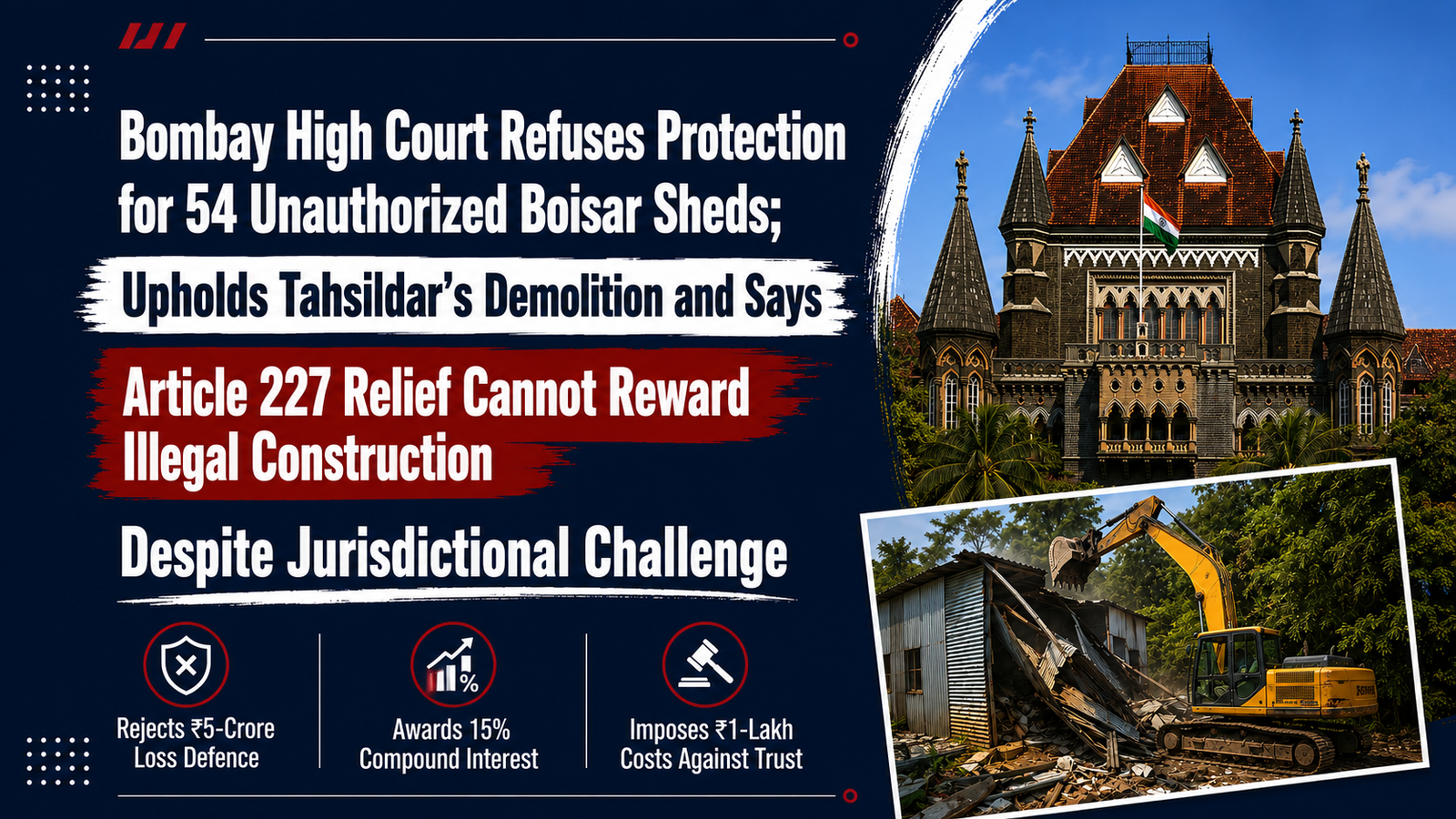
Bombay High Court Rejects Owners’ Plea Against Demolition of 54 Tin Sheds; Says Illegal Construction Cannot Secure Equitable Protection Through Article 227
Facts
The petitioners had purchased old Gram Panchayat House Nos. 460 to 462 situated on Gat No. 100 at Village Boisar, Palghar, under a registered sale deed dated 22 June 2023. They subsequently obtained an NOC from the Village Panchayat, Boisar and erected tin sheds on the property.
On 17 July 2025, the Tahsildar, Palghar issued notice alleging that the petitioners had constructed 54 sheds, each measuring approximately 6 x 3.05 metres, without obtaining permission from the competent Planning Authority or District Collector.
The petitioners sought regularization under Section 143 of the Maharashtra Regional and Town Planning Act, 1966. Their regularization attempt ultimately failed.
On 3 February 2026, the Tahsildar directed removal of unauthorized development within seven days, failing which demolition would follow. The petitioners filed a civil suit seeking a declaration that this order was a nullity and sought an injunction against its implementation.
The Civil Judge rejected their temporary injunction application, finding prima facie that the construction had been carried out without permission of the Planning Authority. The District Court dismissed their appeal and also noted the bar under Section 149 MRTP Act.
The petitioners therefore approached the Bombay High Court under Article 227.
Issues
The principal issues were whether the Tahsildar had jurisdiction under Sections 52, 53 and 54 of the MRTP Act after MMRDA became the Special Planning Authority for the extended Mumbai Metropolitan Region; whether the Collector’s earlier 2022 delegation to the Tahsildar survived MMRDA’s later appointment and delegation of authority to the Collector; whether this amounted to impermissible sub-delegation; and whether Article 227 relief should nevertheless be granted to protect structures admittedly built without planning permission.
Petitioners’ Arguments
The petitioners’ principal contention was jurisdictional.
They argued that after the State Government’s notification dated 9 July 2024 extending the Mumbai Metropolitan Region and appointing MMRDA as Special Planning Authority, the Tahsildar could no longer exercise planning powers based on the Collector’s earlier delegation dated 31 March 2022.
Although MMRDA subsequently delegated its powers to the District Collector, the petitioners argued that the Collector, being himself a delegate, could not further sub-delegate those powers to the Tahsildar.
They relied on Section 151 MRTP Act and the general principle delegatus non potest delegare—a delegate cannot ordinarily further delegate his authority.
The petitioners fairly admitted that the structures had been erected without permission of the Planning Authority and that their regularization application had also been rejected. Their case was nevertheless that demolition could not proceed on the basis of an order passed by an authority lacking jurisdiction.
Respondents’ Arguments
The State argued that the real and undisputed issue was the existence of grossly unauthorized construction.
It emphasized that 54 structures had been erected without planning permission and that the petitioners therefore had no equitable basis for seeking discretionary protection.
The State further argued that the Village Panchayat’s NOC was irrelevant because the Village Panchayat was not the Planning Authority under the MRTP Act.
MMRDA supported the demolition action and contended that its delegation to the District Collector expressly enabled the Collector to exercise Planning Authority powers in accordance with the prevailing operating procedure. That existing procedure included exercise of powers through the Tahsildar.
Analysis of the Law
The High Court first recorded an important undisputed fact: the structures were erected without permission of any competent Planning Authority.
The Village Panchayat NOC could not cure that defect because the Village Panchayat was not the relevant Planning Authority under the MRTP Act. The petitioners’ regularization application had also failed. The Court therefore characterised the structures as “completely unauthorized and illegal.”
The remaining legal controversy concerned delegation.
Under Section 151(3), a Planning Authority may delegate powers exercisable by it to an officer of the State Government with the previous consent of the State Government and subject to specified conditions. The Court noted that the statutory phrase allowing delegation “subject to such conditions” was sufficiently broad to regulate the manner in which the delegated power was to be exercised.
MMRDA had delegated its Special Planning Authority powers to the District Collectors of Palghar and Raigad. The delegation authorised exercise of those powers in accordance with the prevailing operating procedure.
The High Court interpreted that language as effectively preserving or “resurrecting” the Collector’s existing arrangement under which planning enforcement powers had been delegated to the Tahsildar.
Section 18 and Delegation to Tahsildar
Section 18(1)(iii) itself recognises the Collector’s authority regarding development in specified areas and expressly permits the Collector to delegate that power to an officer not below the rank of Tahsildar.
The Court reasoned that requiring every planning-enforcement action to be personally undertaken by the Collector would make practical implementation of the MRTP Act difficult.
It also relied by analogy upon the statutory principle that earlier orders and notifications may continue under a changed legal regime where they are not inconsistent with the later regime.
Accordingly, the Court was not persuaded that the Tahsildar lacked authority to exercise powers under Sections 52, 53 and 54 merely because MMRDA had subsequently become the Special Planning Authority.
Precedent Analysis
State of Bombay v. Morarji Cooverji
The Bombay High Court relied on this authority for an important principle governing discretionary writ relief.
Merely proving that an impugned administrative order suffers from some legal defect is not always sufficient. A writ petitioner must also satisfy the Court that granting relief would advance justice and that justice lies on his side.
This principle became decisive because the petitioners were seeking equitable protection for structures they admitted had been erected without planning permission.
Garment Craft v. Prakash Chand Goel, (2022) 4 SCC 181
The Supreme Court clarified that Article 227 is a supervisory and correctional jurisdiction, not a substitute for a first appeal.
The High Court does not interfere merely to correct every legal or factual error. Intervention is principally justified where there is grave dereliction, perversity, abuse of jurisdiction or miscarriage of justice.
The Court applied this principle to hold that even assuming there was room for debate over the delegation issue, interference was not warranted where the ultimate result—action against admittedly illegal construction—was consistent with justice.
Rajendra Kumar Barjatya v. U.P. Avas Evam Vikas Parishad
The Supreme Court strongly reiterated that unauthorized construction cannot be perpetuated merely because time has passed, money has been spent, or authorities were initially inactive.
Construction raised without sanctioned approval must be dealt with strictly, and courts should not display misplaced sympathy.
Kaniz Ahmed v. Sabuddin
The Supreme Court again warned courts against engaging in judicial regularization of buildings erected without requisite permissions.
The Bombay High Court relied on this judgment to reinforce the rule-of-law dimension of dealing firmly with illegal development.
Court’s Reasoning
The Court held that the petitioners’ argument on delegation did not justify protection of their structures.
First, the MMRDA delegation to the Collector expressly contemplated exercise of power according to existing operating procedure, which included the Collector’s prior delegation to the Tahsildar.
Second, Section 18 itself contemplated delegation by a Collector to an officer not below Tahsildar rank.
Third, and independently, the Court held that even if two views were possible on whether the Collector’s 2022 delegation technically survived, that alone would not justify exercising Article 227 jurisdiction in favour of the petitioners.
Article 227 jurisdiction is discretionary and justice-oriented. A petitioner asking the Court to exercise supervisory jurisdiction must demonstrate not merely an arguable legal defect but that intervention would actually serve justice.
That threshold was not met here.
The petitioners had erected 54 tin sheds, which were being put to commercial use, without permission from any Planning Authority. The Court described the development as wholly illegal and observed that this was not a case of a minor deviation from an otherwise sanctioned development.
The Court stated that unauthorized development cannot be tolerated as an act of “judicial generosity”, nor can regularization of illegal construction become a routine policy of governance.
Granting relief merely because the petitioners had discovered a technical jurisdictional argument would effectively allow Article 227 to shield admitted illegality.
Conclusion
The Bombay High Court held that the Tahsildar’s exercise of delegated authority could not be faulted in the circumstances and, in any event, no discretionary or equitable relief could be granted to protect the admittedly unauthorized development.
The Court therefore upheld the concurrent decisions of the Civil Judge and District Court refusing temporary injunction against demolition.
The Writ Petition was dismissed, Rule discharged and no costs were imposed.
The petitioners thereafter sought continuation of the existing ad-interim protection for a reasonable period. The High Court rejected that request as “wholly unjustifiable”, thereby declining to further stay demolition action.
Case Details
Case: Smt. Nirmala Rupchandra Ghatawat & Ors. v. Collector of Palghar & Ors.
Court: High Court of Judicature at Bombay, Civil Appellate Jurisdiction
Case Number: Writ Petition No. 9692 of 2026
Judge: Justice N. J. Jamadar
Reserved on: 18 August 2026
Date of Judgment: 1 September 2026
Result: Writ Petition dismissed; refusal of temporary injunction against demolition upheld. Court held that the Tahsildar could exercise delegated MRTP powers and, independently, that Article 227 relief could not be used to protect 54 admittedly unauthorized commercial sheds. Request to continue ad-interim protection was also rejected.