


Court’s decision
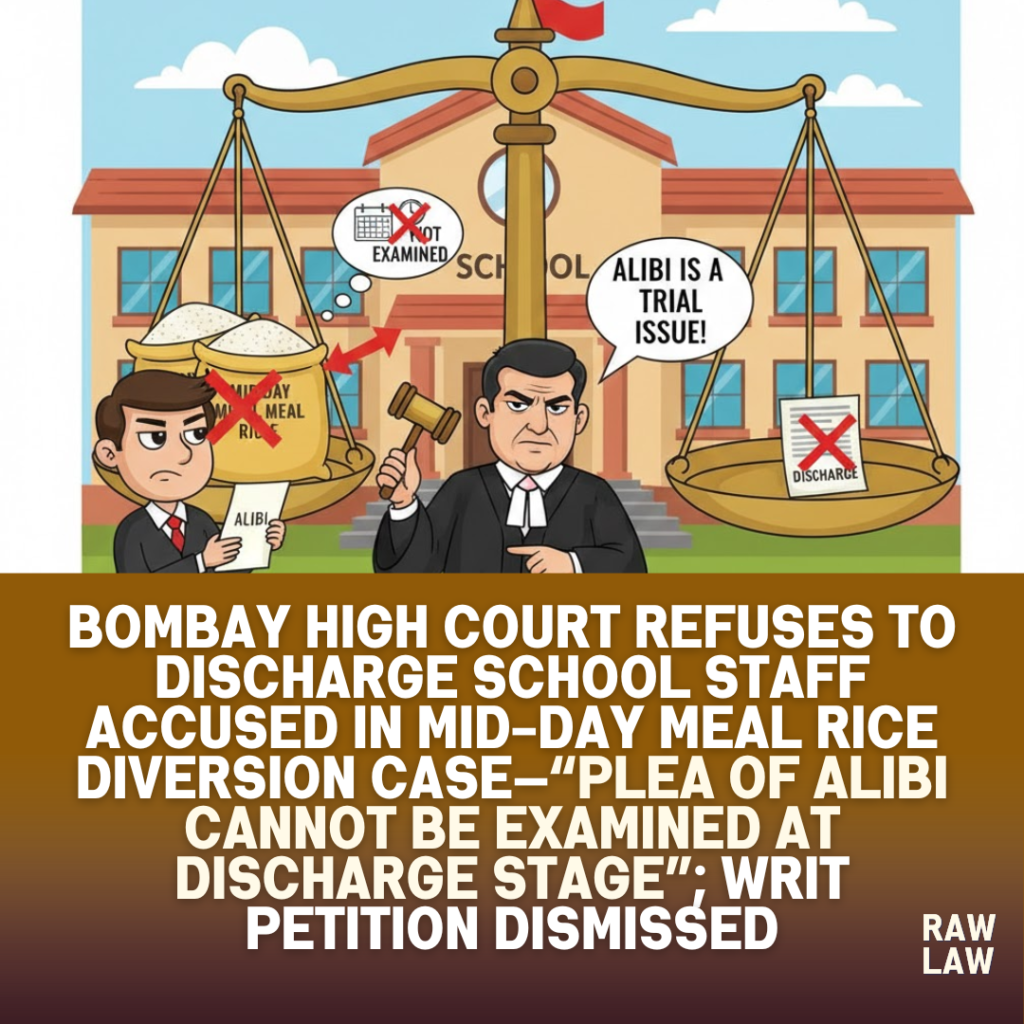
The Bombay High Court (Aurangabad Bench) declined to interfere with concurrent orders of the trial court and the revisional court rejecting discharge applications filed by two school employees accused of diverting food grains meant for the mid-day meal scheme. The Court held that at the stage of discharge, the court is required only to see whether a prima facie case exists on the basis of the prosecution material and that defence pleas, including alibi, cannot be considered. Finding sufficient material to proceed to trial, the Court dismissed the criminal writ petition.
Facts
The prosecution case arose from a raid conducted on the basis of secret information that food grains meant for school children under the mid-day meal scheme were being illegally transported for sale in the open market. An auto-rickshaw driven by a co-accused was intercepted, and a gunny bag of rice was seized. The rice bore markings indicating its linkage with government supply and public welfare distribution. An offence was registered under the provisions of the Essential Commodities Act.
During interrogation, the arrested auto-rickshaw driver stated that the seized rice had been handed over to him by the in-charge headmistress and the peon of a government-aided Urdu primary school. On this basis, the school staff were arraigned as accused. After investigation, a charge-sheet was filed, leading the accused to seek discharge before the trial court.
Issues
The principal issues before the High Court were whether the material on record disclosed a prima facie case against the accused school staff, whether their implication based largely on the statement of a co-accused was legally sustainable at the discharge stage, and whether the plea of alibi supported by attendance records could be examined while considering an application for discharge.
Petitioner’s arguments
The petitioners contended that they were falsely implicated solely on the basis of the statement of a co-accused, which by itself could not form the foundation for prosecuting them. It was argued that no essential commodities were recovered from their possession or from the school premises and that the seizure was effected from an auto-rickshaw located far away from the school.
The headmistress asserted that she was attending an official meeting at the Zilla Parishad on the date and time of the alleged incident, supported by an attendance certificate issued by the Education Officer. The peon was also stated to be accompanying her. It was submitted that the charge-sheet lacked documentary proof showing shortfall or diversion of rice from the school, no student or parent had lodged any complaint, and even the seized gunny bag did not bear the name of the school. On these grounds, the petitioners claimed that forcing them to face trial would amount to abuse of process.
Respondent’s arguments
The State opposed the petition, asserting that the raid was conducted on credible intelligence and resulted in recovery of rice meant exclusively for distribution under the mid-day meal scheme. The prosecution relied on official communications from the education authorities showing that rice was supplied to the concerned school every month through authorised channels and that the records maintained by the school contained discrepancies and blank entries.
It was contended that the FIR and investigation material indicated that the rice was handed over to the auto-rickshaw driver at the instance of the petitioners. The State emphasised that the plea of alibi and explanations offered by the accused could only be tested during trial and not at the stage of discharge.
Analysis of the law
The High Court reiterated the settled legal position governing discharge under the Code of Criminal Procedure. At this stage, the court is not required to conduct a meticulous evaluation of evidence or assess the probable defence of the accused. The scope is limited to examining whether the prosecution material, if taken at face value, discloses sufficient grounds to proceed.
The Court relied on Supreme Court authority holding that the expression “record of the case” refers only to documents and material produced by the prosecution. The accused has no right to adduce defence material at the stage of framing of charge or discharge. A detailed scrutiny or weighing of evidence would amount to a premature trial, which is impermissible.
Precedent analysis
The High Court placed reliance on recent Supreme Court jurisprudence clarifying that the defence of the accused, including pleas such as alibi, cannot be considered at the discharge stage. It also referred to established principles that the court must only determine whether a prima facie case exists and whether the prosecution version, if unrebutted, would warrant framing of charges.
These precedents were applied to reject the petitioners’ argument that their attendance records and explanations should lead to discharge at the threshold.
Court’s reasoning
On examining the charge-sheet and accompanying material, the Court noted that the petitioners held positions of responsibility in the school and that the prosecution alleged diversion of rice supplied for a welfare scheme. The statement of the co-accused, the seizure of rice with government markings, and the correspondence from education authorities collectively constituted sufficient material to raise grave suspicion.
The Court acknowledged the existence of an attendance certificate supporting the plea of alibi but held that such a defence could be raised only during trial. At the present stage, the prosecution material disclosed enough grounds to proceed. The trial court and revisional court were therefore justified in rejecting the discharge applications.
Conclusion
The Bombay High Court found no error, perversity, or material irregularity in the concurrent findings of the courts below. Holding that sufficient prima facie material existed against the petitioners, it dismissed the criminal writ petition. The Court clarified that its observations were prima facie and would not prejudice the trial on merits.
Implications
This ruling reinforces the strict limits on judicial scrutiny at the discharge stage in criminal proceedings. It underscores that defence pleas, however persuasive, must ordinarily await trial and that courts will be slow to terminate prosecutions involving alleged diversion of public welfare resources at a preliminary stage. The judgment has significant implications for cases involving mid-day meal schemes and other public distribution mechanisms, highlighting accountability of institutional functionaries.
Case law references
- State of Gujarat v. Dilipsinh Kishorsinh Rao (2023): Held that defence material cannot be examined at the stage of discharge and that courts must confine themselves to prosecution records.
- Krishnanath v. State (2009): Clarified that at the discharge stage, an in-depth scrutiny of evidence is impermissible and only a prima facie view is required.
FAQs
1. Can a plea of alibi be considered at the stage of discharge?
No. Courts have consistently held that alibi and other defence pleas can be examined only during trial, not while deciding discharge applications.
2. Is a co-accused’s statement sufficient to proceed against other accused?
At the discharge stage, courts only assess whether the prosecution material raises a prima facie case. The evidentiary value of such statements is tested at trial.
3. When will a court discharge an accused before trial?
Discharge is granted only when the prosecution material, even if accepted as true, does not disclose sufficient grounds to proceed.