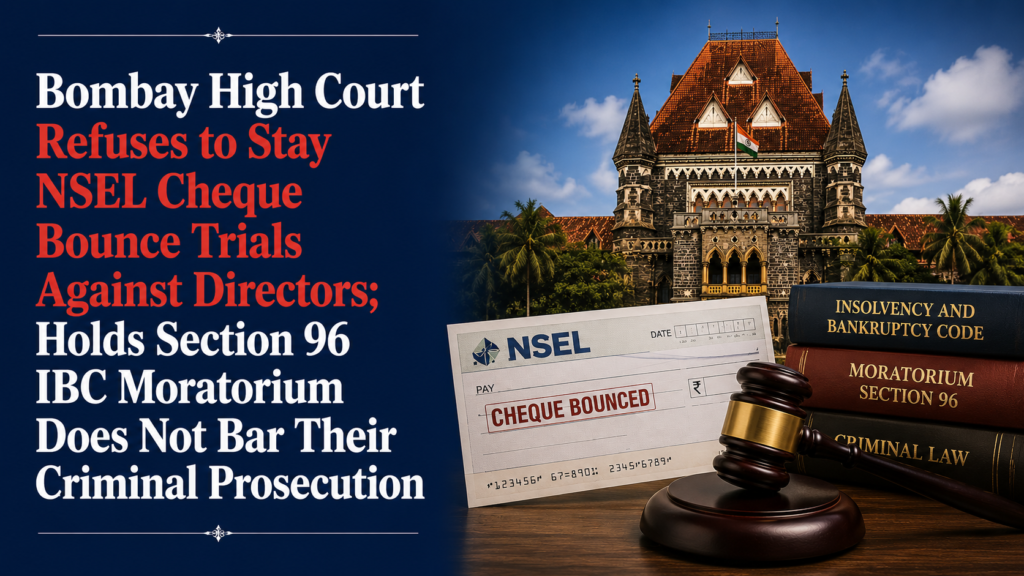
Bombay High Court Refuses to Stay NSEL Cheque Bounce Trials Against Directors; Holds Section 96 IBC Moratorium Does Not Bar Their Criminal Prosecution

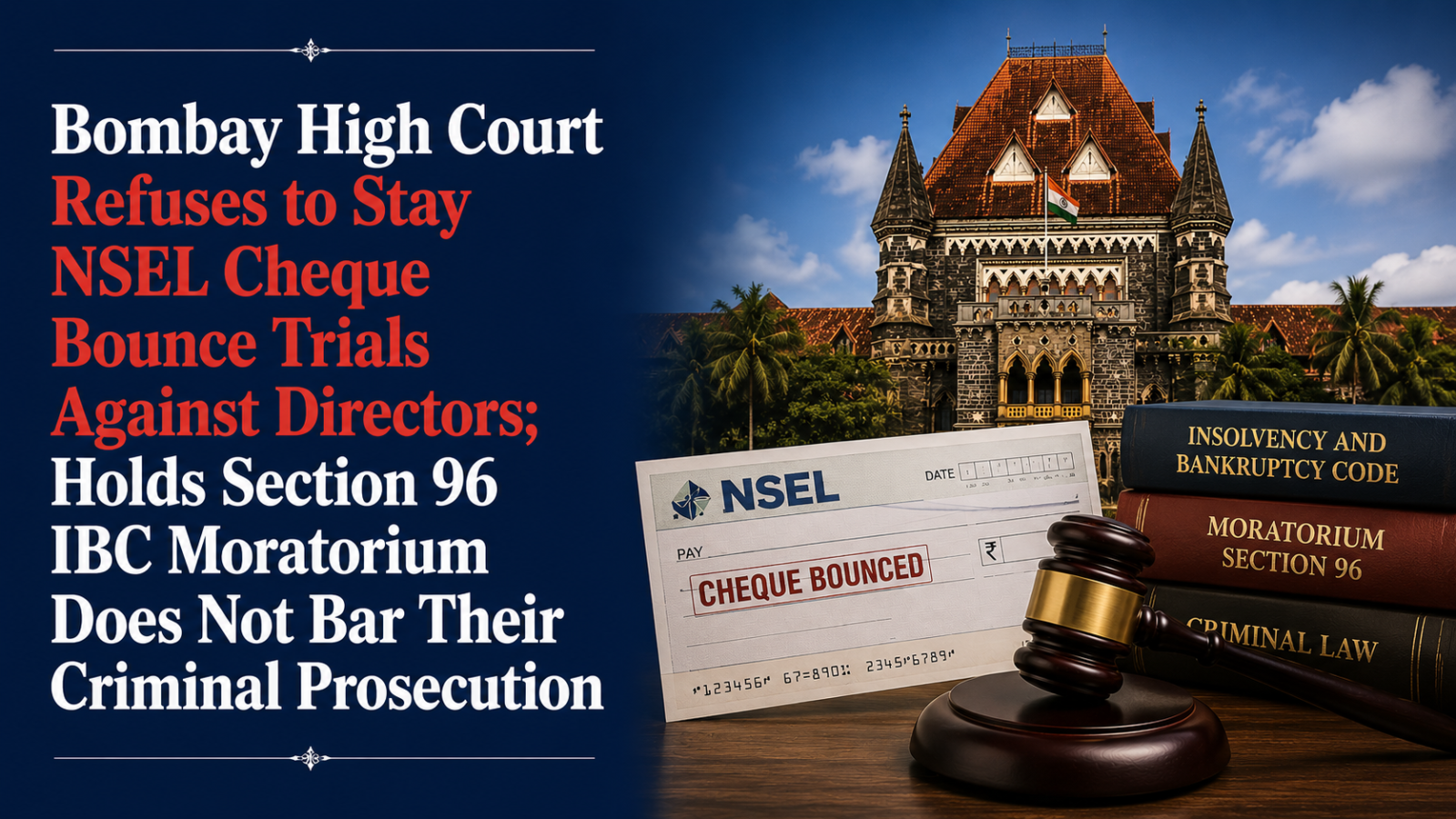
Bombay High Court Vacates Stays in NSEL Cheque Cases; Holds Directors’ Section 138 Trials Can Continue Despite Interim Moratorium Under IBC
Facts
The Bombay High Court decided together a large batch of criminal applications and writ petitions raising a common question: does the interim moratorium under Section 96 of the Insolvency and Bankruptcy Code, 2016 stay proceedings under Sections 138/141 of the Negotiable Instruments Act against company directors or responsible persons undergoing personal insolvency proceedings?
The Court treated Application No. 1749 of 2024, Jagmohan Garg v. National Spot Exchange Ltd. & Anr., as the representative matter.
National Spot Exchange Ltd. (“NSEL”) operated an electronic spot-trading platform. Mohan India Pvt. Ltd. was its trading and clearing member, while the applicant was alleged to be its director and authorised signatory responsible for its day-to-day affairs.
Following defaults, a settlement award dated 30 October 2013 made approximately ₹771 crore payable in 13 instalments. After payment of the first instalment, defaults followed and ₹124.50 crore remained payable as of 10 March 2014.
Towards the liability, the company issued a ₹30 crore cheque, signed by its directors. The cheque was dishonoured with the remarks “funds insufficient” and “account freezed”, resulting in prosecution under Section 138 read with Section 141 NI Act.
During the prosecution, the applicant instituted personal insolvency proceedings under Section 94 IBC and sought a stay of the Section 138 proceedings on the ground that an interim moratorium under Section 96 had automatically commenced.
The Magistrate rejected the application. Similar questions arose in the connected petitions involving insolvency proceedings initiated under Sections 94 or 95 IBC.
Issues
The principal issue was:
Whether an interim moratorium under Section 96 IBC, triggered by personal insolvency proceedings concerning a director/person responsible for a company, stays a prosecution against that person under Section 138 read with Section 141 NI Act for dishonour of a cheque issued by the company.
The Court also considered:
- Whether the expression “any legal action or proceeding in respect of any debt” in Section 96 includes such cheque-dishonour prosecutions.
- Whether the corporate debt underlying the dishonoured cheque becomes the director’s “debt” merely because Section 141 NI Act creates vicarious criminal liability.
- Whether the proceedings should nevertheless be stayed pending the Supreme Court larger-bench reference in Dineshchand Surana v. UCO Bank.
Petitioner’s Arguments
The applicants argued that Section 96 is wider than Section 14 IBC because Section 96 speaks of “all the debts” and “any legal action or proceeding in respect of any debt.”
According to them, Section 138 proceedings arise directly from a legally enforceable debt and are substantially compensatory or debt-recovery oriented despite their criminal form.
They relied heavily on P. Mohanraj v. Shah Brothers Ispat Pvt. Ltd. to argue that Section 138 proceedings are sufficiently connected with enforcement of debt to fall within an insolvency moratorium.
They further submitted that allowing prosecution against directors while insolvency proceedings were pending would undermine the breathing space that the IBC seeks to provide.
It was also argued that the distinction between a company’s debt and the director’s liability was artificial because conviction under Section 138/141 may result in substantial fine or compensation against the director personally.
Certain petitioners additionally argued that Rakesh Bhanot was distinguishable because their insolvency proceedings had been initiated by creditors under Section 95, rather than voluntarily by debtors under Section 94.
Respondent’s Arguments
NSEL argued that the debt underlying the dishonoured cheque remained the company’s debt.
The directors were prosecuted as natural persons because of the statutory vicarious liability imposed by Section 141 NI Act. That did not convert the company’s debt into their personal debt.
Therefore, personal insolvency proceedings concerning a director could not stay his criminal prosecution arising from a cheque drawn by the company.
NSEL relied principally on the Supreme Court decisions in Ajay Kumar Radheyshyam Goenka and Rakesh Bhanot to contend that insolvency proceedings do not extinguish or suspend the personal criminal liability of natural persons under Sections 138/141 NI Act.
It further argued that the pending larger-bench reference in Dineshchand Surana did not justify staying the trials because existing Supreme Court precedents remained binding until overruled or modified.
Analysis of the Law
The High Court read Sections 94, 95 and 96 IBC together, rather than construing the words “any debt” in Section 96 in isolation.
Section 96 is triggered when an application is filed under Section 94 or Section 95. Those provisions necessarily contemplate insolvency proceedings concerning debts owed by the person against whom the personal insolvency process is initiated.
Therefore, the “debt” referred to in Section 96 must be a debt of that particular debtor.
This distinction became decisive.
A company is an independent juristic person. Its directors do not own its property and, ordinarily, its debts do not become their debts merely by reason of their office.
Where a cheque is issued by a company from its own bank account towards discharge of the company’s liability, the underlying debt remains the corporate entity’s debt. Section 141 creates statutory criminal liability against directors and responsible officers, but does not transform the company’s underlying debt into their personal debt.
The Court accordingly held:
The Section 96 moratorium must relate to the debt of the person undergoing insolvency; it cannot automatically be extended to a corporate debt merely because that person faces vicarious criminal liability under Section 141 NI Act.
Precedent Analysis
P. Mohanraj v. Shah Brothers Ispat Pvt. Ltd.
The Court examined the three-Judge Bench decision in P. Mohanraj, which held that Section 138 proceedings fall within the corporate moratorium under Section 14 insofar as the corporate debtor is concerned.
Crucially, however, P. Mohanraj itself held that natural persons covered by Section 141 NI Act continue to be statutorily liable even though proceedings against the corporate debtor are interdicted by the moratorium.
Thus, P. Mohanraj did not establish that directors automatically obtain immunity from prosecution.
Ajay Kumar Radheyshyam Goenka v. Tourism Finance Corporation of India Ltd.
The High Court treated Ajay Kumar Goenka as an authoritative precedent supporting continuation of criminal prosecution against natural persons despite insolvency proceedings.
The criminal proceedings and insolvency proceedings operate in different fields; the latter do not automatically erase personal penal liability arising under the NI Act.
Rakesh Bhanot v. Gurdas Agro Pvt. Ltd.
The Court relied heavily on Rakesh Bhanot for the proposition that the moratorium under Sections 96/101 does not shield individuals from personal criminal liability under Section 138 NI Act.
The statutory liability of directors under Section 141 continues notwithstanding insolvency proceedings.
The Court also rejected the attempted distinction between insolvency initiated by the debtor under Section 94 and insolvency initiated by a creditor under Section 95. The operation of Section 96 on the criminal prosecution did not turn on who initiated the insolvency process.
Saranga Anilkumar Aggarwal v. Bhavesh Dhirajlal Sheth
The High Court noted the Supreme Court’s distinction between the broader corporate moratorium under Section 14 and the targeted personal moratorium under Section 96.
Section 96 is not a blanket prohibition against every proceeding involving the debtor. Its statutory protection is specifically tied to proceedings “in respect of” the debtor’s debt.
Dineshchand Surana v. UCO Bank
The Court dealt extensively with the recent Supreme Court decision in Dineshchand Surana, where questions concerning the interaction between personal insolvency moratorium and Section 138 proceedings had been referred to a larger Bench.
The Bombay High Court found that Dineshchand Surana did not hold that the criminal trial itself must be stayed.
On the contrary, it reiterated that Section 96/101 moratorium does not affect the criminal aspect of Section 138 proceedings and directors cannot escape personal criminal liability. The judgment distinguished this from the compensatory aspect, where recovery of compensation may attract the moratorium.
Accordingly, the High Court held that Dineshchand Surana did not justify stopping the ongoing trials.
Court’s Reasoning
The Court drew a crucial distinction between:
(a) prosecution and determination of criminal liability under Sections 138/141 NI Act; and
(b) recovery of compensation imposed upon an individual undergoing personal insolvency.
The first is not stayed by Section 96.
The second may attract the moratorium at the appropriate stage, depending upon the compensatory order and the debtor’s insolvency status.
Therefore, there was no justification for stopping the Section 138 trials themselves. Any question regarding the moratorium’s impact upon compensation could be considered by the criminal court at the stage of sentencing or recovery.
The Court also refused to defer the cases merely because Dineshchand Surana had referred certain questions to a larger Bench.
A reference to a larger Bench does not wipe out or suspend existing precedent. Unless the Supreme Court specifically directs otherwise, High Courts must decide cases according to the law presently holding the field.
This was particularly important because the underlying NSEL prosecutions had been pending for around ten years or more and several had reached advanced stages, including cross-examination, Section 313 statements and final arguments.
The Court ultimately held that Ajay Kumar Goenka and Rakesh Bhanot authoritatively establish that initiation of insolvency proceedings under either Part II or Part III of the IBC does not prevent continuation of Section 138 prosecution against individual directors.
Conclusion
The Bombay High Court held that Section 96 IBC does not stay the criminal prosecution of directors under Section 138 read with Section 141 NI Act merely because personal insolvency proceedings have been initiated concerning those directors.
Where the dishonoured cheque was issued by the company towards discharge of its own liability, the underlying debt remains that of the company. The director’s vicarious criminal liability under Section 141 does not convert that corporate debt into his personal debt for purposes of Section 96.
The Court clarified that the moratorium may become relevant to the recovery of compensation, but that issue does not justify staying the criminal trial itself.
The pending larger-bench reference in Dineshchand Surana was also no ground to halt the decade-old prosecutions.
Accordingly, all applications and writ petitions seeking stay were dismissed, the interim orders were vacated, and the request to continue the stay was also rejected.
Case Details
Case: Jagmohan Garg v. National Spot Exchange Ltd. & Anr. with connected Applications and Writ Petitions
Court: High Court of Judicature at Bombay, Criminal Appellate Jurisdiction
Case Number: Application No. 1749 of 2024 with Writ Petition Nos. 2228/2025, 2229/2025, 6264/2024 and connected applications
Judge: Justice N. J. Jamadar
Date: 18 August 2026 (Reserved on 23 July 2026)
Citation: 2026:BHC-AS:34126
Result: Applications and writ petitions dismissed; Section 138/141 NI Act trials permitted to continue against directors despite Section 96 IBC interim moratorium. Interim stays vacated and further stay refused