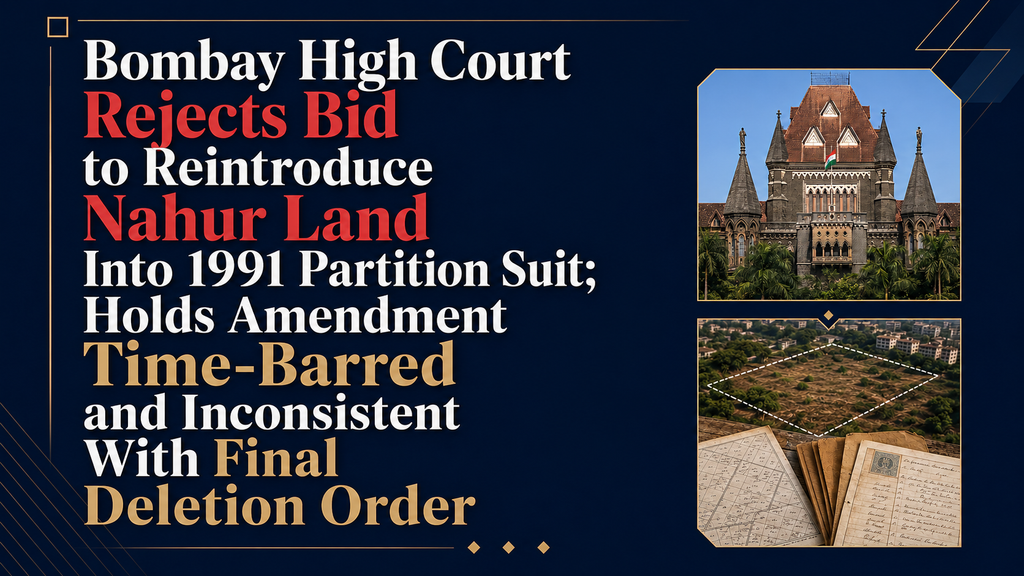
Bombay High Court Rejects Bid to Reintroduce Nahur Land Into 1991 Partition Suit; Holds Amendment Time-Barred and Inconsistent With Final Deletion Order

Bombay High Court Rejects Amendment Seeking Return of Survey No.151A to Partition Suit; Holds Final Deletion Order Cannot Be Circumvented by Later Impleadment
Facts
The petition arose from a long-pending partition suit filed by members of the Patil family. The original suit, instituted in 1991, sought a declaration that various properties were Hindu Undivided Family properties and sought partition by metes and bounds.
One of the properties originally included in the suit was Survey No.151A at Village Nahur, Mumbai Suburban District. However, the land had already been transferred in 1971 by the Khot family to Bafna Charitable Trust under an Indenture dated 14 January 1971. The plaintiffs knew about this transfer when they filed the suit but deliberately did not implead Bafna Charitable Trust, stating that they wanted to avoid misjoinder.
A Court Receiver was nevertheless appointed over the suit properties, including Survey No.151A. Bafna Charitable Trust challenged the Receiver’s appointment and sought deletion of the property from the suit.
By order dated 1 August 2008, the Bombay High Court directed deletion of Survey No.151A from the suit and discharged the Court Receiver in respect of that property, while granting liberty to the parties to adopt appropriate proceedings against the Trust. That order attained finality after dismissal of the appeal and SLP.
In 2009, Bafna Charitable Trust conveyed the land to Atul Builders and Estates Ltd.
The plaintiffs thereafter filed Chamber Summons No.718 of 2010 seeking to implead Bafna Charitable Trust and Chamber Summons No.1089 of 2011 seeking to implead Atul Builders and to restore the disputed land into the list of suit properties.
The City Civil Court rejected both amendment applications by a common order dated 14 September 2015. The present writ petition challenged that rejection.
Issues
The principal questions were whether the earlier High Court order granting liberty to take “appropriate proceedings” permitted the plaintiffs to restore Survey No.151A into the same partition suit; whether Bafna Charitable Trust and Atul Builders could be impleaded at such a late stage; whether the proposed amendments were barred by limitation; whether the amendments would alter the nature of the partition suit; and whether an outsider’s title transaction could be adjudicated within a family partition suit.
Petitioners’ Arguments
The petitioners argued that the City Civil Court had wrongly rejected the amendments and had recorded inconsistent findings on limitation.
They relied heavily upon the High Court’s 1 August 2008 order and contended that the liberty to adopt appropriate proceedings permitted them to cure the earlier defect by impleading Bafna Charitable Trust and its assignee, Atul Builders.
They argued that the amendments were sought before commencement of trial and therefore ought to have been considered liberally.
The petitioners also submitted that alienation of joint family property can be challenged in a partition suit and that refusal of amendment would leave them remediless regarding the disputed land.
They relied on LIC v. Sanjeev Builders for liberal treatment of pre-trial amendments and on decisions of the Calcutta and Madras High Courts concerning challenges to alienations in partition proceedings.
Respondent’s Arguments
Atul Builders argued that the proposed amendments were grossly time-barred.
The transfer in favour of Bafna Charitable Trust occurred in 1971 and the plaintiffs had expressly referred to that alienation in their 1991 plaint. Despite knowing of the transaction, they consciously chose not to challenge it or implead the Trust.
Atul Builders therefore contended that the right to sue had arisen decades earlier and could not be revived through an amendment filed in 2010.
It also argued that the dispute regarding the validity of the 1971 conveyance could not properly be converted into an issue within a family partition suit, particularly because the alienation had been made by outsiders, namely the Khot family, rather than by a coparcener of the Patil family.
Reliance was placed on Trinity Infraventures, Asian Hotels, South Konkan Distilleries and other authorities.
Analysis of the Law
Effect of the Final 2008 Deletion Order
The Court treated the finality of the 1 August 2008 order as crucial.
That order had not merely discharged the Court Receiver. It had also expressly directed deletion of Survey No.151A from the suit.
The High Court held that the expression “adopt appropriate proceedings” could not be interpreted as permission to undo what the Court had expressly directed.
Once Survey No.151A stood deleted and that order attained finality, the plaintiffs could not seek to reintroduce the same property through amendment of the very same suit.
Conscious Exclusion of Bafna Trust
The Court also placed considerable emphasis on the plaintiffs’ own original pleading.
In paragraph 13 of the plaint, they had acknowledged the 1971 transaction and expressly stated that Bafna Charitable Trust had not been joined to avoid misjoinder.
The High Court therefore held that this was not an inadvertent omission capable of being casually corrected by amendment. It was a deliberate litigation choice.
Permitting impleadment years later would allow the plaintiffs to take a position inconsistent with their own pleading.
Partition Suit and Alienation by Outsiders
The Court made an important distinction.
It rejected the broad proposition that an alienation of joint family property can never be challenged in a partition suit.
The Court expressly observed that an alienation by a Karta or coparcener may, in an appropriate case, be challenged within a partition suit because determination of shares and validity of alienation may be interconnected.
However, the present case was different.
Here, the alienation was made by the Khot family, who were outsiders to the Patil joint family. Whether the Khots had title and whether they could validly transfer title to Bafna Charitable Trust involved an independent title dispute between strangers.
That issue could not properly be converted into part of the Patil family’s partition suit.
No Direct Challenge to the Indentures
The Court also noted a drafting defect in the proposed amendments.
The plaintiffs sought declarations that Bafna Charitable Trust and Atul Builders had no right, title or interest in the land, but did not directly challenge either:
- the Indenture dated 14 January 1971 in favour of Bafna Charitable Trust; or
- the Indenture dated 28 October 2009 in favour of Atul Builders.
The Court found it highly doubtful that absence of title could be declared without attacking the very conveyances under which title was claimed.
Even if such challenges had been added, however, the Court held that the amendments would still fail on limitation and scope.
Limitation and Order VI Rule 17
The petitioners argued that the City Civil Court had itself said Article 137 of the Limitation Act did not govern amendment applications.
The High Court clarified the distinction.
There may be no fixed limitation period merely for filing an application for amendment, but that does not mean a court must permit an amendment which introduces a claim already barred by limitation.
The relevant question is not whether the amendment application itself is delayed, but whether the substantive claim proposed to be introduced has become legally time-barred.
The Court relied on LIC v. Sanjeev Builders, which recognises that amendments should ordinarily be allowed if necessary to decide the real controversy, but may be refused where they introduce a time-barred claim, change the nature of the suit or cause prejudice by taking away an accrued defence.
In this case, the plaintiffs knew about the 1971 Indenture when they filed the suit in 1991, but waited until 2010 to seek relief against Bafna Charitable Trust.
The Court held that the proposed claim was grossly barred by limitation.
Atul Builders had merely stepped into the shoes of Bafna Charitable Trust, so the corresponding amendment against Atul Builders was also barred.
Precedent Analysis
LIC v. Sanjeev Builders Pvt. Ltd.
The petitioners relied upon this Supreme Court decision for liberal amendment principles.
The High Court accepted the general proposition but applied the judgment against the petitioners on the facts.
The Supreme Court itself recognises that an amendment may be refused when it introduces a time-barred claim, changes the nature of the suit or takes away an accrued defence.
The Court therefore held that the case did not support amendment here.
South Konkan Distilleries v. Prabhakar Gajanan Naik
This authority supported the respondent.
The Supreme Court held that an amendment introducing a new cause of action cannot ordinarily be permitted where a fresh suit on that cause would already be barred by limitation.
The Bombay High Court found the same principle applicable to the plaintiffs’ proposed title claims against Bafna Charitable Trust and Atul Builders.
Trinity Infraventures Ltd. v. M.S. Murthy
The Supreme Court had observed that in a simple partition suit, parties cannot assert title against strangers merely by impleading them.
The Bombay High Court clarified that this does not create an absolute prohibition against challenging every alienation in a partition suit.
Rather, the principle is that an independent title dispute against strangers cannot ordinarily be adjudicated within a simple family partition action.
Asian Hotels (North) Ltd. v. Alok Kumar Lodha
This precedent was relied upon for the rule that an amendment should not be permitted if it changes the nature of the suit or causes misjoinder of causes of action.
The High Court held that introducing the title dispute between the Khot family, Bafna Charitable Trust and Atul Builders would divert the partition suit into an entirely different inquiry.
Court’s Reasoning
The Court found four decisive factors.
First, Survey No.151A had already been deleted from the suit by a final High Court order, so restoration through amendment would effectively circumvent that order.
Second, the plaintiffs had consciously excluded Bafna Charitable Trust despite having full knowledge of the 1971 Indenture.
Third, the dispute concerned title conveyed by outsiders, not alienation by a coparcener. It therefore fell outside the proper scope of the Patil family’s partition suit.
Fourth, the proposed title claims were grossly time-barred and would substantially alter the nature of the suit.
The Court therefore agreed with the City Civil Court that the Chamber Summons were rightly rejected.
Conclusion
The Bombay High Court dismissed the writ petition and upheld the City Civil Court’s order dated 14 September 2015 rejecting Chamber Summons Nos.718 of 2010 and 1089 of 2011.
The Court held that the proposed amendments could not be permitted because Survey No.151A had already been finally deleted from the suit, the plaintiffs had consciously excluded Bafna Charitable Trust, the title dispute concerned outsiders rather than a coparcener’s alienation, and the proposed claims were grossly time-barred.
The Court also observed that the plaintiffs could seek fresh consideration of their impleadment in Suit No.8031 of 1984, as indicated by the Supreme Court’s earlier order, but inability to obtain relief in that suit could not justify enlarging the scope of the present partition proceeding.
Case Details
Case: Arun Narayan Patil and Ors. v. Jayshree Jaywant Patil and Ors.
Court: High Court of Judicature at Bombay, Civil Appellate Jurisdiction
Case Number: Writ Petition No.1918 of 2016
Neutral Citation: 2026:BHC-AS:35171
Judge: Justice Sandeep V. Marne
Reserved On: 13 August 2026
Date: 27 August 2026
Impugned Order: City Civil Court, Mumbai order dated 14 September 2015 rejecting Chamber Summons Nos.718 of 2010 and 1089 of 2011 in S.C. Suit No.9984 of 1991.
Subject Matter: Amendment of a 1991 HUF partition suit to reintroduce Survey No.151A, Nahur and implead Bafna Charitable Trust and Atul Builders.
Key Issue: Whether a property already deleted by a final court order and an outsider-title dispute known since 1991 could later be restored through amendment of the partition suit.
Result: Writ Petition dismissed. Rejection of amendment applications upheld. Proposed claims held grossly time-barred and outside the permissible scope of the partition suit.