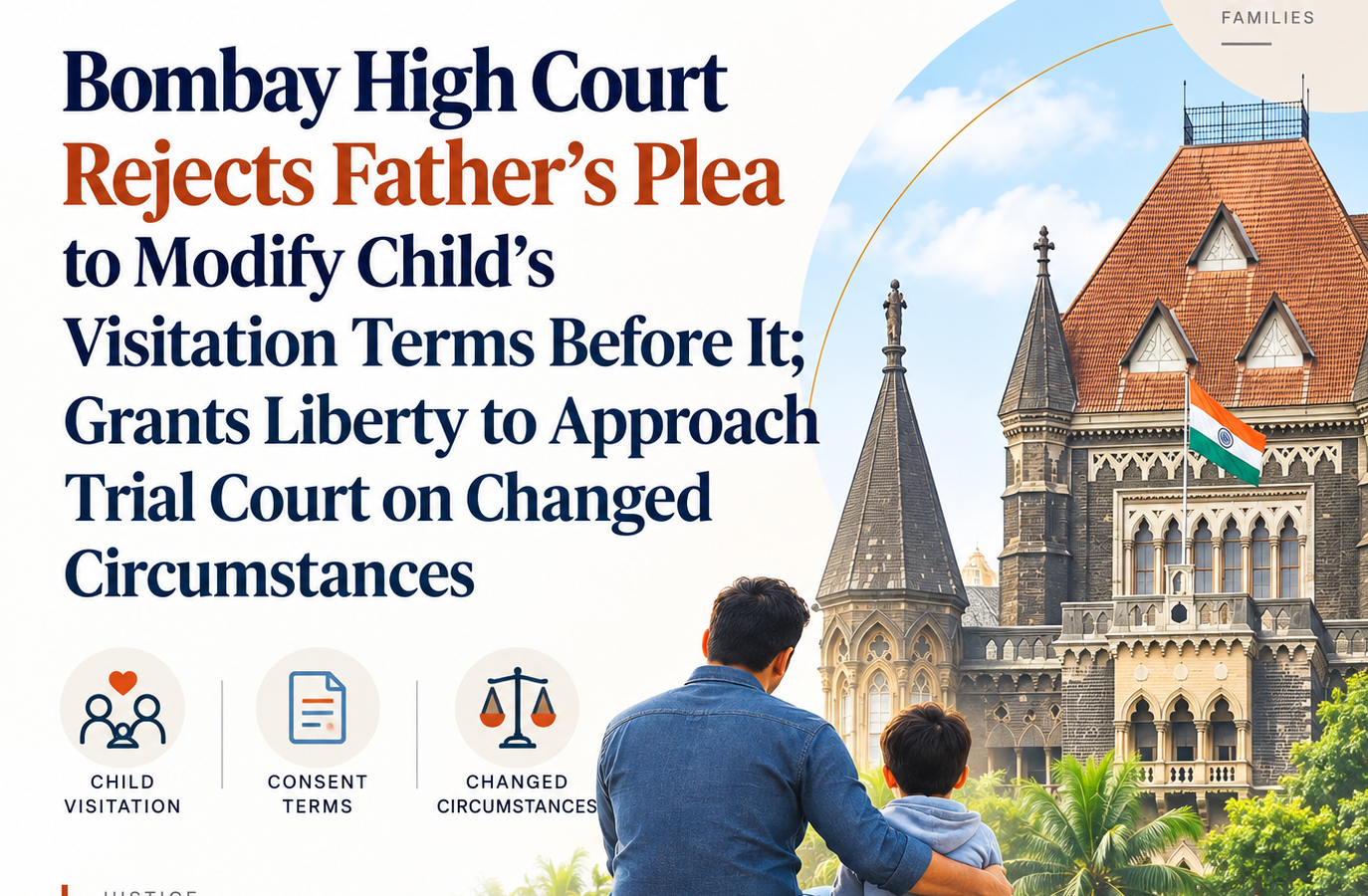
Bombay High Court Rejects Father’s Plea to Modify Child’s Visitation Terms Before It; Grants Liberty to Approach Trial Court on Changed Circumstances

Facts
The dispute arose from matrimonial proceedings between Sandeep Naresh Bhatia and Vanita Rajkumar Aswani. An earlier Miscellaneous Civil Application had been filed under Section 24 CPC seeking transfer of the matrimonial proceedings from Kalyan to Pune. During those proceedings, the parties amicably resolved their disputes and filed Consent Terms dated 28 April 2022, pursuant to which the transfer application was disposed of.
Under the Consent Terms, permanent custody of the minor child was to remain with the father, while the mother was granted visitation and access on weekends and during summer, Diwali and Christmas holidays. The matrimonial petition was thereafter converted into a petition for divorce by mutual consent, and the marriage was dissolved on 24 August 2022 under Section 13B of the Hindu Marriage Act.
The father subsequently approached the Bombay High Court seeking modification of the visitation provisions contained in Clause 11 of the Consent Terms on the basis of changed circumstances, particularly the child’s alleged unwillingness or lack of interest in meeting the mother.
Issues
- Whether Consent Terms concerning child visitation, which were recorded by the Bombay High Court, could be modified only by the High Court itself.
- Whether Order XXIII Rule 3-A CPC barred the father from approaching the Trial Court for modification.
- Whether subsequent changes in circumstances concerning the child justified permitting the competent Trial Court to reconsider custody and visitation arrangements.
Applicant’s Arguments
The father contended that since the Consent Terms had been accepted by the Bombay High Court, an application seeking their modification could only be made before the same Court. He argued that permitting a subordinate Trial Court to modify those terms would effectively allow it to interfere with an order of the High Court.
Reliance was placed upon the Supreme Court decision in Pushpa Devi Bhagat v. Rajinder Singh, (2006) 5 SCC 566, particularly the principles concerning Order XXIII Rule 3-A CPC.
Respondent’s Arguments
The mother agreed that the appropriate remedy for modification based upon subsequent circumstances was to approach the Trial Court.
Analysis of the Law
The High Court distinguished between a challenge to the legality or genuineness of a compromise and an application seeking modification of child custody or visitation arrangements because of subsequent changed circumstances.
Order XXIII Rule 3-A CPC would become relevant where it is alleged that the compromise on which a decree or order is founded was unlawful. In the present case, neither party alleged that the original Consent Terms were unlawful or were not genuinely entered into. Therefore, the bar under Order XXIII Rule 3-A did not apply.
The Court further reiterated that orders concerning custody, visitation and access to a minor child are never absolutely final and can always be revisited in accordance with law. Even an arrangement arrived at by consent remains operative only until it is lawfully varied.
Precedent Analysis
The applicant relied upon Pushpa Devi Bhagat to contend that modification had to be sought before the same Court that recorded the compromise.
The High Court held that the precedent was not applicable to the present circumstances because the father was not challenging the validity of the original compromise. His application was founded entirely upon subsequent developments concerning the child after the Consent Terms had already been acted upon.
Court’s Reasoning
The Court noted that the original proceeding before the Bombay High Court was merely an application under Section 24 CPC for transfer of the matrimonial proceedings. Custody, access and visitation were never substantively adjudicated by the High Court; the Court had merely taken the parties’ Consent Terms on record.
The father’s present case involved the child’s psychology, psychologists’ opinions and events occurring after implementation of the Consent Terms. Such allegations could not be decided merely on the basis of a psychologist’s report and would require evidence from the parties.
The scope of the original Section 24 transfer proceeding could not therefore be enlarged into a substantive adjudication concerning modification of visitation and access. The appropriate remedy was to approach the competent Trial Court.
Conclusion
The Bombay High Court dismissed the father’s Interim Application, while expressly granting him liberty to file an appropriate application before the Trial Court seeking modification of the Consent Terms concerning visitation and access.
The Court clarified that Order XXIII Rule 3-A CPC would not bar such an application, and the Trial Court would decide it independently on its merits after considering the parties’ contentions and evidence.
Until any such modification is ordered, the existing Consent Terms continue to remain binding upon both parties.