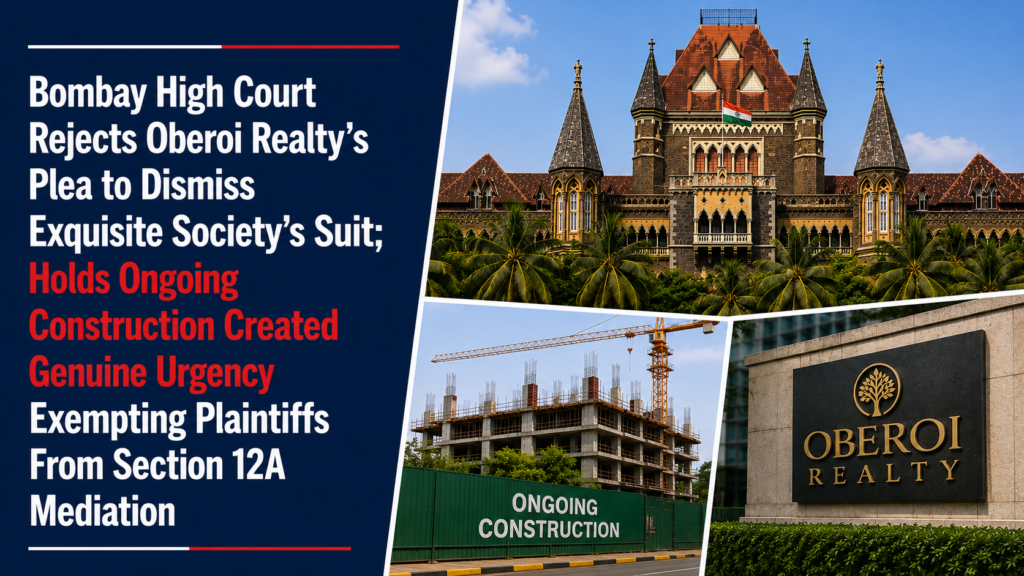
Bombay High Court Rejects Oberoi Realty’s Plea to Dismiss Exquisite Society’s Suit; Holds Ongoing Construction Created Genuine Urgency Exempting Plaintiffs From Section 12A Mediation

Bombay High Court Rejects Oberoi Realty’s Plea to Dismiss Exquisite Society’s Suit; Holds Continuing Construction Justified Skipping Pre-Litigation Mediation
Facts
The application arose in a commercial suit filed by Exquisite Co-operative Housing Society Ltd. and three flat purchasers against Oberoi Realty Limited and municipal authorities. Plaintiff No. 1 is a co-operative housing society consisting of 801 members, while Oberoi Realty is the developer and promoter of the project within the meaning of the Maharashtra Ownership Flats Act, 1963 (“MOFA”).
The dispute concerns the residential project “Exquisite”, comprising Towers A-4 and A-5, forming part of the larger Oberoi Garden City development.
The plaintiffs claim that the Society is entitled to an undivided 25.33% right, title and interest in Plot No. B/larger layout, together with the corresponding share in FSI, TDR and other development benefits. They also claim entitlement to approximately 44,905.25 square metres of undivided land share.
The suit seeks, among other reliefs:
- protection of the Society’s claimed land and FSI entitlement;
- restraint against Oberoi Realty from carrying out construction by using the Society’s alleged FSI share;
- restraint against municipal authorities from granting approvals for such construction;
- conveyance of the Society’s proportionate share in the land and FSI;
- declarations concerning clauses in flat-purchase agreements allegedly contrary to MOFA; and
- alternatively, ₹500 crore as compensation and damages for utilisation of the Society’s alleged FSI.
Oberoi Realty filed Interim Application No. 6995 of 2025 seeking rejection of the plaint under Order VII Rule 11 CPC read with Section 151 CPC. Its sole ground was that the plaintiffs had instituted the commercial suit without first exhausting the mandatory pre-litigation mediation under Section 12A of the Commercial Courts Act, 2015.
The plaintiffs did not dispute that they had not undergone pre-institution mediation. Their case was that the suit genuinely contemplated urgent interim relief, bringing it within the statutory exception contained in Section 12A(1).
Issues
The principal issues before the Court were:
- Whether the plaintiffs’ failure to undertake pre-litigation mediation under Section 12A of the Commercial Courts Act required rejection of the plaint.
- Whether the suit genuinely “contemplated any urgent interim relief” so as to fall within the exception to mandatory pre-litigation mediation.
- Whether the interim injunction prayers were genuine or merely a camouflage or device to bypass Section 12A.
- Whether the Court, while deciding an application under Order VII Rule 11, could consider the plaintiffs’ post-filing conduct, particularly their failure to move the interim application for approximately two-and-a-half years.
- Whether delay in filing the suit or seeking interim relief necessarily disproved urgency.
- Whether the alleged continuing breaches of MOFA and ongoing construction constituted a continuing wrong and continuing cause of action, sustaining the need for interim relief.
Applicant/Defendant’s Arguments
Oberoi Realty argued that Section 12A is mandatory and that a commercial suit which does not genuinely contemplate urgent interim relief cannot be instituted without exhausting pre-litigation mediation.
It relied principally on Yamini Manohar v. T.K.D. Keerthi to argue that a plaintiff cannot bypass Section 12A merely by adding a prayer for urgent relief. According to it, the plaint must objectively demonstrate such immediacy that the plaintiff cannot wait for the statutory mediation process.
The developer contended that the alleged urgency was artificial because:
- the plaintiffs knew about the additional construction from around December 2021;
- they filed the suit only in March 2023; and
- even after filing it, they did not effectively move for interim protection for approximately two-and-a-half years.
According to Oberoi Realty, that conduct showed that no real or immediate interim protection was ever required and that the injunction prayers had merely been inserted to avoid mediation.
It further submitted that “urgent relief” must involve such critical immediacy that the plaintiff genuinely cannot wait through the pre-litigation mediation period.
Reliance was also placed on decisions including Image Developer/Kamla Landmarc, Exclusive Capital, Ekta Housing/Shraddha Shelters, and Tech Data Advanced Solutions, where delay or post-filing conduct had been considered in assessing whether the claimed urgency was genuine.
Plaintiffs’ Arguments
The plaintiffs argued that Section 12A itself excludes suits which contemplate urgent interim relief.
They submitted that the inquiry must be conducted from the plaintiff’s standpoint, after holistically considering:
- the subject matter of the suit;
- cause of action;
- pleadings;
- supporting documents; and
- nature of the interim relief sought.
Reliance was placed on Dhanbad Fuels Pvt. Ltd. v. Union of India and Yamini Manohar.
The plaintiffs argued that the suit alleged that Oberoi Realty was actively carrying out further construction and thereby consuming or threatening to consume the Society’s alleged share of FSI.
They had expressly sought orders restraining:
- further construction using the Society’s alleged FSI;
- creation of third-party rights;
- alterations to sanctioned plans;
- municipal approvals facilitating such construction; and
- actions affecting the Society’s claimed land and development entitlement.
According to the plaintiffs, this was not a fabricated case of urgency. If the construction continued while mediation was pending, their eventual substantive relief could be rendered ineffective.
They further argued that post-filing conduct was legally irrelevant to an Order VII Rule 11 inquiry, which must ordinarily remain confined to the plaint and documents filed with it.
Finally, they submitted that breaches of MOFA obligations constitute continuing wrongs, meaning that both the cause of action and the need for interim protection continue while the alleged violation persists.
Analysis of the Law
1. Section 12A is mandatory, but expressly contains an urgent-relief exception
The Court began by reaffirming Patil Automation Pvt. Ltd. v. Rakheja Engineers Pvt. Ltd.
Section 12A is not an empty procedural formality. Where a commercial suit does not contemplate urgent interim relief, pre-litigation mediation is mandatory, and failure to comply can result in rejection of the plaint under Order VII Rule 11.
However, Section 12A(1) itself creates an important exception.
Where the suit genuinely contemplates urgent interim relief, the plaintiff cannot be forced to undergo mediation and wait through the statutory period before approaching the Court.
2. Adding an injunction prayer is not enough by itself
The Court applied Yamini Manohar.
A plaintiff does not possess an absolute right to bypass Section 12A merely by inserting an interim prayer.
The Commercial Court must examine:
- nature and subject matter of the suit;
- cause of action;
- documents;
- factual circumstances; and
- interim prayers.
The Court must determine whether the claimed urgency is genuine or merely a disguise, camouflage or mask used to avoid mediation.
At the same time, this is a limited examination. The Court is not deciding whether the injunction will ultimately be granted.
3. Order VII Rule 11 inquiry must remain confined to the plaint and its documents
The Court held that while considering rejection of the plaint, it must primarily examine the plaint as a whole and the documents filed with it.
Extraneous material ordinarily cannot be imported into an Order VII Rule 11 inquiry.
This principle became important because Oberoi Realty relied heavily upon events occurring after the suit was filed.
4. Interim relief sought by the Society was substantial and directly connected with ongoing construction
The Court examined the suit itself.
The Society claimed 25.33% of the larger layout property and approximately 44,905.25 sq. metres of land entitlement, along with corresponding FSI/TDR.
It alleged that further construction by Oberoi Realty would consume or diminish that entitlement.
The plaintiffs’ interim application sought, among other things:
- conveyance;
- restraint against creation of third-party rights;
- restraint against modification of sanctioned plans;
- restraint against further construction using the Society’s alleged FSI; and
- restraint against MCGM from granting approvals for construction consuming that FSI.
On a holistic reading, the Court could not conclude that these prayers were artificially inserted merely to escape Section 12A.
5. Test is whether urgency was genuinely contemplated, not whether injunction would eventually succeed
The Court relied significantly on Dhanbad Fuels.
The relevant test is not whether urgent interim relief is ultimately granted.
Instead, the question is whether, considering the subject matter and cause of action from the plaintiff’s standpoint, urgent interim protection could genuinely have been contemplated when the suit was instituted.
Consequently, a later refusal of injunction would not retrospectively establish that Section 12A ought to have been complied with.
6. Urgency must be assessed from the plaintiff’s standpoint
The Court stressed that the issue is not whether the defendant or even the Court believes interim relief is likely to succeed.
The relevant inquiry is whether the plaintiff’s professed need for urgent protection was genuine, or whether the pleadings disclose obvious deception or falsity.
On the present pleadings, the Court held that:
- the interim relief was genuine;
- the apprehension pleaded was real; and
- the injunction prayer was not mere camouflage.
7. Post-filing delay was irrelevant to Order VII Rule 11 determination
Oberoi Realty heavily relied on the plaintiffs’ failure to move for interim relief between March 2023 and November 2025.
The Court rejected that argument.
It held that the post-institution conduct of the plaintiff is irrelevant when deciding whether the plaint itself attracts rejection under Order VII Rule 11 for non-compliance with Section 12A.
The Court declined to treat observations in Kamla Landmarc as laying down a universal principle that subsequent conduct must always be examined.
Instead, it followed IIFL Finance Ltd., which treated the reference to post-filing conduct in Kamla Landmarc as a passing observation incapable of overriding Supreme Court principles governing Section 12A and Order VII Rule 11.
The Court also relied on Warna Sugar Ltd., which held that what matters is whether the plaint itself demonstrates contemplated urgency. Subsequent developments are ordinarily irrelevant to deciding whether pre-institution mediation should have been undertaken.
8. Delay in instituting the suit does not automatically negate urgency
Oberoi Realty also relied on the fact that the plaintiffs allegedly knew about construction from December 2021 but filed suit only in March 2023.
The Court rejected any rigid rule that delay necessarily destroys urgency.
There is no universal “straitjacket formula.” The plaint must be read holistically, and each matter must be judged on its individual facts.
Where the alleged infringement or wrong is continuing, delay alone cannot establish that urgent interim relief was not genuinely contemplated.
9. MOFA obligations can create a continuing cause of action
The Court considered this particularly significant.
The suit was not based exclusively upon a completed historical event. It sought enforcement of statutory obligations under MOFA, including obligations concerning conveyance and development rights.
The Court noted that breach of obligations under Section 11 of MOFA has been judicially treated as a continuing breach giving rise to a continuing cause of action.
Therefore, even if construction commenced earlier, continuing construction could maintain the need for interim protection.
10. Ongoing construction meant the need for injunction continued
The Court ultimately found that construction activity was still continuing.
As long as Oberoi Realty continued construction in the layout, the Society could legitimately pursue its request to prevent alleged consumption of its FSI.
The fact that construction began years earlier did not make the interim prayer automatically meaningless.
Accordingly, where both the alleged wrong and the need for protection are continuing, mere passage of time cannot by itself negate urgency under Section 12A.
Precedent Analysis
Patil Automation Pvt. Ltd. v. Rakheja Engineers Pvt. Ltd.
This is the foundational authority establishing the mandatory nature of Section 12A.
The Supreme Court held that where a commercial suit does not contemplate urgent interim relief, failure to exhaust pre-institution mediation can lead to rejection of the plaint under Order VII Rule 11.
The Bombay High Court accepted that principle completely but held that the present suit fell within the statutory exception.
Yamini Manohar v. T.K.D. Keerthi
This precedent supplied the principal test.
A plaintiff cannot circumvent mandatory mediation merely by inserting a prayer for urgent relief.
The Court must holistically examine whether urgency genuinely arises from the subject matter, cause of action and relief sought. If the urgent prayer is merely camouflage, Section 12A remains applicable.
The High Court applied Yamini Manohar and found no such camouflage here.
Dhanbad Fuels Pvt. Ltd. v. Union of India
Dhanbad Fuels clarified that the test is not whether urgent relief is ultimately granted.
The question is whether such relief was reasonably contemplable from the plaintiff’s standpoint when the suit was filed.
This proposition substantially supported the Society’s case.
IIFL Finance Ltd. v. Gundecha Estates Pvt. Ltd.
IIFL Finance was important on the relevance of events occurring after filing.
The Court followed it in holding that post-filing stages and conduct ordinarily cannot be used to reject a plaint under Order VII Rule 11(d) for non-compliance with Section 12A.
It also treated the contrary-looking observations in Kamla Landmarc concerning post-filing conduct as non-binding passing observations.
Warna Sugar Ltd. v. IL&FS Financial Services Ltd.
Warna Sugar similarly held that the Court must examine whether the pleadings demonstrate contemplated urgent relief from the plaintiff’s standpoint.
Post-filing circumstances are ordinarily irrelevant to deciding the justification for not undergoing pre-institution mediation.
Buildcon Sethia Construction v. Dipti Co-operative Housing Society Ltd.
The Court relied upon this decision for two propositions:
- there is no straitjacket formula for Section 12A urgency; and
- mere delay in filing the suit does not automatically negate urgency.
Where the plaint, supporting documents and interim prayers together establish a genuine case of contemplated urgent relief, the plaint cannot be rejected merely because mediation was not undertaken.
Gavrill Metal Pvt. Ltd. v. Maira Fabricators Pvt. Ltd.
This Calcutta High Court decision was cited for the proposition that Section 12A does not prescribe a fixed period within which urgent relief must be sought.
The statute requires that the suit contemplate urgent interim relief; it does not expressly require that the relief be sought within a specified number of days or months.
Tech Data Advanced Solutions — Distinguished
Oberoi Realty relied upon Tech Data, where a plaint had been rejected under Section 12A.
The Court distinguished that decision on its facts. There, the Court had found fundamental deficiencies including absence of privity with one defendant and absence of relief against another relevant defendant.
The present MOFA and FSI dispute involved materially different pleadings demonstrating an ongoing need to restrain construction.
Sushama Tulsidas Adhav v. Pradeep D. Shah
This judgment supported the proposition that breach of statutory obligations imposed by MOFA may constitute a continuing wrong.
In particular, non-compliance with a promoter’s statutory conveyance obligations can give rise to a continuing cause of action until the obligation is fulfilled.
Novenco Building & Industry A/S v. Xero Energy Engineering Solutions
Although arising in the context of continuing intellectual-property infringement, Novenco was relied upon by analogy.
The Supreme Court held that continuing infringement may sustain genuine urgency notwithstanding delay and that insistence upon mediation should not allow ongoing injury to continue merely because some time has elapsed.
The Bombay High Court found this principle useful in assessing the Society’s continuing-construction grievance.
Court’s Reasoning
The Court did not treat the mere existence of interim prayers as sufficient. It independently examined whether those prayers were genuine.
The suit alleged that Oberoi Realty was continuing construction in the larger layout while the Society claimed substantial undivided land and FSI rights. If the alleged FSI continued to be consumed during the statutory mediation period, the plaintiffs argued that their eventual relief could become ineffective.
On those facts, the Court found the plea of urgency plausible and genuine.
The Court also considered that the dispute involved alleged continuing violations of MOFA. The alleged wrong was therefore not necessarily exhausted when construction first commenced.
Most importantly, the Court refused to use the plaintiffs’ post-filing failure to obtain or press interim relief as retrospective proof that no urgency existed when the suit was filed.
For an Order VII Rule 11 inquiry, the focus remained the plaint, accompanying documents, cause of action and nature of the interim relief contemplated at institution.
The Court therefore concluded that the injunction prayers were not inserted merely as a device to evade mediation.
Conclusion
The Bombay High Court rejected Oberoi Realty’s application for rejection of the plaint.
It held that:
- Section 12A pre-litigation mediation is mandatory for commercial suits which do not contemplate urgent interim relief;
- the exception for genuine urgent interim relief applied to the present suit;
- the Society’s prayers concerning continuing construction and alleged consumption of its land and FSI entitlement were real and not camouflage;
- the Court need not determine at the Order VII Rule 11 stage whether those interim prayers will ultimately succeed;
- post-filing conduct, including failure to press the interim application for approximately two-and-a-half years, could not be used to reject the plaint;
- delay alone does not destroy urgency where the alleged wrong and need for protection continue; and
- alleged breaches of MOFA obligations and ongoing construction supported the plaintiffs’ case of continuing urgency.
The Court consequently held that the suit clearly contemplated urgent interim relief within Section 12A, and Oberoi Realty had failed to establish any ground for rejection of the plaint under Order VII Rule 11. The Interim Application was therefore rejected with costs.
Case Details
Case: Oberoi Realty Limited v. Exquisite Co-operative Housing Society Ltd. & Ors. — Interim Application in Exquisite Co-operative Housing Society Ltd. & Ors. v. Oberoi Realty Limited & Ors.
Court: High Court of Judicature at Bombay, Ordinary Original Civil Jurisdiction, Commercial Division
Case Number: Interim Application No. 6995 of 2025 in Commercial Suit No. 109 of 2023
Judge: Justice Sandeep V. Marne
Date: 21 August 2026
Result: Oberoi Realty’s application under Order VII Rule 11 rejected with costs; commercial suit permitted to continue despite absence of pre-litigation mediation because it genuinely contemplated urgent interim relief.