


Court’s decision
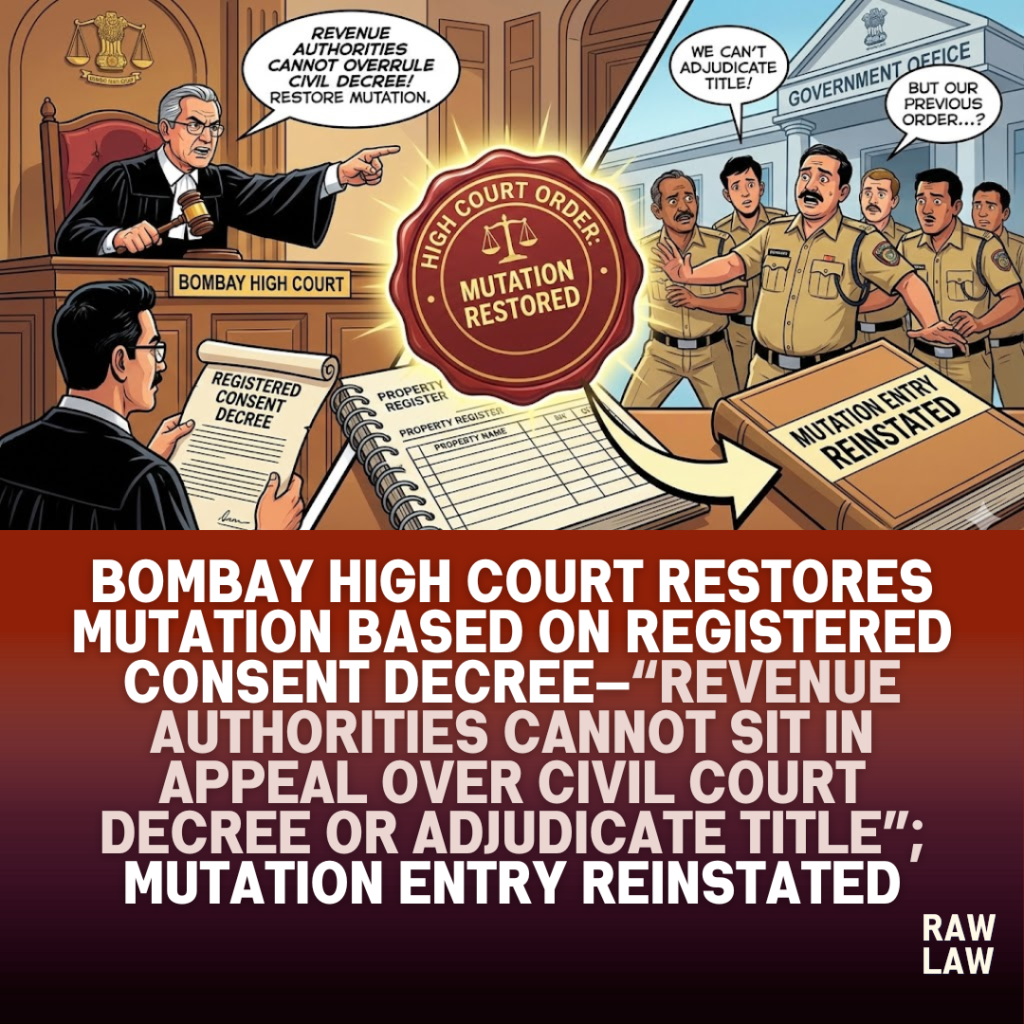
The Bombay High Court (Ordinary Original Civil Jurisdiction) allowed a writ petition and quashed concurrent orders passed by revenue authorities which had deleted a mutation entry effected in favour of a purchaser despite the existence of a registered consent decree of the High Court. The Court held that revenue authorities acting under the Maharashtra Land Revenue Code, 1966 have no jurisdiction to adjudicate questions of title, testamentary succession, validity of conveyances, or legality of civil court decrees. It ruled that once a civil court decree has attained finality and stands registered, revenue authorities are duty-bound to reflect it in revenue records for fiscal purposes. The mutation entry was accordingly restored.
Facts
The dispute concerned a valuable immovable property situated at Hill Road, Bandra (West), Mumbai. The property originally belonged to an individual who died in January 1966, after which it devolved upon his widow. Following her death later that year, the property was claimed by her siblings as legal heirs and legatees under a Will.
In 1979, the petitioner entered into an agreement for sale with the said heirs for purchase of the property. As the vendors failed to complete the transaction, the petitioner instituted a suit for specific performance before the Bombay High Court. During pendency of the suit, the parties resolved the dispute amicably and consent terms were executed in November 1985. Based on these terms, the High Court passed a consent decree directing conveyance of the property in favour of the petitioner.
Although the consent decree was passed in 1985, issues relating to stamp duty delayed its registration. The decree ultimately came to be registered in July 2007. Thereafter, the petitioner applied for mutation of her name in the Property Register Card on the basis of the registered consent decree. The City Survey Officer allowed the mutation.
However, a third party claiming to be a lessee of a portion of the property objected to the mutation and preferred statutory appeals. The Superintendent of Land Records, the Deputy Director of Land Records, and finally the State Government successively set aside the mutation, primarily on the ground that no probate or letters of administration had been obtained in respect of the Wills forming the foundation of title. These orders deleting the mutation entry were challenged before the High Court.
Issues
The principal issues before the Court were whether revenue authorities can refuse or delete a mutation entry sought on the basis of a registered civil court decree, whether they are entitled to examine the validity of title, testamentary succession, or legality of registration of such decree, and whether an objector claiming possession or leasehold rights without adjudication of title could obstruct mutation proceedings under the Maharashtra Land Revenue Code.
Petitioner’s arguments
The petitioner contended that the impugned orders were wholly without jurisdiction, as the mutation was sought on the basis of a registered consent decree passed by the High Court which had attained finality and had never been challenged. It was argued that once such a decree exists, revenue authorities are statutorily bound under Sections 149 and 150 of the Maharashtra Land Revenue Code to give effect to it for fiscal purposes.
The petitioner submitted that mutation proceedings are administrative in nature and do not involve adjudication of title. The revenue authorities, by examining issues such as absence of probate, validity of testamentary succession, subsisting prohibitory orders, and legality of registration, had effectively sat in appeal over a civil court decree. It was further argued that the objector had no locus, having failed to produce any lease deed or legally enforceable document evidencing subsisting rights in the property.
Respondents’ arguments
The State authorities defended the impugned orders by contending that the petitioner’s title itself was clouded. It was argued that testamentary succession had not crystallised in the absence of probate or letters of administration, rendering the agreement for sale and the consent decree legally ineffective. The State further contended that the consent decree was registered decades after its passing and beyond the period of limitation prescribed under the Registration Act, and that payment of stamp duty could not revive a time-barred document.
The objector argued that he was a “person interested” within the meaning of Section 150 of the Maharashtra Land Revenue Code, claiming long-standing possession and leasehold rights. Reliance was placed on prohibitory orders allegedly restraining transfer of the property and on judgments holding that transactions in violation of statutory restraints are void.
Analysis of the law
The High Court undertook an exhaustive analysis of the statutory scheme under Sections 149 and 150 of the Maharashtra Land Revenue Code and the Rules governing mutation proceedings. Reiterating settled law, the Court emphasised that mutation entries are maintained primarily for fiscal and administrative purposes and neither create nor extinguish title.
The Court relied on consistent precedent holding that revenue authorities cannot adjudicate upon title, test validity of registered instruments, or question civil court decrees. Their jurisdiction is limited to ascertaining whether documents produced prima facie disclose acquisition of rights and to updating revenue records accordingly. Once a registered decree of a competent civil court is produced, revenue authorities are bound to act upon it unless the decree is set aside by a competent court.
Precedent analysis
The Court relied heavily on earlier Bombay High Court judgments holding that mutation proceedings cannot be converted into title adjudication. It distinguished Supreme Court decisions where mutation was sought solely on the basis of an unproved Will, noting that in the present case the claim was founded on a registered consent decree passed in a suit for specific performance.
The Court also held that judgments dealing with invalid transfers or statutory prohibitions cannot be invoked by revenue authorities to declare a civil court decree void or ineffective. Such issues can only be examined in substantive civil proceedings by competent courts.
Court’s reasoning
Applying these principles, the Court held that the revenue authorities had clearly exceeded their jurisdiction. By questioning the petitioner’s title, examining testamentary succession, scrutinising alleged prohibitory orders, and doubting the legality of registration of the consent decree, the authorities had effectively nullified a subsisting civil court decree, which they had no power to do.
The Court further held that mere assertion of possession or leasehold rights, unsupported by legally enforceable documents or adjudication, was insufficient to clothe the objector with locus to obstruct mutation based on a registered decree. If the objector claimed independent rights, the appropriate remedy lay in civil proceedings, not mutation objections.
Conclusion
The Bombay High Court quashed the orders passed by the Superintendent of Land Records, Deputy Director of Land Records, and the State Government deleting the mutation entry. It directed restoration of the mutation entry in favour of the petitioner on the basis of the registered consent decree, clarifying that such restoration is purely for fiscal purposes and does not confer or declare title nor prejudice the rights of any party to seek appropriate relief before a competent civil court.
Implications
This judgment reaffirms the limited scope of mutation proceedings and draws a clear boundary between fiscal administration and adjudication of civil rights. It sends a strong message that revenue authorities cannot undermine or disregard civil court decrees under the guise of mutation enquiries. The ruling provides significant protection to decree holders and purchasers, ensuring certainty in revenue records while preserving the primacy of civil courts in deciding title disputes.
Case law references
- Shrikant R. Sankanwar v. Krishna Balu Naukudkar: Held that revenue authorities cannot adjudicate title in mutation proceedings.
- Ramesh Shantilal Modi v. State of Maharashtra: Reiterated that registered instruments and decrees cannot be indirectly set aside by revenue officers.
- Jitendra Singh v. State of Madhya Pradesh: Distinguished as applicable to mutation claims based solely on unproved Wills.
- Keshrimal Jivji Shah v. State of Maharashtra: Held that validity of transfers violating prohibitory orders must be examined by competent courts, not revenue authorities.
FAQs
Can revenue authorities refuse mutation despite a registered civil court decree?
No. Once a civil court decree is registered and subsists, revenue authorities must reflect it in mutation records and cannot sit in appeal over it.
Do mutation entries decide ownership or title?
No. Mutation entries are purely fiscal and administrative; they do not create, declare, or extinguish title.
Can objections based on Wills or possession block mutation based on a decree?
No. Such objections raise title disputes which must be decided by civil courts, not in mutation proceedings.