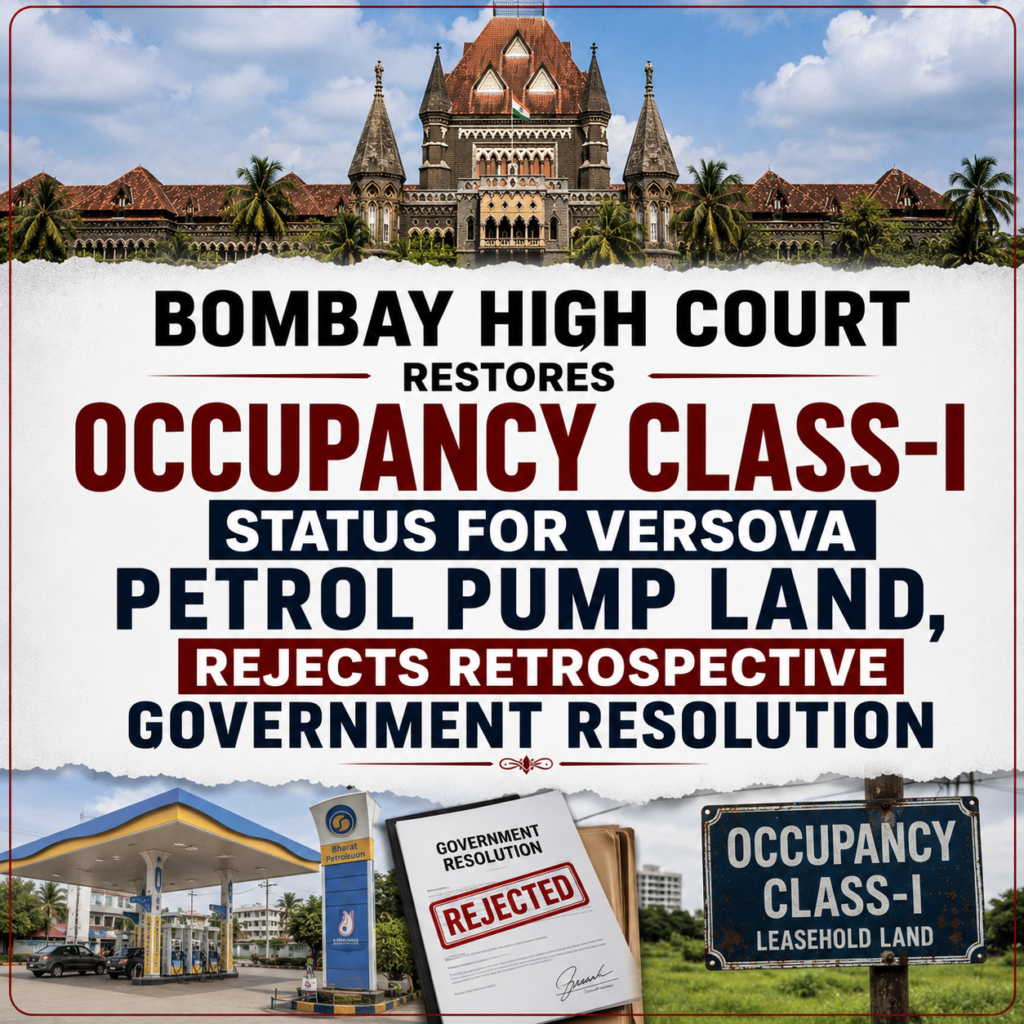
Bombay High Court Restores Occupancy Class-I Status for Versova Petrol Pump Land, Rejects Retrospective Government Resolution

Bombay High Court Restores Conversion of Versova Petrol Pump Land to Occupancy Class-I, Holds Later Government Resolution Cannot Apply Retrospectively
Facts
The petitioners challenged a common order dated 5 June 2025 passed by the Revenue Minister in revisional proceedings under Section 257 of the Maharashtra Land Revenue Code, 1966.
By the impugned order, the Revenue Minister had set aside the Collector’s order dated 20 April 2021, by which the petitioners’ leasehold rights in land situated at Village Versova, Taluka Andheri, Mumbai Suburban District, were converted into Occupancy Class-I rights.
The land measured approximately 1,127 sq. metres and was originally leased for running a petrol pump. The petitioner had paid a premium of ₹6,39,79,790 under the Maharashtra Land Revenue (Conversion of Occupancy Class-II and Leasehold Lands into Occupancy Class-I Lands) Rules, 2019.
Bharat Petroleum Corporation Limited was earlier associated with the petrol pump operations and had been granted a sub-lease, which expired on 11 September 2020. The Collector passed the conversion order later, on 20 April 2021.
After the conversion order was passed, a Government Resolution dated 14 July 2021 was issued stating that lands allotted for essential services such as petrol pumps and CNG stations should not be converted into Occupancy Class-I. Relying on this later Government Resolution, the revisional authority set aside the Collector’s earlier conversion order.
The petitioners approached the Bombay High Court contending that the later Government Resolution could not be applied retrospectively to invalidate a conversion order that had already been passed.
Issues
- Whether the Government Resolution dated 14 July 2021 could be applied retrospectively to set aside a conversion order passed on 20 April 2021.
- Whether an executive instruction could override or modify statutory rights created under the 2019 Conversion Rules.
- Whether Bharat Petroleum Corporation Limited, as an expired sub-lessee, had locus standi to challenge the conversion of the petitioners’ leasehold land into Occupancy Class-I.
- Whether the Revenue Minister exceeded revisional jurisdiction under Section 257 of the Maharashtra Land Revenue Code by adjudicating disputes between the lessee and sub-lessee.
- Whether the Collector’s conversion order was valid and liable to be restored.
Petitioner’s Arguments
The petitioners argued that the impugned order was illegal because it applied the Government Resolution dated 14 July 2021 retrospectively to a conversion order already passed on 20 April 2021.
They submitted that the Government Resolution was only an executive instruction and could not override the statutory Conversion Rules of 2019 framed under the Maharashtra Land Revenue Code. According to the petitioners, executive instructions may supplement statutory rules but cannot supplant them or take away vested rights.
The petitioners argued that the 2019 Conversion Rules permitted conversion of leasehold lands into Occupancy Class-I after completion of the prescribed period. Since the petitioners had held the land for nearly 30 years and had paid the premium, their rights had crystallised before the later Government Resolution was issued.
They further contended that the allegations of breach of lease conditions, construction of garage and motor parts shop, sub-letting, and non-employment of handicapped persons were unsupported by material. They relied on the Tahsildar’s site inspection report dated 22 December 2020, which recorded that there was no breach of the lease conditions.
On BPCL’s role, the petitioners argued that BPCL had no right, title or interest in the land. Its sub-lease had expired on 11 September 2020, before the conversion order was passed. Therefore, BPCL had no locus to challenge the conversion order.
The petitioners also submitted that the revisional authority exceeded its limited jurisdiction under Section 257 of the Maharashtra Land Revenue Code by entering into civil and contractual disputes between the petitioners and BPCL.
Respondent’s Arguments
BPCL argued that the matter should be remanded to the Collector because BPCL was an affected party and should have been heard before the conversion order was passed.
It submitted that the land was originally allotted for running a petrol pump on behalf of BPCL, and that BPCL had invested substantially in the property and erected structures thereon. It relied on the definition of “land” under the Maharashtra Land Revenue Code and the Transfer of Property Act to contend that its structures gave it an interest in the property.
BPCL also argued that it had consistently borne financial liabilities in respect of the land, including lease rent, differential rent and other dues. According to BPCL, it had paid ₹2.94 crore towards arrears and differential rent on the assurance that the sub-lease would be renewed.
It was further argued that the conversion order directly affected BPCL’s rights and that the Government Resolution dated 14 July 2021 reflected a policy that lands used for essential services, including petrol pumps, should not be converted into Occupancy Class-I.
The State supported BPCL and argued that the petitioners’ rights had to be tested strictly within the terms of the original lease. The State contended that the land was allotted for a specific public purpose, namely running a petrol pump, and that the petitioners had allegedly committed breaches by using the land for other purposes and by failing to comply with conditions relating to employment of handicapped persons.
The State also argued that lands used for essential services could not be converted from leasehold or Occupancy Class-II into Occupancy Class-I in view of the Government Resolution dated 14 July 2021.
Analysis of the Law
The High Court held that the Government Resolution dated 14 July 2021 was an executive instruction and could not be applied retrospectively. The Court noted that the language of the Government Resolution itself used expressions such as “in the future” and “henceforth”, indicating prospective operation.
The Court held that the 2019 Conversion Rules framed under the Maharashtra Land Revenue Code governed the conversion of leasehold lands into Occupancy Class-I. These Rules did not contain any restriction prohibiting conversion of land used as a petrol pump.
The restriction introduced by the Government Resolution dated 14 July 2021 was therefore a new policy restriction and could not invalidate an order already passed under the statutory rules.
The Court reiterated that executive instructions cannot override statutory rules. They also cannot take away vested rights unless the law expressly permits such retrospective operation.
Since the Collector’s order was passed on 20 April 2021 and the petitioners had already paid the substantial conversion premium, the petitioners’ rights had crystallised before the later Government Resolution was issued.
On the issue of locus standi, the Court held that conversion from leasehold to Occupancy Class-I was a matter between the State as lessor and the petitioner as lessee. BPCL, as sub-lessee, had no independent right, title or interest in the land.
The Court further held that BPCL’s sub-lease had already expired before the conversion order was passed. BPCL could not claim to be a continuing sub-lessee by holding over, especially when the petitioner had communicated that the sub-lease would not be renewed.
Precedent Analysis
The Court relied on Vanshakti v. Union of India to support the principle that executive instructions cannot override statutory rules.
The Court referred to Suchitra Components Ltd. v. Commissioner of Central Excise for the proposition that an order which was valid and lawful when passed cannot be invalidated by a later change in policy.
The Court also relied on Uday Pratap Singh v. State of Bihar, holding that vested rights in property cannot be taken away by an executive order without authority of law.
The reliance placed by BPCL on Lakshmi Narayan Guin v. Niranjan Modak was rejected. The Court held that the principle that a person directly affected by an order may challenge it did not apply because BPCL had no subsisting right in the land after expiry of the sub-lease.
The Court also found Lachmeshwar Prasad Shukul v. Keshwar Lal Chaudhari inapplicable, observing that it did not assist BPCL on the issue of the limited jurisdiction of the revisional authority under the Maharashtra Land Revenue Code.
Court’s Reasoning
The Court found that the Government Resolution dated 14 July 2021 was clearly prospective and could not be used to undo a conversion order passed almost three months earlier.
It held that the Collector’s order dated 20 April 2021 was passed under the applicable statutory Conversion Rules of 2019. At that time, there was no restriction preventing conversion of land used as a petrol pump.
The Court also gave weight to the fact that the petitioners had already paid ₹6,39,79,790 as premium pursuant to the Collector’s order. This payment crystallised their rights before the later Government Resolution came into existence.
On BPCL’s claim, the Court held that its rights were limited to structures and contractual arrangements under the sub-lease. The sub-lease expressly did not confer ownership or proprietary rights in the land. The Court also noted that the Collector’s earlier permission for sub-lease specifically stated that BPCL would not get any right in the land.
The Court rejected the argument that BPCL’s participation in earlier proceedings or payment of rent gave it any right to challenge conversion. Such participation arose from contractual obligations and did not create title or interest in the land.
The Court further held that the revisional authority under Section 257 of the Maharashtra Land Revenue Code exercises supervisory jurisdiction. It cannot adjudicate civil or contractual disputes between lessee and sub-lessee. By deciding issues relating to BPCL’s contractual rights, the revisional authority travelled beyond its jurisdiction.
The Court also found that the suo motu revision proceedings were initiated belatedly, more than 540 days after the conversion order, without sufficient material. The allegations of continuing breach were not supported by documentary evidence, and the Tahsildar’s inspection report dated 22 December 2020 recorded no breach of lease conditions.
Conclusion
The Bombay High Court allowed the writ petition and quashed the Revenue Minister’s common order dated 5 June 2025.
The Court held that the Government Resolution dated 14 July 2021 could not be applied retrospectively to invalidate the Collector’s conversion order dated 20 April 2021.
The Court further held that BPCL, whose sub-lease had expired before the conversion order, had no locus standi to challenge the conversion of the land into Occupancy Class-I.
The Court restored the Collector’s order dated 20 April 2021 converting the subject property from leasehold occupancy to Occupancy Class-I in favour of the petitioner.
The Court also rejected the request for stay of its order.
Case Details
Case: Dharampal Sharma & Ors. v. State of Maharashtra & Ors.
Court: Bombay High Court, Ordinary Original Civil Jurisdiction
Case Number: Writ Petition No. 4891 of 2025
Judge: Justice Kamal Khata
Date: 07 July 2026
Result: Petition allowed; Revenue Minister’s order quashed; Collector’s conversion order restored; stay refused.