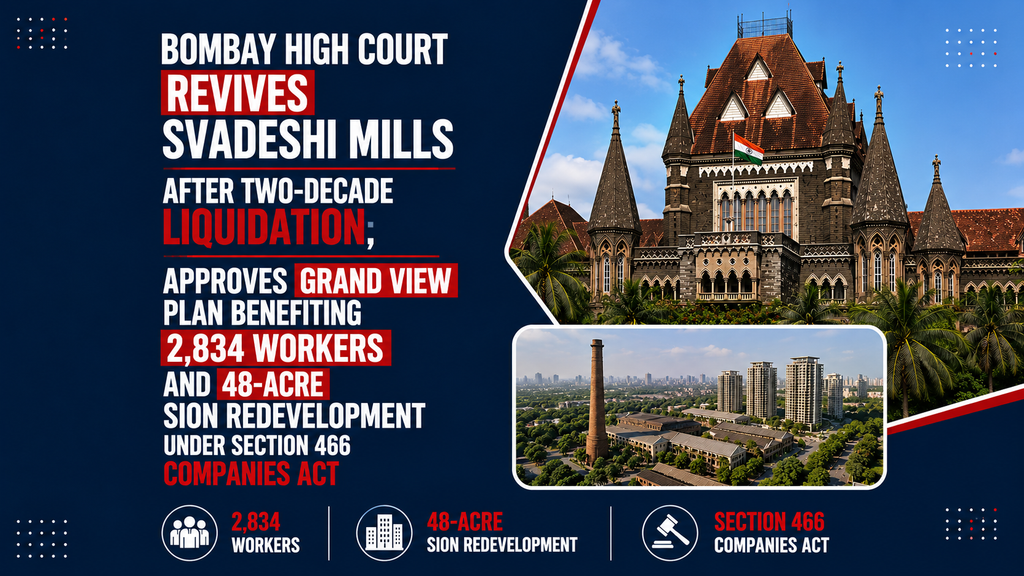
Bombay High Court Revives Svadeshi Mills After Two-Decade Liquidation; Approves Grand View Plan Benefiting 2,834 Workers and 48-Acre Sion Redevelopment Under Section 466 Companies Act

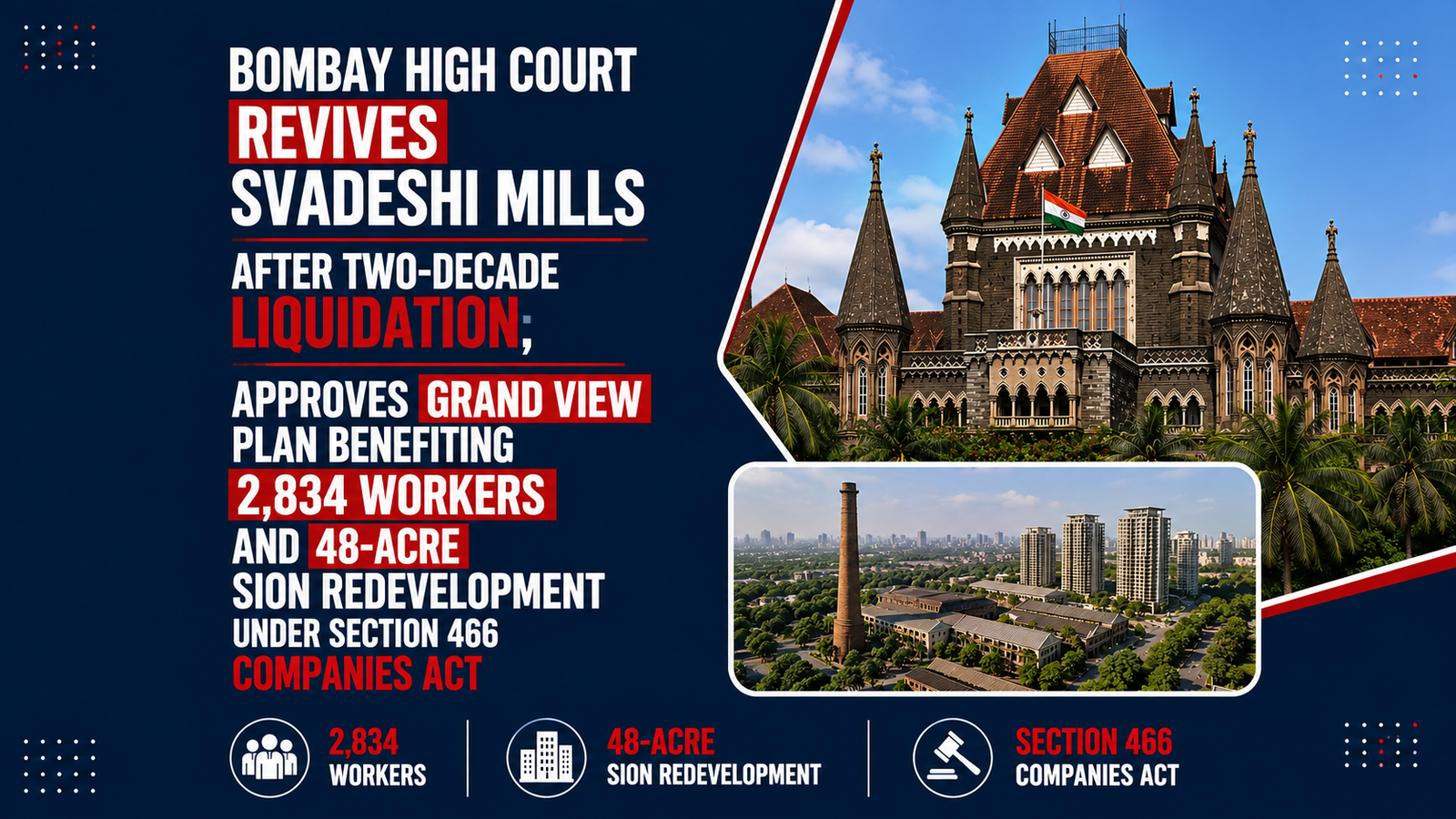
Bombay High Court Allows Revival of Svadeshi Mills After 21 Years; Says Workers’ ₹223-Crore Settlement and Redevelopment Plan Serve Public Interest and Commercial Morality
Facts
Svadeshi Mills Company Limited had been ordered to be wound up on 5 September 2005. More than two decades later, Grand View Estates Pvt. Ltd., together with Forbes & Co. Ltd., sought a permanent stay of the winding-up under Section 466 of the Companies Act, 1956 and revival of the company. Grand View and Forbes together held 53.25% of the share capital, while Grand View also claimed to be a secured creditor through an assigned recovery certificate.
The company’s principal remaining asset was approximately 48 acres of land at Sion, Mumbai. Grand View proposed that, instead of selling the land through liquidation, the revived company itself would undertake redevelopment.
During an interregnum when the company had briefly come out of winding-up, an Extraordinary General Meeting on 14 May 2024 amended its object clause to include real estate development, with 99.85% of those present and voting supporting the resolution. Grand View also deposited ₹240 crore with the Official Liquidator, and approximately ₹169 crore had already been distributed to workmen.
The revival proposal contemplated, among other things, 100% payment to creditors and workmen, payment even to badli workers who might otherwise receive nothing in liquidation, payment of Official Liquidator costs, deferment of approximately ₹1,322 crore claimed by Grand View and Forbes, a textile/educational institution, and housing benefits for workers.
A learned Single Judge rejected the revival application on 23 February 2026, followed by an order dated 27 February 2026. Grand View, Forbes and Rashtriya Mill Mazdoor Sangh (RMMS) appealed.
Issues
The principal issue was whether the circumstances justified permanently staying the winding-up under Section 466 of the Companies Act, 1956 and permitting revival of Svadeshi Mills.
The Division Bench particularly considered whether the revival proposal satisfied the tests of public interest, commercial morality and bona fides; whether revival required restarting the company’s historic textile manufacturing business; whether changing its object to real-estate development defeated the concept of revival; whether redevelopment by the company’s majority shareholders amounted in substance to an impermissible sale of the mill land; and whether objections raised by two minority shareholders holding only 0.07321% collectively should defeat a settlement benefiting 2,834 workers.
Appellants’ Arguments
Grand View argued that circumstances had fundamentally changed since earlier revival attempts were rejected.
Grand View and Forbes together held 53.25% shareholding, while Grand View was also a secured creditor. RMMS, representing the former workers, now actively supported the revival, and the Official Liquidator had no objection.
Relying on Meghal Homes Pvt. Ltd. v. Shree Niwas Girni K.K. Samiti, Grand View submitted that the relevant Section 466 considerations were public interest, commercial morality and bona fides. It argued that the proposal met each test because creditors and workers would be paid, ₹240 crore had already been deposited, and the redevelopment would create substantial value rather than leaving the Sion land idle.
Grand View stressed that it did not propose transferring the 48-acre property to an outside developer. The property would remain with Svadeshi Mills and be redeveloped by the revived company itself.
RMMS strongly supported the proposal. It stated that negotiations before a Court-appointed committee had increased the workers’ settlement from around ₹70 crore to over ₹240 crore. Nearly 2,000 workers had already received ₹169 crore, while the remaining workers awaited payment.
The workers’ chart placed before the Court showed that while ex-workers might have received only around ₹74 crore in liquidation, the settlement would provide approximately ₹223 crore, amounting on average to about ₹5.25 lakh more per worker. Badli workers would also be treated at par with permanent workers, and approximately 800 workers’ families would receive housing benefits.
Respondents’ Arguments
Two minority shareholders opposed revival and sought continuation of liquidation followed by a public auction of the company’s assets.
They argued that Grand View’s claimed secured dues were inflated because interest had been calculated at 16% per annum. They also alleged suppression of an earlier ₹16-crore dividend and contended that Grand View and Forbes had not clearly explained how their deferred dues would be treated after the company emerged from liquidation.
They further argued that the ₹240 crore deposited for the revival had been raised by encumbering company land rather than using Grand View’s own funds.
Their central legal submission was that a true revival required resumption of the business previously carried on by the company—textile manufacturing—and not conversion of the company into a real-estate enterprise.
They relied heavily upon previous decisions rejecting earlier revival proposals and upon Meghal Homes, arguing that the present proposal was essentially an attempt to commercially exploit the valuable 48-acre property.
Analysis of the Law
Section 466 Revival Does Not Require Revival of the Identical Old Business
A significant holding of the Division Bench was that there is no rule of law prohibiting a company, while being revived, from changing its objects or undertaking a commercially viable business different from its historic activity.
The Court took judicial notice of the commercial reality that Mumbai’s textile mills had closed and noted that no industrialist had come forward over two decades to revive Svadeshi Mills as a textile manufacturer.
The Court expressly rejected the proposition that revival necessarily means restarting the precise business that existed before liquidation.
This was especially relevant because the textile plant, machinery and stock were no longer available and earlier feasibility assessments had themselves raised doubts about restarting the mill.
Redevelopment Is Not Alienation of Company Property
The Division Bench disagreed with the Single Judge’s description of the proposal as a device permitting Grand View and Forbes to exploit the land without public auction.
The Court held that redevelopment by the company does not amount to transfer or divestment of its land.
It added in particularly strong terms that profit-making is not inherently objectionable. The possibility that the revived company or its investors may make profits does not, by itself, establish lack of bona fides or commercial morality.
Deferred Promoter Dues Did Not Destroy Commercial Morality
The Court rejected the contention that absence of an immediately crystallised mechanism for repayment of Grand View and Forbes necessarily rendered the scheme improper.
Deferral of those dues was characterised as a commercial decision and could not automatically justify an inference that the revival proposal offended commercial morality.
Precedent Analysis
Meghal Homes Pvt. Ltd. v. Shree Niwas Girni K.K. Samiti, (2007) 7 SCC 753
This was the central precedent.
The appellants relied upon the three relevant considerations derived from Meghal Homes: public interest, commercial morality and bona fides.
The Division Bench distinguished the factual situation in Meghal Homes. There, creditors who were not themselves developers proposed disposing of company land to an outside developer under the guise of revival.
Here, Grand View was itself a substantial shareholder, creditor and developer, and the property would remain with the company rather than being alienated to an external builder. Redevelopment would therefore take place within the revived corporate entity for the benefit of stakeholders.
Mrs. Bacha F. Guzdar v. Commissioner of Income Tax, 1954 (2) SCC 563
The Court relied upon this decision in examining the rights of shareholders.
A shareholder is entitled to participate in declared profits and, after winding-up liabilities are discharged, in the surplus assets corresponding to his proprietary interest. However, a shareholder does not directly own the company’s assets merely by holding shares.
The Court used this principle in rejecting the suggestion that two minority shareholders could dictate how a revived company must conduct its business simply because they remained shareholders.
Earlier Svadeshi Mills Orders
The minority shareholders relied upon the earlier 2011 and 2013 judgments rejecting previous proposals, as well as the Supreme Court order of 2016.
The Division Bench, however, considered the materially altered circumstances, especially the fresh workers’ settlement, amendment to the company’s objects, ₹240-crore deposit, payments already made to workers and present support of RMMS.
It therefore did not treat the earlier failures as an absolute prohibition against considering the present proposal.
Court’s Reasoning
The Division Bench saw the dispute as essentially between two camps.
On one side were Grand View and Forbes, holding 53.25%, together with RMMS representing thousands of workmen and supporting revival after extensive negotiations.
On the other side were two shareholders collectively holding only 0.07321%, demanding sale of the assets through public auction.
The Court was sharply critical of the minority shareholders’ position. It observed that they had offered no workable mechanism for satisfying the dues of 2,834 workers, nor any assurance that a public auction would secure the benefits already negotiated by RMMS.
The Bench described their litigation in unusually strong language as an “elitist form of extortion”, expressing concern that prolonged opposition could be used as bargaining leverage while the revival remained stalled.
The Court also disagreed with the Single Judge’s treatment of workers’ interests. While workers’ consent need not be the sole criterion for a Section 466 revival, their position after more than two decades of winding-up was a major equitable and public-interest consideration.
Nearly 2,000 workers had already been paid, others awaited disbursement, and the workers had spent two years negotiating before a Court-appointed committee.
The Court compared the minority shareholders’ potential financial interest with the much larger human consequences for workers. Even assuming the land fetched ₹3,000 crore at auction, the two objecting shareholders’ collective 0.07321% holding would amount to roughly ₹2.19 crore before liabilities, whereas the revival affected negotiated benefits for 2,834 employees and their families.
Ultimately, the Bench held that revival was conducive rather than detrimental to commercial morality and public interest. It found no reason to discard the Grand View-Forbes proposal, particularly when the interests of creditors, workers and shareholders were otherwise safeguarded.
Conclusion
The Bombay High Court allowed Grand View Estates’ appeal.
It set aside the Single Judge’s judgment dated 23 February 2026 read with the order dated 27 February 2026 in Interim Application No. 6953 of 2025 and allowed Appeal (L) No. 10776 of 2026 in terms of prayer clause (a), thereby accepting the revival challenge under Section 466.
The connected appeals filed by Rashtriya Mill Mazdoor Sangh and Forbes & Co. Ltd. were disposed of in terms of the same judgment, and the connected interim applications were disposed of.
The two minority shareholders requested a three-week stay of the judgment to approach the Supreme Court. The Division Bench expressly refused that request.
Case Details
Case: Grand View Estates Pvt. Ltd. v. Official Liquidator of The Svadeshi Mills Company Limited (In Liquidation) & Ors. with connected appeals
Citation: 2026:BHC-OS:19625-DB
Court: Bombay High Court, Ordinary Original Civil Jurisdiction
Case Numbers: Appeal (L) Nos. 10776/2026, 10663/2026 and 10666/2026, arising from Interim Application No. 6953/2025 in Company Petition No. 385/2002
Bench: Justice A. S. Gadkari and Justice Kamal Khata
Judgment by: Justice Kamal Khata
Reserved on: 19 August 2026
Pronounced on: 2 September 2026
Result: Grand View’s appeal allowed; Single Judge’s rejection of the Section 466 revival application set aside; connected RMMS and Forbes appeals disposed of accordingly; request for three-week stay refused.