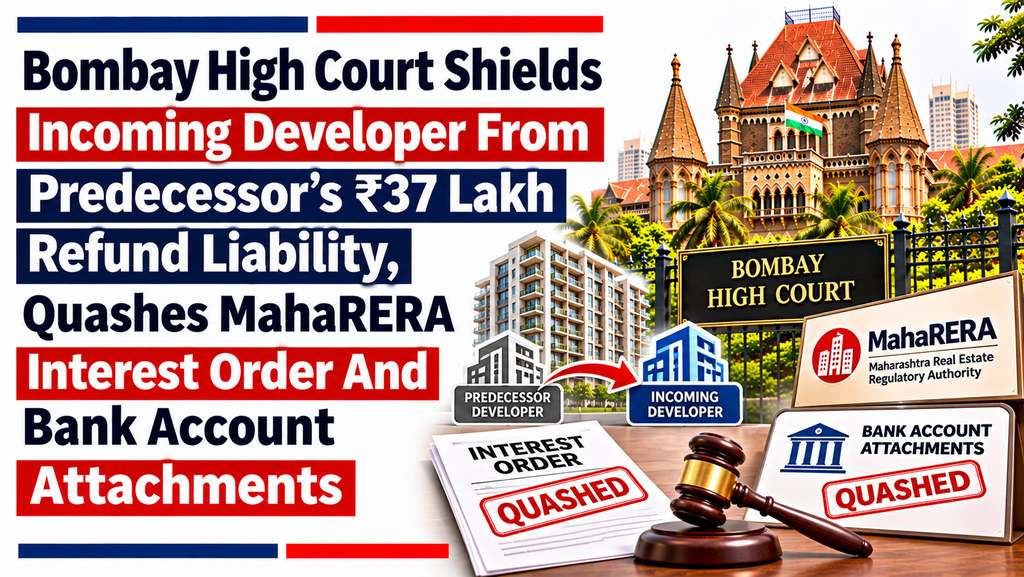
Bombay High Court Shields Incoming Developer From Predecessor’s ₹37 Lakh Refund Liability, Quashes MahaRERA Interest Order And Bank Account Attachments

Bombay High Court Holds Court-Facilitated Replacement Developer Does Not Automatically Inherit Past RERA Debts, Says Mere Notice Cannot Replace Formal Impleadment
Facts
H. Rishabraj Developers was appointed to complete the stalled “Samaj Darshan” redevelopment in Kandivali after the landowning trust terminated its agreement with the former developer, Jayant Mehta of Bhakti Enterprises. Flat purchasers Kinjal and Mahesh Karia had paid ₹37 lakh for Flat No. 902 under a 2015 allotment by the former developer. In May 2018 MahaRERA disposed of their refund complaint on Mehta’s written undertaking to return the principal, without interest; he repeatedly defaulted. In July 2021, following Bombay High Court orders facilitating the appointment of a replacement developer, H. Rishabraj entered a fresh development agreement with the trust. MahaRERA registered the new developer in January 2022 with express protection against past liabilities. Yet, by order dated 21 March 2022 on a remanded review-cum-execution application, MahaRERA directed both the old and new developers to pay interest on ₹37 lakh from 17 May 2018. Revenue authorities then attached the new developer’s bank accounts, prompting two writ petitions.
Issues
Whether MahaRERA could impose a pre-existing refund-related interest liability on a replacement developer never formally impleaded in the purchasers’ proceedings; whether Sections 2(zk), 15 and 18 of RERA automatically transferred the previous developer’s debts; whether the writs were maintainable despite withdrawal of statutory remedies; and whether consequential revenue attachments could stand.
Petitioner’s Arguments
H. Rishabraj argued that it had not received the purchasers’ money, was absent from the original complaint and appeal, and acquired development rights through a court-supervised, fresh contract rather than an assignment by the defaulting promoter. Mehta had personally undertaken repayment on several occasions. The promoter-change registration order expressly insulated the newcomer from past claims. Its appearance after receiving hearing notice did not substitute for formal joinder or a pleaded cause of action. The petitioner also challenged MahaRERA’s power of review and the bank-account distraint under Section 180 of the Maharashtra Land Revenue Code.
Respondents’ Arguments
The purchasers argued that RERA’s promoter definition and Sections 15 and 18 protect allottees despite changes in development control, and that the new developer knew of existing liabilities. They questioned writ maintainability after withdrawal of review and appeal proceedings and relied on MahaRERA Regulation 36 to support reconsideration. The former developer argued that the successor and trust benefited from its construction expenditure and could not disclaim project liabilities; the trust, conversely, said the refund promises were made solely by the former developer and that the subsequent development arrangement excluded historical obligations.
Analysis of the Law
Section 2(zk) of the Real Estate (Regulation and Development) Act, 2016 permits joint responsibility where different persons construct and sell a project, but it does not transfer every pre-existing financial debt to any future promoter. Section 15 concerns transfer or assignment of development rights and pending obligations; it did not govern a fresh appointment after termination and court-receiver intervention. A crystallised, personal ₹37 lakh refund undertaking was not a pending project obligation passing under Section 15(2). Section 18 protects purchasers claiming return of amounts actually received by a promoter; here the replacement developer received none of the purchasers’ funds. An adverse adjudicatory order also requires formal impleadment and proper pleadings, not simply notice of hearing or voluntary appearance.
Precedent Analysis
The Bench distinguished Wadhwa Group Housing Pvt. Ltd. v. Vijay Choksi, 2024 SCC OnLine Bom 660, on concurrent co-promoter liability, from a court-supervised substitution on a clean-slate basis. It rejected reliance on Sarguja Transport Service v. State Transport Appellate Tribunal, (1987) 1 SCC 5, because the petitioner had withdrawn statutory proceedings to pursue its disclosed writ, not withdrawn and refiled a prior writ. Applying Union of India v. Manjurani Routray, (2023) 9 SCC 144, the Court declined to decide the validity of Regulation 36 without a pleaded vires challenge; accordingly it did not rule generally on MahaRERA’s inherent review powers or apply Kapra Mazdoor Ekta Union to invalidate the provision.
Court’s Reasoning
Justices Suman Shyam and Gautam A. Ankhad found non-joinder independently fatal: neither the complaint nor the review-cum-execution application sought relief against H. Rishabraj, and its lawyer’s presence at a remand hearing could not cure that omission. The original repayment obligation arose solely from the former developer’s undertakings in 2018, three years before the petitioner entered the project. MahaRERA’s January 2022 registration order had excluded the newcomer’s historic liabilities, yet its March 2022 order imposed interest without explaining the contradiction. A change of promoter through fresh court-facilitated development rights is not a Section 15 transfer from the erstwhile promoter; knowledge of a debt is not its assumption. As the purchaser funds remained with Mehta, no interest could be imposed on the successor under Section 18. The Court left the validity of the flat allotment, the trust’s possible liability and the arbitration dispute undecided.
Conclusion
Both writ petitions were allowed. The MahaRERA order dated 21 March 2022, related recovery warrants, and the revenue authorities’ distraint and freezing measures, including attachments of the petitioner’s Cosmos Co-operative Bank accounts, were quashed insofar as they sought recovery from H. Rishabraj Developers; the November 2024 recovery measure was likewise set aside qua the petitioner. The ruling did not extinguish the former developer’s obligations under its undertakings. The purchasers remain free to seek principal, interest and other lawful relief against the former developer, and, if maintainable, the trust. Questions relating to the earlier allotment, charitable-trust sanction and co-promoter status were expressly left open. The Court did not issue a blanket exemption from RERA obligations for all incoming developers.
Case: H. Rishabraj Developers v. State of Maharashtra & Ors.
Court: High Court of Judicature at Bombay, Division Bench
Case Number: Writ Petition Nos. 894 of 2024 and 7618 of 2022; 2026:BHC-OS:24157-DB
Bench: Justices Suman Shyam and Gautam A. Ankhad
Date: 5 November 2026 (reserved on 7 October 2026)
Result: Writ petitions allowed; MahaRERA liability and account attachments quashed only qua the incoming developer; purchasers’ claims against former developer preserved.