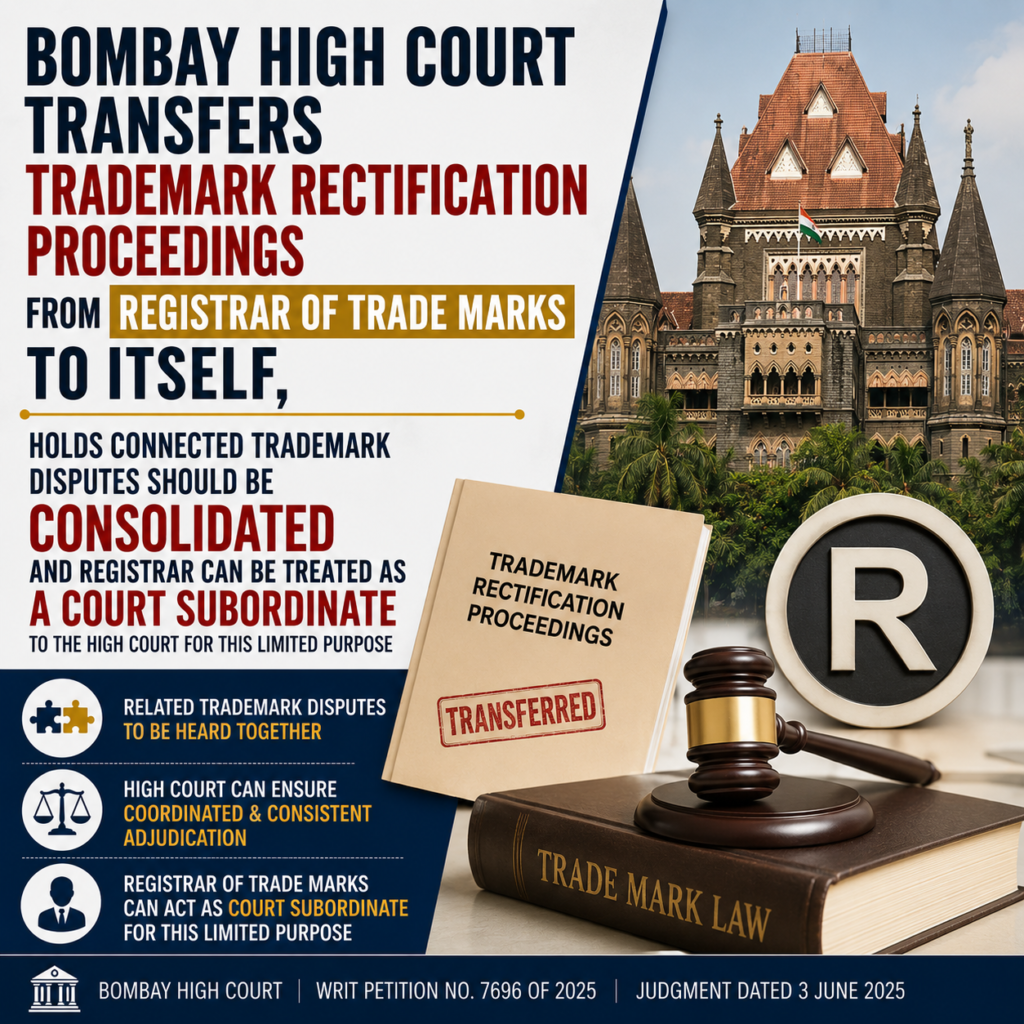
Bombay High Court Transfers Trademark Rectification Cases From Registrar to Itself, Holds Connected IP Disputes Should Be Heard Together

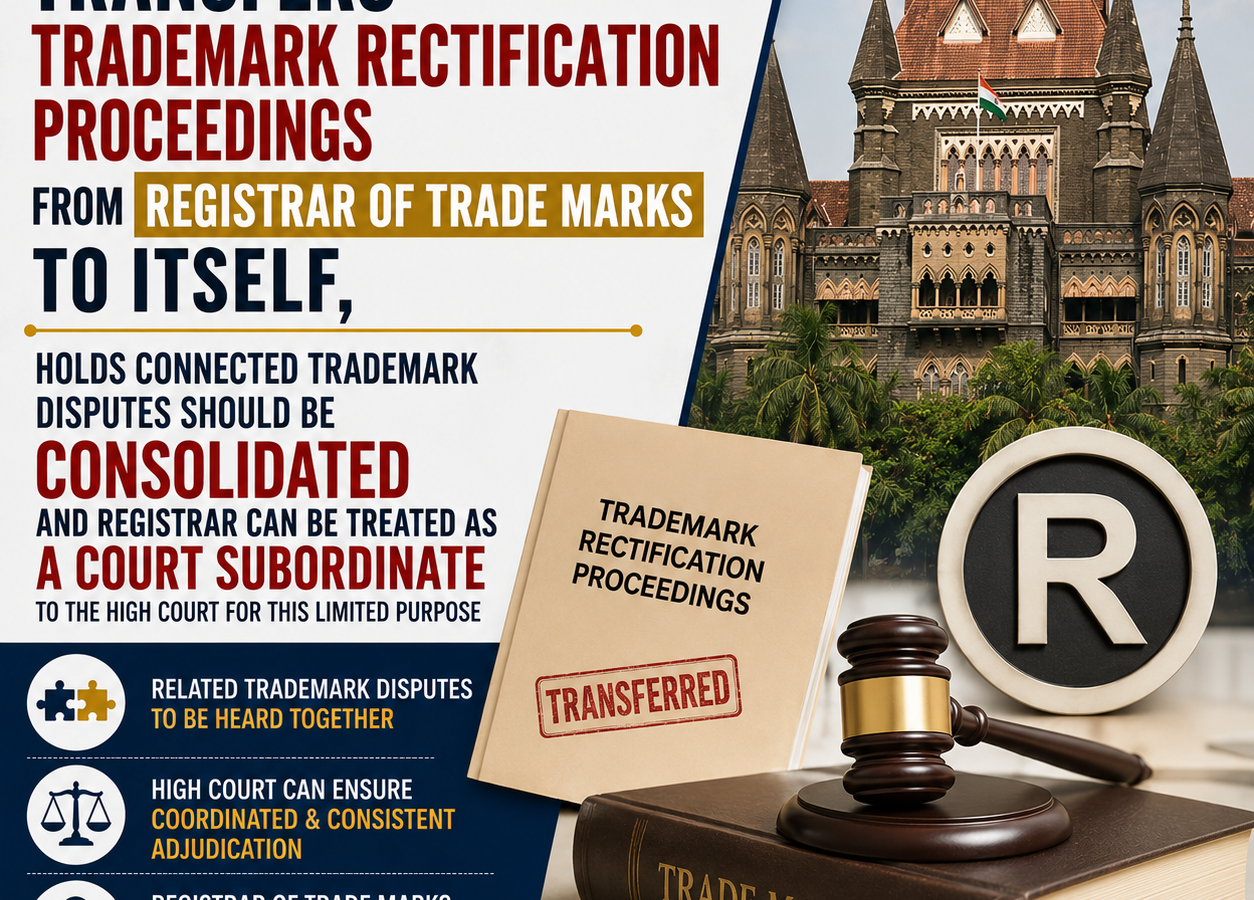
Registrar of Trade Marks Can Be Treated as a Court Subordinate to the High Court for Transfer of Trademark Proceedings Under the Code of Civil Procedure: Bombay High Court
Facts
Institute for Technology and Management Trust (“ITM”) carries on educational activities using various trademarks referred to as the “ITM Marks.” Samata Lok Sansthan Trust (“Samata”), another educational trust based in Madhya Pradesh, was alleged to have improperly used or obtained registrations concerning marks claimed by ITM.
ITM instituted Commercial IP Suit No. 102 of 2015 before the Bombay High Court on 14 September 2015 against Samata and other defendants.
Before instituting the suit, ITM had filed three rectification proceedings under Sections 47 and 57 of the Trade Marks Act, 1999 before the Registrar of Trade Marks, Mumbai. These proceedings sought cancellation or removal of certain trademark registrations standing in Samata’s name.
On 16 February 2016, Samata filed 17 separate rectification applications before the Intellectual Property Appellate Board challenging trademark registrations standing in ITM’s name.
Following the abolition of the Intellectual Property Appellate Board, Samata’s 17 rectification proceedings were transferred to the Bombay High Court. By an order dated 2 January 2025, those proceedings were directed to be heard along with the pending commercial intellectual property suit.
Consequently, the Bombay High Court was already dealing with:
- the commercial intellectual property suit; and
- 17 rectification proceedings filed by Samata.
However, the three rectification proceedings filed by ITM continued to remain pending before the Registrar of Trade Marks.
ITM therefore filed Interim Application No. 3128 of 2025 in the pending suit, seeking transfer of its three rectification proceedings from the Registrar to the Bombay High Court so that all connected disputes could be consolidated and decided together.
There was no substantial dispute that the parties were the same, the trademark registrations were interconnected and parallel adjudication before the High Court and Registrar could result in overlapping or inconsistent findings. The principal controversy concerned whether the High Court possessed jurisdiction under Sections 24 and 151 of the Code of Civil Procedure, 1908 to transfer proceedings from the Registrar of Trade Marks to itself.
Issues
- Whether the Registrar of Trade Marks could be regarded as a “Court subordinate” to the High Court for the purposes of Section 24 of the Code of Civil Procedure.
- Whether the Bombay High Court could transfer rectification proceedings pending before the Registrar to itself and consolidate them with related proceedings already pending before it.
- Whether the High Court’s inherent powers under Section 151 of the Code of Civil Procedure could be exercised to prevent fragmented and parallel adjudication.
- Whether the transfer application was maintainable as an interim application in the commercial intellectual property suit on the Original Side of the Bombay High Court.
- Whether ITM was required first to approach the Registrar under Section 125(2) of the Trade Marks Act and thereafter challenge any refusal through a writ petition.
- Whether the absence of specialised intellectual property rules similar to the Delhi High Court Intellectual Property Division Rules prevented the Bombay High Court from transferring and consolidating the proceedings.
Petitioner’s Arguments
ITM submitted that the three rectification proceedings pending before the Registrar involved the same parties, related trademark registrations and substantially overlapping questions already being considered in the suit and Samata’s 17 rectification proceedings before the High Court.
It argued that parallel adjudication before different forums would be inefficient and could result in conflicting findings concerning the validity of the rival trademark registrations.
ITM relied upon Section 24 of the Code of Civil Procedure and submitted that the High Court had wide powers to transfer proceedings from a subordinate forum to itself where such transfer would promote convenience and the ends of justice.
It further relied upon Section 151 of the Code to contend that, even if any procedural uncertainty existed under Section 24, the Court possessed inherent powers to consolidate proceedings, avoid multiplicity and prevent chaotic consequences.
ITM submitted that the Registrar possessed substantial trappings of a civil court under Section 127 of the Trade Marks Act, including powers to:
- receive evidence;
- administer oaths;
- compel attendance of witnesses;
- order discovery and production of documents;
- issue commissions;
- impose costs executable as a civil court decree; and
- review its own decisions.
It also pointed out that the Registrar and the High Court exercised concurrent jurisdiction under Sections 47 and 57 of the Trade Marks Act in rectification matters.
Further, every order of the Registrar was appealable to the High Court under Section 91 of the Trade Marks Act. Therefore, for the limited and contextual purpose of Section 24, the Registrar could be treated as a court subordinate to the High Court.
ITM relied upon decisions of the Delhi and Madras High Courts where similar rectification proceedings had been transferred and consolidated.
It also argued that the absence of separate intellectual property rules in the Bombay High Court could not extinguish a substantive power conferred by statute.
Respondent’s Arguments
Samata argued that the transfer application was fundamentally misconceived because the Registrar of Trade Marks was not a “Court,” much less a court subordinate to the High Court, under Section 24 of the Code of Civil Procedure.
It relied upon earlier judicial decisions holding that the Registrar was a statutory tribunal possessing certain trappings of a court but was not a civil court.
According to Samata, Section 24 could apply only to suits, appeals or proceedings pending before a court subordinate to the High Court. Since the Registrar was not such a court, the High Court lacked power under Section 24 to withdraw the rectification proceedings.
Samata submitted that ITM ought to have filed an application before the Registrar under Section 125(2) of the Trade Marks Act requesting referral of the rectification proceedings to the High Court.
If the Registrar rejected that request, ITM could then challenge the rejection through a writ petition. According to Samata, this was the proper statutory route.
It further contended that an application under Section 24 should ordinarily have been filed as a miscellaneous application on the Appellate Side of the Bombay High Court rather than as an interim application in a suit on the Original Side.
Samata also pointed out that, unlike the Delhi High Court, the Bombay High Court did not have separate Intellectual Property Division Rules containing an express provision for consolidation and transfer of intellectual property proceedings.
It therefore submitted that the Court could not rely upon precedents based on the Delhi High Court’s specialised procedural rules.
Analysis of the Law
Scope and purpose of Section 24 of the Code of Civil Procedure
Section 24 grants the High Court wide authority to transfer or withdraw suits, appeals and other proceedings from courts subordinate to it.
The Court held that the underlying principle is one of forum conveniens—proceedings should be heard by the forum best suited to ensure efficient, consistent and convenient adjudication.
In the present case, the High Court was already seized of the suit and 17 related rectification proceedings. Only three interconnected rectification applications remained before the Registrar.
Transferring those three proceedings to the High Court would prevent fragmented litigation and the possibility of contradictory outcomes.
Contextual meaning of “Court”
The Code of Civil Procedure does not define “Court” for all purposes. Whether a statutory tribunal can be regarded as a court must therefore be examined contextually, having regard to:
- the powers conferred upon it;
- the nature of its adjudicatory role;
- the statutory appellate structure; and
- the legislative purpose of the provision being applied.
The Court rejected the proposition that a statutory tribunal must either always or never be regarded as a court.
A forum may not be treated as a court for one statutory purpose but may qualify as one for another, depending upon the context and legislative policy.
Powers and status of the Registrar
The Registrar possesses significant adjudicatory powers under Section 127 of the Trade Marks Act.
The Registrar can receive evidence, administer oaths, summon witnesses, compel document production, issue commissions, award costs enforceable as civil court decrees and review decisions.
Further, under Sections 47 and 57, the Registrar exercises rectification jurisdiction concurrently with the High Court. An applicant may choose either the Registrar or the High Court as the original forum.
Under Section 91, every order or decision of the Registrar is appealable to the High Court.
The Court therefore held that, for the purposes of Section 24, the Registrar had sufficient trappings of a court and stood within the High Court’s appellate hierarchy. It could consequently be regarded as a court subordinate to the High Court.
Inherent powers under Section 151
Section 151 preserves the inherent powers of courts to pass orders necessary for the ends of justice or to prevent abuse of process.
The Court held that Section 151 supplemented Section 24 and enabled the High Court to remove procedural obstacles that would otherwise result in parallel, fragmented and inefficient litigation.
The inherent power was particularly relevant because the High Court was already considering 18 connected proceedings concerning substantially the same disputes.
Concurrent jurisdiction under the Trade Marks Act
The Court found it important that both the Registrar and High Court had original jurisdiction under Sections 47 and 57.
The Registrar’s role in rectification proceedings was essentially the same adjudicatory role that the High Court itself could perform.
Under Section 124, findings in rectification proceedings may bind the court deciding an infringement suit. This further demonstrated the substantial and judicial character of the Registrar’s role.
Absence of specialised intellectual property rules
The Court held that the absence of rules similar to the Delhi High Court Intellectual Property Division Rules did not affect the existence of the High Court’s substantive statutory or inherent powers.
Procedural rules facilitate the exercise of power; they do not ordinarily create or extinguish powers already conferred by legislation.
The Court relied upon the principle that a statutory power cannot be rendered unusable merely because detailed subordinate rules have not been framed.
Filing on the Original Side
Although applications under Section 24 ordinarily fall within the Appellate Side Rules, trademark proceedings before the Bombay High Court are specially governed by Chapter XLV of the Original Side Rules.
Rule 835 provides that, in matters not specifically covered by that Chapter, the Code of Civil Procedure and Original Side Rules apply to proceedings under the Trade Marks Act.
The Court therefore held that the transfer application was properly filed as an interim application in the pending commercial intellectual property suit on the Original Side.
Section 125(2) was not the exclusive remedy
The Court rejected the argument that ITM was required first to apply to the Registrar under Section 125(2).
Where more than one lawful procedure is available to achieve the same legitimate result, a party may choose the procedure it considers appropriate unless one route is expressly made exclusive.
The filing of an interim transfer application in proceedings already consolidating the suit and 17 rectification applications was therefore a logical and legally permissible course.
Precedent Analysis
Jumeirah Beach Resort LLC v. Designarch Infrastructure Pvt. Ltd.
The Delhi High Court had permitted the transfer of rectification proceedings from the Registrar for consolidation with connected proceedings before the High Court.
The Bombay High Court agreed with the purposive interpretation adopted in that case. It held that where the Registrar had statutory power under Section 125(2) to refer rectification proceedings to the High Court, it would be illogical to conclude that the High Court could never withdraw such proceedings to itself under Sections 24 and 151.
Nippon Paint Holdings Co. Ltd. v. Suraj Sharma
The Madras High Court had similarly permitted consolidation of related trademark proceedings.
The Court treated this as supporting the principle that connected intellectual property disputes should be tried together where possible to avoid inconsistent findings.
Anglo French Drug Co. v. R.D. Tinaikar
This Bombay High Court decision held that the Registrar was not a court for the purpose of restricting the appearance of trademark agents under the Bombay Pleaders Act.
The Court distinguished it contextually. That judgment concerned whether non-lawyer trademark agents could appear before the Registrar, not the High Court’s power to consolidate rectification proceedings under Section 24.
The status of the Registrar had to be determined with reference to the legislative purpose of the particular provision under consideration.
Promoshirt SM SA v. Armassuisse
The Delhi High Court had held that the Registrar was not a civil court in the context of a second appeal under Section 100-A of the Code of Civil Procedure.
The Court held that the decision did not establish a universal rule that the Registrar could never be treated as a court for any purpose.
The context of second appeals was materially different from transfer and consolidation under Section 24.
Bhagwati Devi v. I.S. Goel
The Supreme Court treated a Motor Accident Claims Tribunal as a civil court for the purpose of transferring proceedings under Section 25 of the Code of Civil Procedure.
The Bombay High Court relied upon this decision to demonstrate that a statutory tribunal may be treated as a court for a particular procedural purpose depending upon the legislative context.
Nahar Industrial Enterprises Ltd. v. Hongkong and Shanghai Banking Corporation
The Supreme Court held that the Debt Recovery Tribunal was not a court subordinate to the High Court under Section 24.
However, the Court distinguished the decision because appeals from the Debt Recovery Tribunal did not directly lie to the High Court.
By contrast, every order of the Registrar of Trade Marks was appealable to the High Court under Section 91. The Registrar therefore formed part of the High Court’s statutory appellate hierarchy.
Khoday Distilleries Ltd. v. Scotch Whisky Association and Sakura v. Tanaji
These decisions treated the Registrar as not being a court for the purpose of applying the Limitation Act to rectification proceedings.
The Court held that those rulings concerned limitation and the statutory scheme governing the filing of rectification applications. They did not determine the Registrar’s status for every other procedural purpose.
Delhi Science Forum v. Union of India
The Supreme Court held that the absence of subordinate rules does not prevent the exercise of a substantive power expressly conferred by statute.
The Court applied this principle to reject the contention that the absence of specialised intellectual property rules in the Bombay High Court prevented transfer and consolidation.
Court’s Reasoning
The Court observed that 18 related proceedings were already pending before it, whereas only three interconnected proceedings remained before the Registrar.
All proceedings concerned the same parties, rival trademark registrations and overlapping questions of validity.
Requiring the parties to conduct parallel proceedings before two forums would:
- duplicate evidence and arguments;
- increase costs and delay;
- create procedural inefficiency; and
- risk inconsistent or conflicting decisions.
The Registrar had all the material trappings of a court and exercised original rectification jurisdiction concurrent with the High Court.
Since every decision of the Registrar was appealable to the High Court, the Registrar could be regarded as subordinate to the High Court for the limited purpose of Section 24.
The Court rejected a rigid classification under which a tribunal must always or never be treated as a court. The correct approach was contextual and purposive.
It further held that Sections 24 and 151 must be interpreted to facilitate smooth and effective justice delivery rather than create technical barriers to consolidation.
The transfer application was properly filed on the Original Side because trademark proceedings were specifically governed by the Original Side Rules.
The suggested alternative procedure under Section 125(2) was not mandatory or exclusive. ITM had adopted a legally valid and more efficient course by filing the application in the proceedings where the suit and 17 rectification matters were already consolidated.
Conclusion
The Bombay High Court allowed ITM’s transfer application.
It held that, for the purposes of Section 24 of the Code of Civil Procedure, the Registrar of Trade Marks could be regarded as a court subordinate to the High Court because:
- the Registrar possessed extensive trappings of a civil court;
- the Registrar exercised concurrent jurisdiction with the High Court under Sections 47 and 57 of the Trade Marks Act; and
- all orders of the Registrar were appealable to the High Court under Section 91.
The Court further held that Sections 24 and 151 authorised the transfer and consolidation of the rectification proceedings.
The Registrar of Trade Marks was directed to transmit the complete records of ITM’s three rectification applications to the Bombay High Court within six weeks.
Upon receipt, the Registry was directed to convert them into Commercial Miscellaneous Petitions and tag them with:
- Commercial IP Suit No. 102 of 2015; and
- the 17 rectification applications filed by Samata.
The consolidated proceedings were directed to be listed on 18 August 2026.
Case: Institute for Technology and Management Trust and Another v. Putch Venkata Ramana and Others
Court: High Court of Judicature at Bombay, Ordinary Original Civil Jurisdiction
Case Number: Interim Application No. 3128 of 2025 in Commercial IP Suit No. 102 of 2015, with connected Commercial Miscellaneous Petitions
Judge: Justice Somasekhar Sundaresan
Date: 30 June 2026
Result: Transfer application allowed; three trademark rectification proceedings pending before the Registrar of Trade Marks directed to be transferred to the Bombay High Court and consolidated with the pending commercial intellectual property suit and 17 connected rectification proceedings.