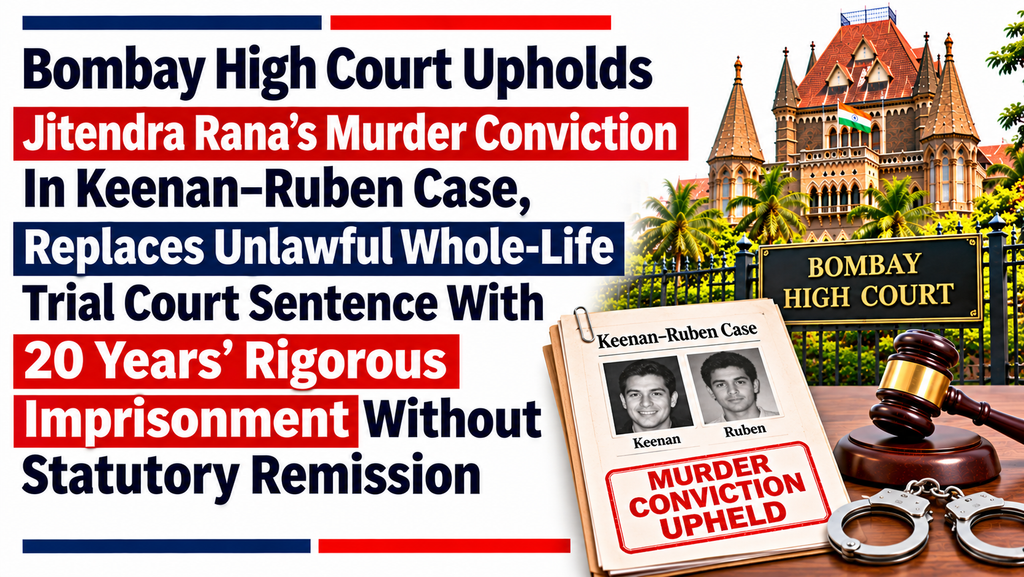
Bombay High Court Upholds Jitendra Rana’s Murder Conviction In Keenan–Ruben Case, Replaces Unlawful Whole-Life Trial Court Sentence With 20 Years’ Rigorous Imprisonment Without Statutory Remission

Bombay High Court Acquits Two Co-Accused Of Murder In 2011 Amboli Double Killing, Holds Participation In Assault Alone Cannot Prove Common Intention Under Section 34 IPC
Facts
These appeals arose from the killing of Keenan Santos and Ruben Fernandez outside Amboli Bar and Kitchen, Andheri, on 20 October 2011. The prosecution alleged that four men harassed and molested a woman (PW-1) accompanying the victims’ group. After Avinash Solanki (PW-17) slapped Jitendra Rana (accused No. 1), the men threatened retaliation and left. They allegedly returned 10–15 minutes later armed with knives, a cricket stump and a bamboo stick. Jitendra stabbed Keenan; Satish Dulgaj (accused No. 2) stabbed Ruben; and Sunil Both and Deepak Piwal (accused Nos. 3 and 4) attacked Avinash and Benjamin. Keenan died shortly after hospitalisation and Ruben subsequently died. On 5 May 2016, the Sessions Court convicted all four under Section 302 read with Section 34 IPC, sentencing them to imprisonment for the remainder of natural life, besides other offences. Satish died on 3 November 2025; his appeal was disposed of separately on 28 August 2026. The present judgment concerns accused Nos. 1, 3 and 4.
Issues
Whether alleged delays, FIR omissions, missing CCTV and discrepancies impaired the prosecution’s proof of molestation and murder; whether the attack attracted Exception 4 to Section 300 IPC as a sudden fight; whether accused Nos. 3 and 4 shared a common intention to commit murder under Section 34 IPC, rather than bearing liability only for hurt; and whether the Sessions Court could impose whole-life imprisonment excluding statutory remission.
Appellants’ Arguments
Jitendra questioned the alleged molestation, which was absent from the initial FIR and added as a charge later. The defence cited delayed witness statements, discrepancies in the number of assailants, delayed identification proceedings, missing CCTV, non-examination of witnesses and alleged weaknesses in the knife recovery. It argued that Avinash’s initial slap triggered a sudden or free fight, attracting Exception 4 to Section 300 and an offence short of murder. Counsel for Sunil and Deepak emphasised that they carried only a stump and bamboo, not knives, and that evidence did not establish their involvement in the fatal stabbings or any agreement to kill. At most, their individual conduct amounted to assault on Avinash and Benjamin, for which the Trial Court had separately convicted them under Section 323 IPC.
Respondent’s Arguments
Special Public Prosecutor Aabad Ponda argued that the Trial Court’s findings rested on consistent eyewitnesses, medical records, spot evidence, recoveries and forensic reports. Neither the later disclosure of molestation nor investigative shortcomings, he submitted, undermined credible direct testimony. The assailants’ departure after threats and armed return 10–15 minutes later established premeditation, not a sudden fight. The State maintained that Sunil and Deepak’s simultaneous assaults on Avinash and Benjamin, alongside the knife attacks, proved common intention under Section 34 despite the absence of fatal blows by them. The intervenor supported the prosecution. On sentence, the State accepted that the Sessions Court could not impose a special whole-life sentence excluding remission but submitted that the High Court could pass a lawful substitute.
Analysis of the Law
Exception 4 to Section 300 IPC requires a sudden fight without premeditation or undue advantage or cruelty, involving the person killed. A later armed attack cannot automatically benefit from that exception because an earlier quarrel occurred. Section 34 IPC creates constructive liability only upon proof of shared intention, whether pre-arranged or formed at the scene; common presence or simultaneous assault alone is not enough. A missing detail in an FIR or a defect in investigation does not necessarily defeat otherwise credible eyewitness evidence. Sentencing law also distinguishes ordinary life imprisonment, which the Sessions Court may award, from special-category imprisonment without statutory remission, which it cannot impose. Valid higher-court restrictions on statutory remission do not curtail constitutional clemency powers under Articles 72 and 161.
Precedent Analysis
Satpal v. State of Haryana, (2018) 6 SCC 610, explains that an FIR need not record every detail; State of Karnataka v. K. Yarappa Reddy, (1999) 8 SCC 715, addresses investigative lapses without rejecting credible independent evidence. Kikar Singh v. State of Rajasthan, (1993) 4 SCC 238, and Surain Singh v. State of Punjab, (2017) 5 SCC 796, guide the application of Exception 4 to Section 300. Asif Khan v. State of Maharashtra, (2019) 5 SCC 210, addresses return with weapons after an earlier altercation. Pandurang, Tukia and Bhilia v. State of Hyderabad, AIR 1955 SC 216, and Ashok Kumar v. State of Punjab explain the meeting-of-minds requirement under Section 34. Naval Kishore v. State of Punjab, 2026 SCC OnLine SC 2000, limits the Trial Court’s sentencing competence; Union of India v. V. Sriharan, (2016) 7 SCC 1, recognises a special no-statutory-remission sentencing category available to superior courts.
Court’s Reasoning
The Bench accepted the eyewitness account of molestation and the armed return. Neither omissions from the FIR, delays, non-production of CCTV nor imperfections in the identification evidence nullified reliable ocular testimony. Since Jitendra left after threatening the group, returned armed 10–15 minutes later and inflicted repeated fatal knife injuries on unarmed Keenan, his attack was deliberate and cruel, not a sudden fight protected by Exception 4. By contrast, accounts of Sunil’s and Deepak’s involvement in the fatal assaults materially varied, while the evidence consistently showed their attack upon Avinash and Benjamin. Their presence did not establish that they knew or shared an intention to commit murder. Thus the murder convictions against them failed, though their Section 323 convictions stood. The Sessions Court exceeded its authority in ordering incarceration for the remainder of natural life without remission. Considering the brutal killing alongside Jitendra’s age and non-habitual-offender status, the High Court substituted 20 years’ rigorous imprisonment without statutory remission.
Conclusion
The Bombay High Court partly allowed Criminal Appeal Nos. 439, 381 and 840 of 2016. Jitendra Fakirchand Rana remained convicted under Section 302 read with Section 34 IPC, but his sentence was altered to 20 years’ rigorous imprisonment without statutory remission. Sunil Omprakash Both and Deepak Ishwar Piwal were acquitted of Section 302/34, with their other sentences—including punishment for hurt under Section 323—confirmed. The pending interim applications were disposed of. The judgment emphasises the separate proof needed for constructive murder liability under Section 34 and the limit on a Sessions Court’s authority to exclude remission. Textual nuance: Although the operative order retains ‘302 read with 34’ for Jitendra, the Court found no murder-level common intention proved against accused Nos. 3 and 4.
Case: Jitendra Fakirchand Rana @ Chaina v. State of Maharashtra (with connected appeals)
Court: High Court of Judicature at Bombay, Criminal Appellate Jurisdiction
Case Number: 2026:BHC-AS:45333-DB; Criminal Appeal Nos. 439, 381 and 840 of 2016
Bench: Justices M. S. Karnik and Sandesh D. Patil (Division Bench)
Date: 5 November 2026 (reserved on 18 September 2026)
Result: Appeals partly allowed; A1 convicted of murder, sentenced to 20 years without statutory remission; A3 and A4 acquitted of murder; other sentences confirmed.