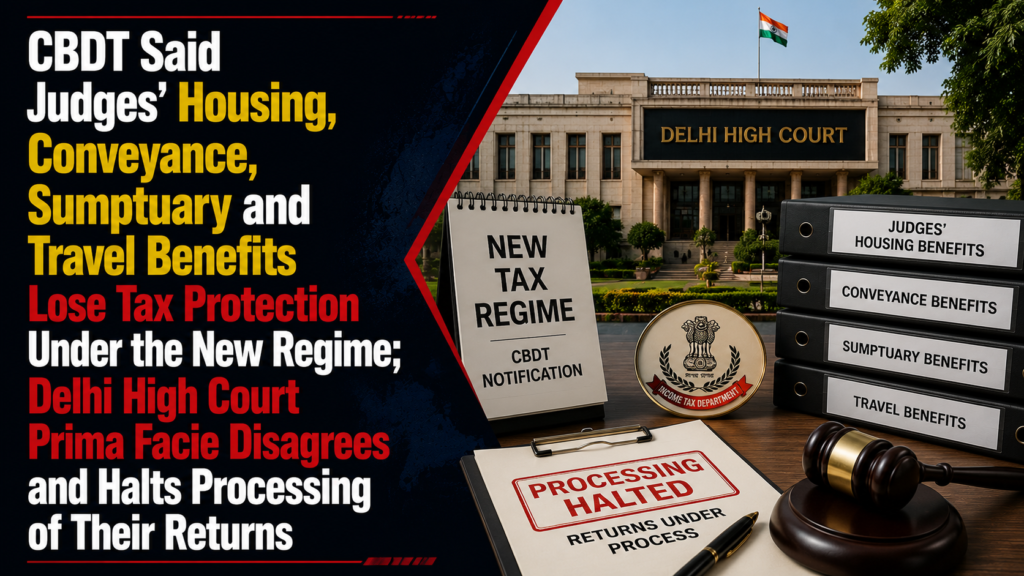
Are Judges’ Official Allowances Taxable Under the New Tax Regime? Delhi High Court Finds Statutory Exclusion May Override Section 115BAC and Grants Interim Protection
Facts
- The Delhi Tax Bar Association filed a writ petition challenging an Office Memorandum dated 12 September 2025 issued by the Central Board of Direct Taxes.
- The Office Memorandum concerned the tax treatment of allowances and benefits provided to High Court judges under Section 22D of the High Court Judges (Salaries and Conditions of Service) Act, 1954, where a judge opts for the new income-tax regime under Section 115BAC of the Income-tax Act, 1961.
- The dispute also affected Supreme Court judges because Section 23D of the Supreme Court Judges (Salaries and Conditions of Service) Act, 1958 contains a corresponding statutory protection.
- The allowances and benefits in question included:
- rent-free official residence or the corresponding allowance;
- official conveyance facilities;
- sumptuary allowance; and
- leave travel concession for judges and their families.
- According to the petitioner, the CBDT’s Office Memorandum treated these benefits as ordinary tax exemptions or deductions that would become unavailable when a judge opted for the new tax regime.
- The petitioner claimed that the statutory provisions do not merely grant an exemption or deduction. They expressly provide that the specified benefits shall not be included while computing income chargeable under the head “Salaries.”
- The Delhi Tax Bar Association explained its standing by stating that its members prepare income-tax returns for High Court and Supreme Court judges, advise them on taxation and investment matters, and have an institutional concern for the independence and dignity of the judiciary.
- The Court made a disclosure regarding the judges constituting the Bench:
- Justice Rajneesh Kumar Gupta had already filed his return under the new regime without claiming exclusion of the disputed allowances.
- Justice Dinesh Mehta stated that he had not yet filed his return and intended to opt for the old tax regime.
- The Court clarified that the matter did not personally affect or influence the judges’ decision-making.
Issues
- Whether the allowances protected by Section 22D of the High Court Judges Act and Section 23D of the Supreme Court Judges Act remain outside taxable salary even when a judge opts for the new tax regime.
- Whether these statutory protections amount to tax “exemptions or deductions,” which may be unavailable under Section 115BAC, or whether the allowances are excluded from income altogether.
- Whether the non-obstante clauses in Sections 22D and 23D override Section 115BAC of the Income-tax Act.
- Whether the CBDT could, through an Office Memorandum, treat the specified judicial allowances as taxable under the new regime.
- Whether the impugned clarification adversely alters the salaries and service conditions of judges, contrary to Articles 125 and 221 of the Constitution.
- What interim arrangement should apply to income-tax returns filed by Supreme Court and High Court judges while the challenge remains pending.
Petitioner’s Arguments
- Sections 22D and 23D expressly state that the specified benefits shall not be included in the computation of a judge’s income chargeable under the head “Salaries.”
- These provisions begin with a non-obstante clause—“notwithstanding anything contained in the Income-tax Act”—and therefore override all inconsistent provisions of the Income-tax Act.
- The benefits are not ordinary exemptions or deductions. The statutes remove them from the computation of salary income at the initial stage itself.
- A receipt that is statutorily excluded from income cannot become taxable merely because deductions and exemptions are generally unavailable under the new tax regime.
- The CBDT’s Office Memorandum wrongly treated the protected benefits as ordinary exemptions and declared them unavailable to judges opting for the new regime.
- The statutory protection continues irrespective of whether a judge chooses the old or new tax regime.
- The Office Memorandum could adversely change the service conditions of sitting judges by increasing their tax liability after appointment.
- Such an adverse variation would violate Articles 125 and 221 of the Constitution, which protect the salaries and allowances of Supreme Court and High Court judges from being varied to their disadvantage after appointment.
- Taxing the protected allowances would interfere with the financial security and independence of the judiciary.
- The income-tax return preparation software did not provide a specific field through which judges opting for the new regime could claim the statutory exclusion.
- As an interim solution, the petitioner requested permission for judges to report these allowances under:
Exempt Income → Other Income → Receipts not in the nature of income
- The petitioner requested that returns filed in this manner be accepted, subject to the final outcome of the writ petition.
Respondents’ Arguments
- The detailed substantive defence of the Union of India and the CBDT was not recorded at this stage.
- Counsel appearing for the respondents sought time to file a reply to the writ petition.
- The Court granted the respondents two weeks to file their reply, with a further two weeks for the petitioner to file a rejoinder.
- The validity of the CBDT’s interpretation was therefore not finally decided after a complete exchange of pleadings.
Analysis of the Law
- Section 22D of the High Court Judges Act begins with a non-obstante clause and operates notwithstanding anything contained in the Income-tax Act.
- It provides that the value of the specified allowances and benefits “shall not be included” in the computation of income chargeable under the head “Salaries.”
- Section 23D of the Supreme Court Judges Act provides corresponding protection to Supreme Court judges.
- Section 115BAC establishes the new tax regime with comparatively moderate tax rates but generally restricts specified deductions and exemptions.
- The crucial legal distinction is between:
- a receipt that forms part of taxable income but is later exempted or deducted; and
- a receipt that the governing statute directs must not be included in income at all.
- Prima facie, the Court found that the judicial allowances fell into the second category.
- If an allowance is excluded from the very computation of salary, it cannot ordinarily be described as a deduction or exemption prohibited under the new regime.
- The non-obstante language of Sections 22D and 23D prima facie gives those provisions overriding force against inconsistent provisions of the Income-tax Act, including Section 115BAC.
- An administrative Office Memorandum cannot override or narrow the protection expressly granted by a parliamentary enactment.
- However, these were only prima facie findings made while considering interim relief. The final interpretation will be decided after the respondents file their reply and the matter is fully heard.
- The constitutional challenge under Articles 125 and 221 was raised by the petitioner but was not finally adjudicated in this interim order.
Precedent Analysis
- No judicial precedent was cited or analysed in the order
- The Court did not rely upon any earlier Supreme Court or High Court judgment while granting interim protection.
- Its prima facie conclusion was based directly on the language of Sections 22D and 23D.
- The non-obstante clauses formed the principal basis of the order
- The Court prima facie treated the words “notwithstanding anything contained in the Income-tax Act” as giving the special statutes overriding effect over the general income-tax provisions.
- This included a prima facie overriding effect over Section 115BAC.
- The Court distinguished statutory non-inclusion from exemption or deduction
- The central interpretative principle was that an amount that is never included in taxable income cannot be treated as an exemption or deduction from such income.
- The new regime’s restrictions on deductions and exemptions would therefore not automatically apply to these allowances.
- The observations are provisional and not a final precedent on the issue
- The order was passed at the interim stage before the respondents filed their substantive reply.
- The Court expressly stated that the matter required consideration.
- The prima facie interpretation should therefore not be presented as a final declaration that the CBDT Memorandum is invalid.
- The constitutional issue remains open
- The petitioner relied upon Articles 125 and 221 to argue that taxation of the allowances would adversely alter judges’ service conditions.
- The Court did not conclusively rule on this constitutional argument at the interim stage.
Court’s Reasoning
- Sections 22D and 23D begin with non-obstante clauses, giving them prima facie overriding effect over the provisions of the Income-tax Act.
- This overriding effect appeared to extend to Section 115BAC and the new tax regime.
- The statutory language does not merely describe the allowances as exempt. It directs that they shall not be included in the computation of salary income.
- The Court observed that an amount not included in income cannot properly be described as having been exempted or deducted.
- Consequently, the exclusion of these benefits would not prima facie violate the structure of Section 115BAC, which restricts deductions and exemptions.
- Since the income-tax filing utility did not provide a specific mechanism for judges opting for the new regime to claim this treatment, an interim filing arrangement was required.
- The Court therefore allowed judges to report the protected benefits as “receipts not in the nature of income.”
- To prevent prejudice before the legal issue was finally decided, the Court directed that such returns should neither be processed nor acted upon until further orders.
Conclusion
The Delhi High Court did not finally quash the CBDT Office Memorandum. It held, at the prima facie stage, that Sections 22D and 23D may override Section 115BAC and that the protected judicial allowances appear to be excluded from salary income rather than merely exempted or deducted.
Pending final adjudication, all Supreme Court and High Court judges were permitted to file original or revised income-tax returns by reporting the specified allowances under:
Exempt Income → Other Income → Receipts not in the nature of income
The Court directed that returns filed in this manner must not be processed or proceeded with until further orders. The respondents were granted two weeks to file their reply, followed by two weeks for the petitioner’s rejoinder.
Case Details
Case: Delhi Tax Bar Association through its Secretary K.G. Bansal v. Union of India and Another
Court: High Court of Delhi at New Delhi
Case Number: W.P.(C) 9365/2026; CM APPL. 43745/2026 and CM APPL. 43746/2026
Judges: Justice Dinesh Mehta and Justice Rajneesh Kumar Gupta
Date: 22 July 2026
Next Hearing: 3 September 2026
Result: Notice-stage interim protection granted. Supreme Court and High Court judges may report the allowances protected by Sections 22D and 23D as “receipts not in the nature of income”; returns filed in this manner shall not be processed or acted upon until further orders.