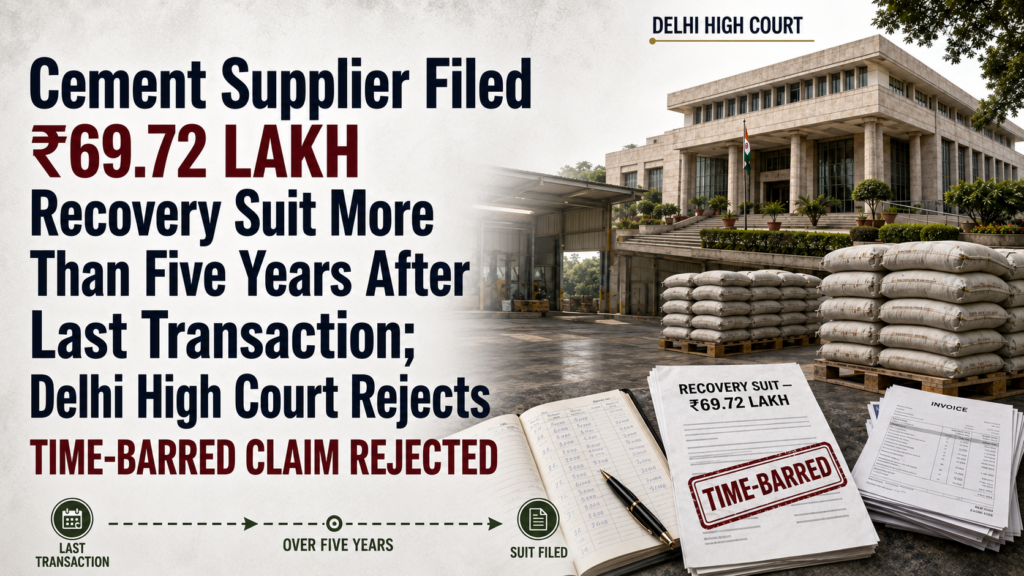
Buyer’s Reply Denying Liability Cannot Restart Limitation for Old Supply Dues: Delhi High Court
Facts
Prism Johnson Limited, formerly known as Prism Cement Limited, manufactures and supplies cement, ready-mix concrete, tiles, sanitaryware and related products.
Master Nihal Singh Memorial Education Society approached Prism Johnson for the supply of different grades of ready-mix concrete for construction of a school in Sector 43, Gurugram.
The Society issued a purchase order dated March 2, 2017. It provided for:
- Supply according to the project’s site requirements.
- Weekly billing.
- A credit period of 60 days for payment.
Prism Johnson supplied the concrete and maintained a running account in the Society’s name. It claimed that every delivery complied with the agreed specifications and was accepted without any contemporaneous complaint.
The Society disputed this account. It alleged that much of the supplied material was substandard and rejected at the site. It also claimed that Prism Johnson failed to provide the requested laboratory test reports.
Prism Johnson claimed that ₹69,72,422 remained outstanding, together with contractual interest at 18% per annum from the respective due dates.
The Society asserted that it had paid for all acceptable material. It relied upon:
- A payment of ₹21,19,596 made on March 6, 2018.
- A further payment of ₹8 lakh made on February 24, 2021.
According to the Society, these payments constituted full and final settlement. Prism Johnson’s running account showed March 6, 2018, as the last transaction relating to the supplies.
On December 18, 2021, Prism Johnson issued a legal notice demanding payment. The Society replied on December 30, 2021, denying liability and alleging that the goods were inferior, several lots had been rejected and the amounts already paid represented complete settlement.
Prism Johnson initiated mandatory pre-institution mediation under Section 12A of the Commercial Courts Act on December 21, 2021. The Society did not participate, and a Non-Starter Report was issued on February 14, 2022.
The company filed its commercial recovery suit electronically on October 13, 2023.
The Society filed an application under Order VII Rule 11 of the Code of Civil Procedure, arguing that the suit was barred by limitation.
On April 19, 2024, the Commercial Court allowed the application and rejected Prism Johnson’s plaint as time-barred. The company challenged that decision before the Delhi High Court.
Issues
- Whether the suit could be rejected under Order VII Rule 11(d) solely from the dates stated in the plaint and accompanying documents.
- Whether limitation was governed by Article 15 of the Limitation Act, applicable to goods sold on a fixed credit period.
- Whether the limitation period began after expiry of the 60-day credit period for each supply.
- Whether non-payment under a running account constituted a continuing wrong or separate recurring causes of action.
- Whether the legal notice dated December 18, 2021, created a fresh cause of action.
- Whether the Society’s reply dated December 30, 2021, amounted to acknowledgment of liability under Section 18 of the Limitation Act.
- Whether the Supreme Court’s COVID-19 limitation-extension orders brought the suit within time.
- Whether the pre-institution mediation period provided an additional exclusion.
- Whether the trial court violated natural justice by deciding the rejection application without allowing Prism Johnson to file a reply.
- Whether any procedural irregularity caused prejudice warranting remand.
Petitioner’s Arguments
Prism Johnson argued that the suit was not barred because the cause of action arose only on December 30, 2021, when the Society replied to the legal notice and expressly refused to pay.
Until that reply, there had allegedly been no categorical denial of liability. The company therefore contended that limitation should run from the date of refusal.
It argued that supplies were made under a running account. The outstanding debit continued from day to day, giving rise to a continuing cause of action so long as payment remained unpaid.
Prism Johnson also relied upon the Supreme Court’s COVID-19 limitation orders, which excluded the period from March 15, 2020, to February 28, 2022. According to it, exclusion of this period brought the October 2023 suit within limitation.
The company submitted that limitation ordinarily involves a mixed question of fact and law. Relying on Shakti Bhog Food Industries Ltd. v. Central Bank of India, it argued that the issue should have been determined after trial rather than through rejection of the plaint.
It further complained that the Commercial Court decided the Order VII Rule 11 application on the day it was listed without giving Prism Johnson an opportunity to file a written reply. It sought remand on the ground of violation of natural justice.
Respondent’s Arguments
The Society argued that Article 15 of the Limitation Act directly governed the claim because the parties had agreed to a fixed 60-day credit period.
Limitation began when the credit period attached to each delivery expired. It did not depend upon a subsequent demand or express refusal.
According to the Society, the last relevant supply transaction was reflected in the running account on March 6, 2018. Even giving Prism Johnson the benefit of a 60-day credit period, the final cause of action arose by May 5, 2018.
The normal three-year limitation period therefore expired on May 5, 2021.
The Society rejected the continuing-wrong argument. It submitted that failure to pay an ascertained debt is a completed breach. The financial loss may continue, but the wrongful act does not repeat every day.
It further argued that a unilateral legal notice issued years later could not restart limitation. Its reply was not an acknowledgment because:
- It was issued after limitation had expired.
- It denied that any debt remained payable.
- It asserted that the account had been fully settled.
Even after applying the Supreme Court’s pandemic orders, Prism Johnson was required to file the suit by the end of May 2022. The October 2023 suit remained substantially delayed.
Analysis of the Law
Rejection of a time-barred plaint
Order VII Rule 11(d) requires rejection of a plaint where the suit appears from the plaint itself to be barred by law.
For this purpose, the Court examines:
- The plaint as a whole.
- Documents filed with the plaint.
- The plaintiff’s own chronology.
The defendant’s written statement or disputed defence is irrelevant.
Although limitation is ordinarily a mixed question of fact and law, a trial is unnecessary where the plaintiff’s own pleadings disclose clear and undisputed dates establishing the bar.
Article 15 of the Limitation Act
Article 15 provides a three-year limitation period for recovering the price of goods sold and delivered where payment is due after expiry of a fixed credit period.
Time begins when the agreed credit period expires.
The purchase order provided for weekly billing and 60 days’ credit. Therefore, every supply generated its own cause of action when payment remained unpaid after 60 days.
The seller did not have to wait for:
- A formal demand.
- A legal notice.
- An express refusal.
- Termination of the running account.
The bundle of facts necessary to sue was complete on the 61st day following the relevant supply or invoice.
Continuing and recurring causes of action
A continuing wrong is a wrongful act that itself continues from day to day.
A recurring wrong occurs separately at different intervals, with each occurrence creating an independent cause of action.
Non-payment of an invoice is complete when the payment deadline expires. What continues afterward is the consequence—the creditor remains unpaid—not the breach itself.
A running account does not convert separate defaults into one perpetual cause of action.
Effect of a legal notice
Once limitation begins, the creditor cannot unilaterally postpone or restart it by waiting and later issuing a legal notice.
If a later notice could revive an old debt, plaintiffs could indefinitely control the limitation period, defeating the purpose of the Limitation Act.
Section 9 reinforces this principle: once time begins to run, a subsequent disability or inability does not stop it.
Acknowledgment under Section 18
For a fresh limitation period under Section 18, the acknowledgment must:
- Relate to a subsisting liability.
- Be in writing.
- Be signed by the party against whom the claim is made.
- Be made before the original limitation period expires.
An acknowledgment after expiry cannot revive a barred claim.
The Society’s December 30, 2021 reply was issued after May 5, 2021. Moreover, it denied that anything remained due and claimed full settlement. It therefore lacked an intention to acknowledge a debtor-creditor relationship.
COVID-19 exclusion
The Supreme Court excluded March 15, 2020, to February 28, 2022, when computing limitation.
Where the remaining period available on March 1, 2022, was less than 90 days, litigants received 90 days from that date.
Even applying the orders in the manner most favourable to Prism Johnson, it had to file the suit by the end of May 2022. The suit filed on October 13, 2023, remained about 17 months late.
Pre-institution mediation
Section 12A(3) of the Commercial Courts Act excludes the period spent in pre-institution mediation.
Here, the mediation period from December 21, 2021, to February 14, 2022, was already within the COVID-19 exclusion period.
The same period could not be excluded twice.
Procedural irregularity and prejudice
Failure to permit a written reply does not automatically invalidate a decision.
An Order VII Rule 11(d) application is determined from the plaint and its accompanying documents. A reply could not change the dates disclosed in Prism Johnson’s own pleadings.
The company was also fully heard by the High Court and did not identify any additional material capable of altering the limitation calculation. A remand would therefore have been an empty formality.
Precedent Analysis
Shakti Bhog Food Industries Ltd. v. Central Bank of India, (2020) 17 SCC 260
The Supreme Court held that limitation may involve a mixed question of fact and law where the date on which the right to sue accrued requires evidence.
The Delhi High Court distinguished that case because it involved a claim governed by the residuary Article 113, where no objective contractual trigger existed.
Here, Article 15 and the agreed 60-day credit period fixed the starting point. No evidentiary inquiry was needed.
Saleem Bhai v. State of Maharashtra, (2003) 1 SCC 557
The Supreme Court held that an application under Order VII Rule 11 must be decided from the plaint and documents filed with it. The defendant’s written statement is irrelevant.
This supported the Commercial Court’s reliance on Prism Johnson’s own dates.
Dahiben v. Arvindbhai Kalyanji Bhanusali, (2020) 7 SCC 366
The Supreme Court held that the plaint must be read meaningfully and as a whole. Courts may reject cleverly drafted claims where the legal bar is apparent.
The High Court found that the undisputed chronology made the limitation bar manifest.
Raghwendra Sharan Singh v. Ram Prasanna Singh, (2020) 16 SCC 601
This decision confirms that a court need not put parties through a trial where the plaint itself reveals an unavoidable legal bar.
Union of India v. Tarsem Singh, (2008) 8 SCC 648
The Supreme Court distinguished a continuing wrong from recurring or successive wrongs. A continuing wrong involves one wrongful act causing continuing injury, while recurring wrongs arise separately and periodically.
The unpaid invoices created separate causes of action rather than one indefinitely continuing claim.
Balakrishna Savalram Pujari Waghmare v. Shree Dhyaneshwar Maharaj Sansthan, AIR 1959 SC 798
The Supreme Court distinguished continuation of the wrongful act from continuation of its effects.
The failure to pay became complete when payment fell due. Prism Johnson’s continued financial loss was only the effect of that completed breach.
M.R. Gupta v. Union of India, (1995) 5 SCC 628
The Supreme Court treated incorrect monthly salary payments as recurring causes of action. Each deficient payment created a new violation, but older claims remained subject to limitation.
This supported treating each unpaid invoice separately.
J.M. Construction Pvt. Ltd. v. Krishna Sachdev
The Delhi High Court held that repeated legal notices do not extend limitation. Once a suit becomes time-barred, neither a later notice nor an admission made after expiry can revive it under Section 18.
Fortune Builders (P) Ltd. v. Blue Star Ltd., 2022 SCC OnLine Del 975
In that case, the notice and reply marked the breaking point in an unfinished and continuing project where the dispute had not previously crystallised.
The High Court distinguished it because Prism Johnson’s supplies had ended, invoices had been raised, credit periods had expired and the debt had already become actionable.
Greatech Fashions v. S.K. Industries, Regular First Appeal (Commercial) 323/2025
A Division Bench held that limitation can be extended only through circumstances recognised by statute, such as a timely written acknowledgment or qualifying part payment.
Issuing a legal notice does not commence a fresh limitation period.
Khan Bahadur Shapoor Fredoom Mazda v. Durga Prasad Chamaria, AIR 1961 SC 1236
The Supreme Court held that an acknowledgment must indicate a present, subsisting liability and an intention to admit the debtor-creditor relationship.
The Society’s reply denied the debt at its root and therefore did not amount to acknowledgment.
In Re: Cognizance for Extension of Limitation
The Supreme Court’s pandemic orders excluded the specified COVID-19 period and provided at least 90 days from March 1, 2022, where the remaining limitation was shorter.
Even with this benefit, Prism Johnson’s filing in October 2023 was late.
Court’s Reasoning
The purchase order expressly fixed weekly billing and a 60-day credit period. Article 15 therefore applied directly.
The cause of action for each supply arose when its credit period expired. The final pleaded transaction relating to supplies was dated March 6, 2018, making May 5, 2018, the latest possible date for accrual.
The normal limitation period expired on May 5, 2021.
Maintaining a running account did not preserve the claim indefinitely. Each default was complete upon expiry of its payment period.
The legal notice of December 18, 2021, merely repeated an existing demand. It did not crystallise a new dispute or restart limitation.
The reply dated December 30, 2021, was neither timely nor an acknowledgment. It asserted defective supplies, rejection of goods and full settlement.
Even after granting the complete benefit of the COVID-19 orders, the suit had to be filed by the end of May 2022. Pre-institution mediation did not provide an additional period because it fell entirely within the already excluded pandemic window.
Finally, Prism Johnson suffered no demonstrated prejudice from the trial court deciding the rejection application without its written reply. All relevant dates came from its own plaint, and it received a full hearing before the High Court.
Conclusion
The Delhi High Court held that Prism Johnson’s recovery suit was clearly barred by limitation.
Every invoice became actionable after the agreed 60-day credit period. Non-payment under the running account created separate recurring causes of action and not a continuing wrong.
Neither the December 2021 legal notice nor the Society’s reply restarted limitation. The reply was also not an acknowledgment under Section 18 because it was issued after expiry and denied the alleged debt.
Even after applying the COVID-19 exclusion and pre-institution mediation provisions, the suit should have been filed by the end of May 2022. It was filed only on October 13, 2023.
The appeal was dismissed, and the Commercial Court’s order rejecting the plaint under Order VII Rule 11(d) was upheld.
Case Details
Case: M/s Prism Johnson Limited v. M/s Master Nihal Singh Memorial Education Society
Court: High Court of Delhi at New Delhi
Case Number: Regular First Appeal (Commercial) 383/2024
Judge: Justice Anil Kshetarpal and Justice Amit Mahajan
Date: July 16, 2026
Result: Appeal dismissed; rejection of the ₹69,72,422 recovery suit as barred by limitation upheld.