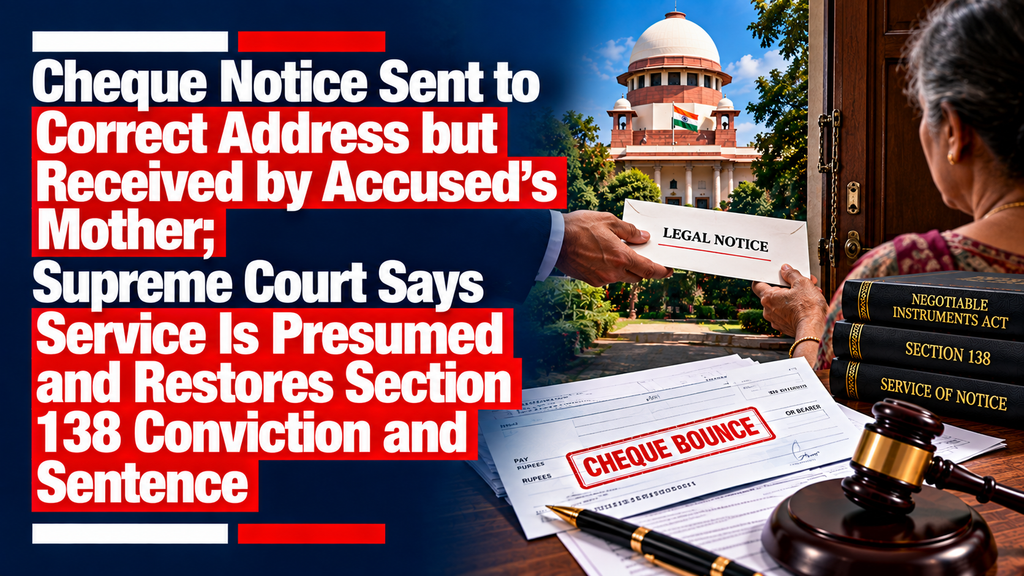
Cheque Notice Sent to Correct Address but Received by Accused’s Mother; Supreme Court Says Service Is Presumed and Restores Section 138 Conviction and Sentence

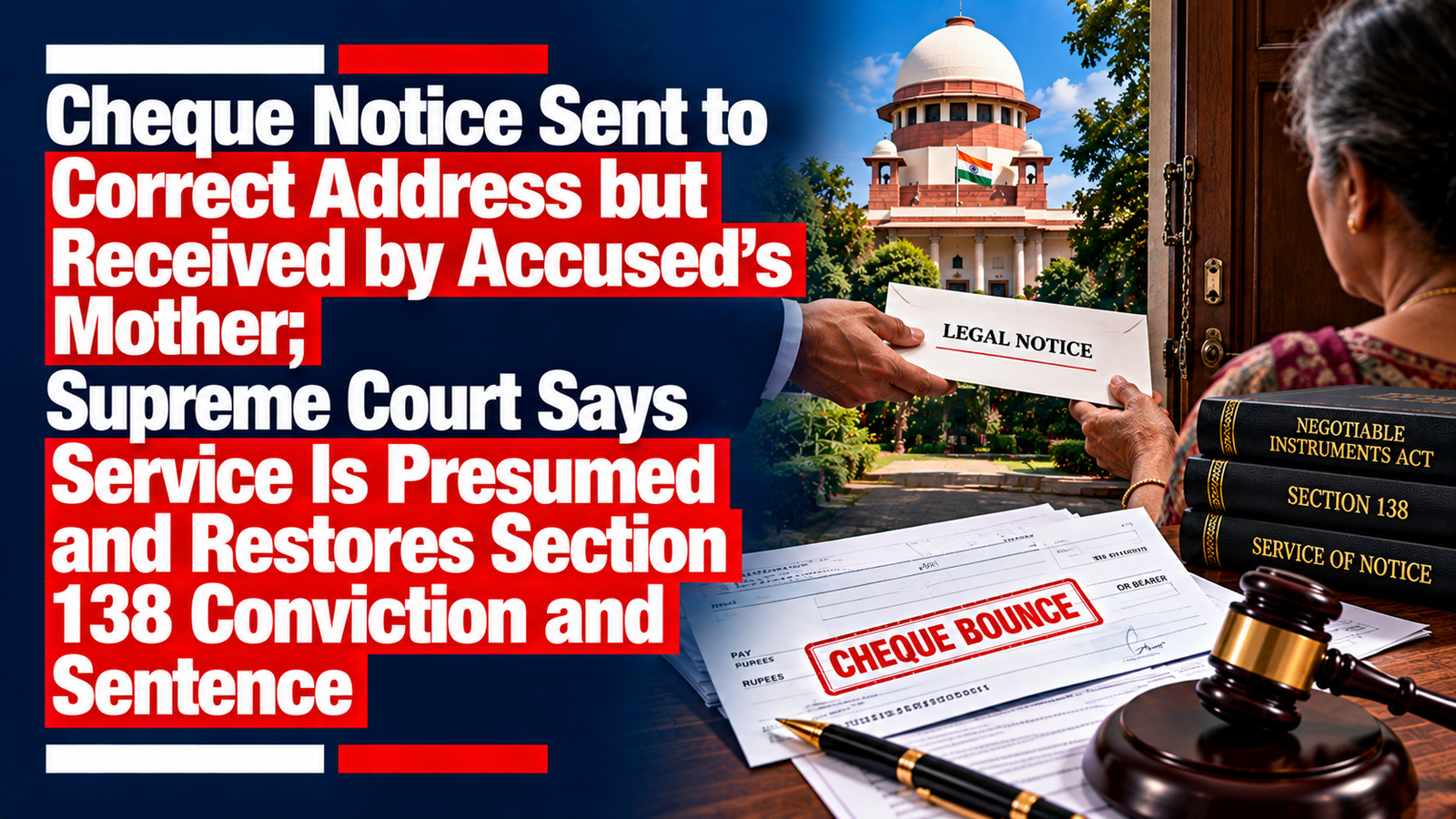
Kerala High Court Acquits Accused Because Mother Received Demand Notice; Supreme Court Reverses and Says Burden Was Wrongly Shifted to Complainant
Facts
Sainaba alleged that Respondent No. 2 had borrowed ₹3 lakh from her. Towards repayment, he issued Cheque No. 479097 drawn on Catholic Syrian Bank, Perumbavoor Branch. The cheque was dishonoured when presented. SAINABA
Sainaba thereafter issued a statutory demand notice dated 31 August 2016 by registered post to the accused’s correct address. The notice was received by his mother, who resided at that address. No payment was made and no reply was sent. SAINABA
The Trial Court convicted the accused under Section 138 of the Negotiable Instruments Act, 1881, sentencing him to six months’ simple imprisonment and a fine of ₹3 lakh. It held that sending the notice to the accused’s correct address satisfied the statutory requirement. SAINABA
The Sessions Court affirmed the conviction, observing that the accused never disputed the address and that his mother had received the demand notice there. SAINABA
However, the Kerala High Court allowed the accused’s revision and set aside the conviction. It reasoned that because the notice was received by the mother, there had to be evidence establishing that the accused himself was aware of it. SAINABA
Sainaba appealed to the Supreme Court.
Issue
The central question was:
Does the statutory requirement under proviso (b) to Section 138 NI Act stand satisfied when the demand notice is correctly addressed and sent by registered post to the cheque drawer, but is actually received by a family member residing at that address?
The connected question was who bears the burden of proving or disproving service once the notice is correctly addressed and dispatched.
Appellant’s Arguments
Sainaba relied principally upon C.C. Alavi Haji v. Palapetty Muhammed, D. Vinod Shivappa v. Nanda Belliappa, Madan & Co. v. Wazir Jaivir Chand and Subodh S. Salaskar v. Jayprakash M. Shah.
Her case was that dispatch of a registered notice to the correct address raises a statutory presumption of service under Section 27 of the General Clauses Act, 1897 and Section 114 of the Evidence Act, 1872. SAINABA
Once the notice was shown to have been correctly addressed, it was not for the complainant to separately prove that the drawer personally received or actually read it.
The accused had never challenged the correctness of the address. Indeed, summons from the Trial Court sent to the same address had successfully resulted in his appearance. SAINABA
Supreme Court on “Giving” and “Receiving” Notice
The Supreme Court reiterated the distinction between “giving of notice” and “receipt of notice.”
Section 138 requires the payee to make a demand by giving written notice to the drawer within the prescribed period. But the law does not permit a drawer to frustrate prosecution merely by avoiding personal receipt.
Under Section 27 of the General Clauses Act, where a document is properly addressed, prepaid and dispatched by registered post, service is deemed to have been effected in the ordinary course unless the contrary is proved. SAINABA
Correct Address Creates a Rebuttable Presumption
The Court reaffirmed C.C. Alavi Haji.
Where the complainant dispatches the demand notice by registered post to the correct address of the cheque drawer, the mandatory requirement of giving notice under Section 138 stands complied with.
The complainant does not additionally have to prove that the drawer deliberately avoided service or actually knew about the notice.
Instead, the burden shifts to the drawer to rebut the presumption by establishing circumstances such as:
- the address was incorrect;
- the letter was never tendered;
- the postal endorsement was wrong; or
- he genuinely had no knowledge that the notice had reached his address. SAINABA
The Supreme Court summarised the position by holding that there exists a rebuttable presumption of valid service whenever the Section 138 notice is dispatched by registered post to the drawer’s correct address. SAINABA
Receipt by Mother Does Not Defeat Service
The Supreme Court rejected the proposition that receipt by a family member automatically invalidates service.
It reasoned that an anomalous situation would otherwise arise: a notice that is returned “unclaimed” could attract deemed service, while a notice that is actually delivered at the drawer’s residence but accepted by his wife, mother or another family member would not.
The Court held that where the notice is correctly addressed, the statutory presumption applies irrespective of the identity of the person who physically receives it, subject of course to the drawer’s right to rebut that presumption. SAINABA
M.D. Thomas Declared Per Incuriam
An important part of the judgment concerns M.D. Thomas v. P.S. Jaleel, (2009) 14 SCC 398.
In M.D. Thomas, a Division Bench had set aside a Section 138 conviction because the statutory notice had been served upon the drawer’s wife rather than personally upon the drawer.
The Supreme Court in Sainaba held that M.D. Thomas had failed to consider the binding three-Judge Bench decision in C.C. Alavi Haji and other earlier authorities.
Accordingly, the Court expressly declared:
M.D. Thomas is per incuriam and cannot be treated as binding precedent under Article 141 of the Constitution. SAINABA SAINABA
Why the Presumption Was Not Rebutted Here
The evidence strongly established that the notice had been sent to the accused’s correct residential address.
The same address appeared in:
the statutory demand notice;
the accused’s vakalatnama;
his appeal;
his revision petition; and
the summons pursuant to which he actually appeared before the Trial Court.
The accused also never disputed the correctness of the address during his Section 313 CrPC examination. Nor did he claim that he and his mother lived separately or had an inimical relationship. SAINABA
The presumption of valid service therefore remained unrebutted.
Kerala High Court Wrongly Shifted the Burden
The Supreme Court found a fundamental error in the Kerala High Court’s approach.
The High Court had effectively required Sainaba to prove that the accused actually knew that his mother had received the notice.
According to the Supreme Court, that reversed the statutory burden.
Once correct addressing and dispatch were established, it was for the accused to rebut the resulting presumption—not for the complainant to independently establish the accused’s actual knowledge. SAINABA
Court’s Reasoning
The Court emphasised the practical purpose behind the rule.
If actual personal receipt were indispensable, a dishonest cheque drawer could escape Section 138 simply by ensuring that someone else at his residence accepts the registered article or by deliberately avoiding receipt.
The statutory scheme does not permit such avoidance.
At the same time, the presumption is rebuttable, protecting a genuine drawer who can establish that the notice did not actually reach his address or that he had no knowledge of its delivery for reasons not attributable to him.
Thus, the rule balances the complainant’s right to effective enforcement with the drawer’s opportunity to establish genuine non-service.
Conclusion
The Supreme Court held that once Sainaba dispatched the statutory demand notice by registered post to the accused’s correct address, the requirement of “giving of notice” under proviso (b) to Section 138 NI Act stood satisfied.
Since the accused failed to prove that the address was incorrect, that he was unaware of delivery, or that he and his mother lived separately or had an inimical relationship, the statutory presumption remained unrebutted. SAINABA
The Supreme Court therefore allowed Sainaba’s appeal, set aside the Kerala High Court judgment and restored the Trial Court’s conviction and sentence of six months’ simple imprisonment with a fine of ₹3 lakh. SAINABA
Case Details
Case: Sainaba v. State of Kerala & Anr.
Citation: 2026 INSC 1069
Court: Supreme Court of India SAINABA
Proceeding: Criminal Appeal arising out of SLP (Crl.) No. 17180 of 2025
Bench: Justice Ahsanuddin Amanullah and Justice Manmohan
Judgment authored by: Justice Manmohan SAINABA
Date: 30 September 2026
Key provisions: Section 138 Negotiable Instruments Act, 1881; Section 27 General Clauses Act, 1897; Section 114 Evidence Act, 1872
Result: Appeal allowed; Kerala High Court judgment set aside; conviction and sentence of six months’ simple imprisonment and ₹3 lakh fine restored