Company Recorded ₹24.3 Crore ROCPS Principal and ₹38.2 Crore Returns but Cited Lender Restrictions; Bombay High Court Refuses Full ₹79.77 Crore Security, Orders Asset Disclosures

Investor Sought ₹79.77 Crore Security for Unredeemed Preference Shares; Bombay High Court Grants Limited Protection and Orders Financial Disclosures
Facts
On 10 November 2017, a Share Purchase Agreement was executed for the acquisition of Sage Metals Limited at an enterprise value of approximately ₹470 crore.
The acquiring entity agreed to purchase 90% of Sage’s shares, while the petitioner, Ramakrishnan Krishnan, continued to hold the remaining 10%. Unlike the other shareholders, a substantial portion of the petitioner’s sale consideration was deferred and structured through Redeemable Optionally Convertible Preference Shares, or ROCPS.
Gluhend India Private Limited was subsequently incorporated as the acquisition vehicle and assumed the purchaser’s obligations. Under successive Framework Agreements, the petitioner was to receive:
- Equity shares representing 10% of Gluhend India’s fully diluted share capital;
- ROCPS representing the deferred consideration;
- Annual returns at 15%, compounded annually;
- A minimum annual payment of ₹5 crore with accrued returns; and
- Complete redemption of the ROCPS by 30 June 2024.
After restructuring, the petitioner held 2,43,33,349 Final ROCPS. Clause 3.3.6 of the Third Framework Agreement required the other shareholders to arrange funds or purchase the ROCPS if Gluhend India lacked sufficient funds. However, this clause was expressly made subject to Clause 3.5, which required compliance with the Financing Documents and prior lender approval.
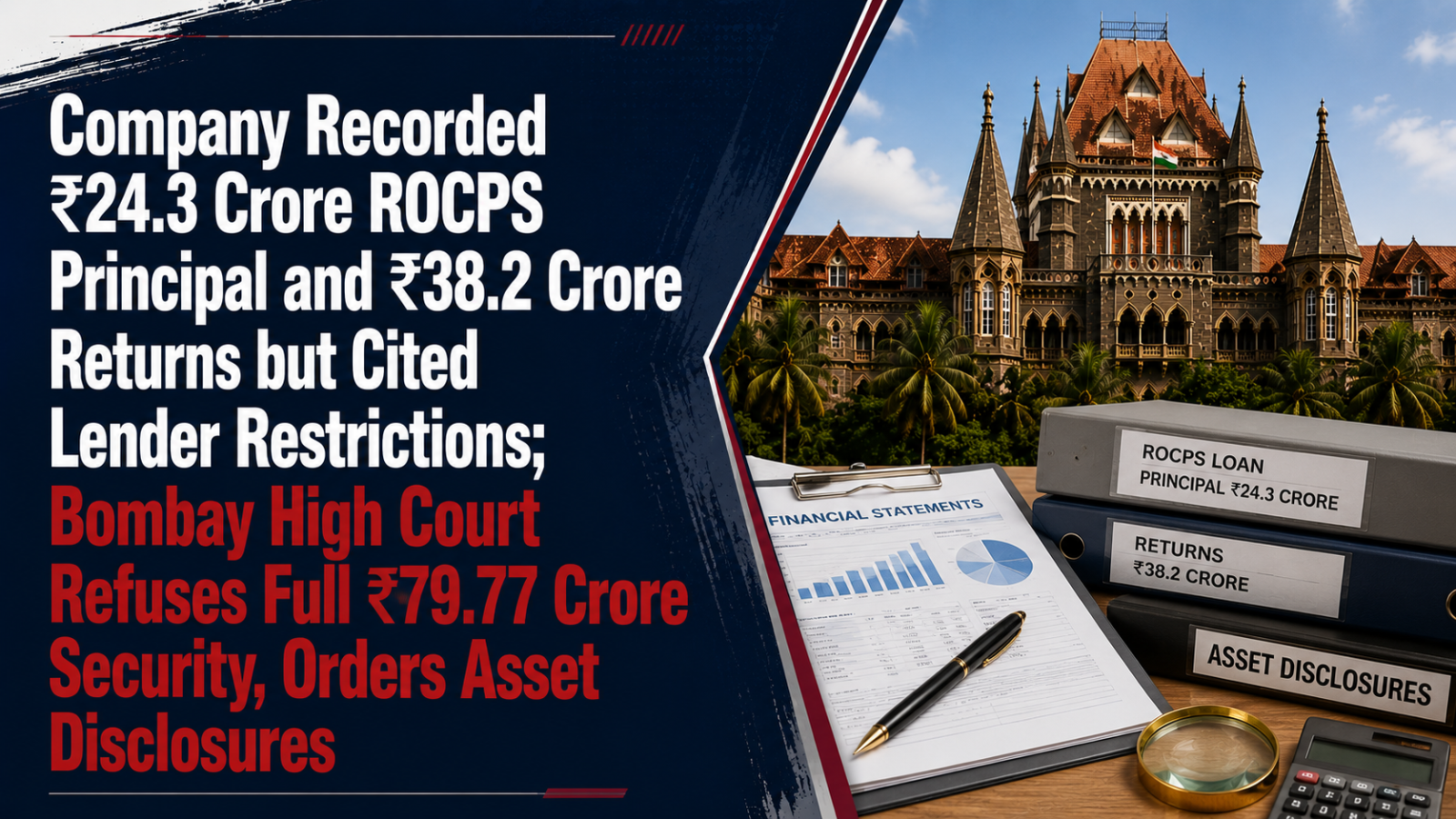
On 20 August 2024, Gluhend India recorded approximately ₹24.3 crore as the outstanding ROCPS principal and approximately ₹38.2 crore as accrued returns up to June 2024.
The respondents did not make payment. They relied upon lender restrictions, absence of lender approval and Section 55 of the Companies Act, 2013, contending that ROCPS could not be redeemed without distributable profits or a fresh issue of shares.
The petitioner invoked arbitration and approached the Bombay High Court under Section 9 of the Arbitration and Conciliation Act, seeking interim protection for a claim of approximately ₹79.77 crore.
Issues
- Whether the petitioner’s rights under Clause 3.3 became immediately enforceable upon expiry of the redemption period on 30 June 2024.
- Whether Clause 3.5 and the Financing Documents merely regulated the manner of payment or prevented the liability from arising altogether.
- Whether the absence of lender approval extinguished or only postponed the respondents’ contractual obligations.
- Whether redemption of the ROCPS was prohibited by Section 55 of the Companies Act, 2013.
- Whether the ROCPS became a debt after expiry of the redemption date.
- Whether classifying the ROCPS as “borrowings” or “financial liabilities” in the balance sheets amounted to an admission of debt.
- Whether the Agreed Annual Return and Agreed Special Return were independent contractual obligations or returns attached to the preference shares.
- Whether financial difficulties, lender restrictions and the proposed sale of shareholding justified interim protection under Section 9.
- Whether previous proceedings before an Emergency Arbitrator affected the High Court’s jurisdiction under Section 9.
Petitioner’s Arguments
- The Third Framework Agreement created binding obligations to redeem the Final ROCPS and pay the Agreed Annual Return and Agreed Special Return.
- Clause 3.3.6 imposed an independent obligation upon US HoldCo either to arrange funds for Gluhend India or purchase the ROCPS itself if Gluhend India lacked funds.
- The respondents repeatedly acknowledged the petitioner’s entitlement and explained that payment could not be made because of lender restrictions and insufficient funds.
- The email dated 20 August 2024 expressly recorded approximately ₹24.3 crore as principal and ₹38.2 crore as accrued returns.
- The respondents’ financial statements classified the ROCPS as borrowings or financial liabilities. This supported the petitioner’s contention that the liability was financial in nature.
- Section 55 of the Companies Act did not apply because the respondents had themselves treated the instrument as a borrowing.
- Alternatively, even if Section 55 governed redemption of the ROCPS, it did not prohibit enforcement of the separate contractual promises relating to annual and special returns.
- The respondents’ financial position had continuously weakened, their liabilities had increased and lender approval remained unavailable.
- Unless protective directions were granted, the petitioner faced a real risk that any eventual arbitral award would become difficult or impossible to enforce.
Respondents’ Arguments
- The petitioner incorrectly assumed that every amount became automatically payable on 30 June 2024.
- Clause 3.3.6 expressly began with the words “Subject to Clause 3.5 below.” Therefore, all redemption and payment obligations were conditional upon lender approval and compliance with the Financing Documents.
- The Board had not approved payment, the lenders had refused consent and the Final Settlement Date had not occurred.
- The respondents could not be directed to breach express restrictions contained in the Debenture Trust Deed and facility agreements.
- Section 55 permitted redemption of preference shares only out of distributable profits or proceeds of a fresh issue made for redemption.
- Gluhend India had accumulated substantial losses, possessed no distributable profits and had not undertaken any fresh issue for redemption.
- The ROCPS remained preference share capital and did not become a loan merely because the redemption date had expired.
- Accounting classification under Ind AS could not change the legal character of the ROCPS or override the Companies Act.
- The annual and special returns were connected with the ROCPS and were therefore subject to Sections 55 and 123 of the Companies Act.
- There was no presently enforceable or crystallised debt. Directing a deposit of approximately ₹79.77 crore would effectively grant the petitioner final relief before arbitration.
- The petitioner produced no evidence of asset diversion, fraudulent transfers or an intention to defeat the arbitral award.
- Mere financial stress could not justify freezing the assets of a functioning company.
- The delay between the redemption date, legal notice and Section 9 proceedings showed absence of urgency.
- The petitioner had already pursued proceedings before an Emergency Arbitrator under the SIAC Rules.
Analysis of the Law
Contractual rights and lender approval
The Court held that the Third Framework Agreement had to be read as a whole. Clause 3.3 could not be interpreted without considering Clause 3.5 and the Financing Documents.
However, the words “subject to Clause 3.5” did not mean that no contractual obligation existed until lender approval was obtained. The Court drew a distinction between:
- The existence of a contractual obligation; and
- The stage and manner in which that obligation becomes enforceable.
Clause 3.3 created substantive rights in favour of the petitioner, while Clause 3.5 regulated how those rights could be performed. Therefore, absence of lender approval could delay or restrict payment but did not automatically wipe out the petitioner’s contractual entitlement.
Section 55 of the Companies Act
The Court held that redemption of the Final ROCPS remained governed by Section 55 of the Companies Act.
Preference shares could be redeemed only from:
- Profits available for payment of dividend; or
- Proceeds of a fresh issue of shares made for that purpose.
The mere expiry of the redemption date did not convert the preference shareholder into a creditor or transform the ROCPS into an ordinary recoverable debt.
Effect of accounting entries
The classification of the ROCPS as borrowings or financial liabilities in the audited accounts was not conclusive.
Accounting entries could possess limited evidentiary value and might indicate how the company recorded or understood the transaction. However, they could not override:
- The statutory requirements of the Companies Act;
- The legal nature of preference share capital; or
- The contractual terms governing the parties.
Nature of annual and special returns
The Court found that the Agreed Annual Return and Agreed Special Return occupied a composite or intermediate position.
They could not be treated entirely as:
- Dividends governed only by the Companies Act; or
- Independent debt obligations wholly disconnected from the ROCPS.
Their source was the Third Framework Agreement, but that agreement was itself structured around the Final ROCPS. Their final character and enforceability were therefore left for determination by the Arbitral Tribunal.
Scope of Section 9
Section 9 is intended to ensure that arbitration does not become ineffective before an award can be enforced.
Although the powers under Section 9 are wider than attachment before judgment under Order XXXVIII Rule 5 CPC, interim protection cannot be granted merely because:
- A monetary claim exists;
- The amount involved is substantial;
- Arbitration is pending; or
- The respondent is experiencing financial difficulties.
There must be material showing a reasonable or strong possibility that the eventual award may become ineffective.
At the same time, absolute proof of dishonest intention or completed dissipation is not required. The Court may act before the assets are completely transferred if the surrounding circumstances demonstrate a genuine risk.
Emergency arbitration and delay
The availability or previous use of an Emergency Arbitrator did not remove the High Court’s jurisdiction under Section 9. However, the nature of those proceedings and the relief considered by the Emergency Arbitrator remained relevant to the High Court’s discretionary assessment.
Similarly, delay did not automatically defeat the petition. Commercial parties must be allowed to negotiate before commencing proceedings. Nevertheless, delay remained relevant while considering urgency and the balance of convenience.
Precedent Analysis
- Nabha Power Ltd. v. Punjab State Power Corporation Ltd., (2018) 11 SCC 508
The Supreme Court held that a commercial contract must be read as a whole. The intention of the parties must ordinarily be gathered from the words used, and every clause should be harmoniously interpreted.
Applying this principle, the Bombay High Court read Clauses 3.3, 3.3.6 and 3.5 together. It held that Clause 3.3 created substantive rights, while Clause 3.5 regulated their performance through lender approvals and Financing Documents.
- Arnold v. Britton, (2015) AC 1619
This decision emphasised that contractual terms must ordinarily be given their natural and ordinary meaning. Courts should not rewrite a commercial agreement merely because its consequences appear commercially inconvenient.
The respondents relied upon this principle to contend that the words “subject to Clause 3.5” could not be ignored. The High Court accepted that Clause 3.5 was operative but refused to interpret it as destroying every obligation under Clause 3.3.
- EPC Constructions India Ltd. v. Matix Fertilizers and Chemicals Ltd., 2025 SCC OnLine SC 2293
The Supreme Court held that preference shares remain part of a company’s share capital and do not become a loan merely because the redemption date has expired.
A preference shareholder does not automatically become a creditor after non-redemption. Redemption remains subject to Section 55 of the Companies Act.
The Bombay High Court applied these principles and held that the petitioner could not treat the ROCPS as an unsecured loan or automatically recoverable debt. However, since EPC Constructions arose under the Insolvency and Bankruptcy Code, the Court left the separate contractual rights under the Third Framework Agreement open for arbitration.
- Lalchand Surana v. Hyderabad Vanaspathy Ltd., (1990) 68 Comp Cas 415 (AP)
This decision, approved in EPC Constructions, held that the holder of redeemable preference shares does not become a creditor merely because the company fails to redeem the shares on the agreed date.
The shareholder continues to hold preference share capital until redemption lawfully takes place in accordance with the Companies Act.
- J.K. Industries Ltd. v. Union of India, (2007) 13 SCC 673
The Supreme Court held that compliance with prescribed Accounting Standards is mandatory and intended to ensure that financial statements present a true and fair picture of the company’s affairs.
The petitioner relied upon this judgment because the ROCPS had been shown as borrowings in the respondents’ accounts.
The High Court clarified that mandatory accounting treatment does not alter substantive contractual or statutory rights. The accounts were relevant evidence but did not conclusively convert the ROCPS into debt.
- State Bank of India v. Commissioner of Income Tax, (1985) 4 SCC 585
This decision held that entries in books of account do not conclusively determine the true legal nature of a transaction.
The High Court applied this principle to hold that describing the ROCPS as borrowings in the balance sheets could not override their legal character as preference share capital.
- Union of India v. Association of Unified Telecom Service Providers of India, (2020) 3 SCC 525
The Supreme Court observed that accounting standards provide uniformity in maintaining accounts but cannot override contractual definitions or statutory provisions.
This supported the conclusion that Ind AS classification could not override Section 55 or the Third Framework Agreement.
- Raman Tech. & Process Engineering Co. v. Solanki Traders, (2008) 2 SCC 302
The Supreme Court cautioned that attachment before judgment cannot be granted merely because a monetary claim has been made. There must be material showing an intention to obstruct or delay execution.
The respondents relied upon this judgment to oppose the ₹79.77 crore security sought by the petitioner.
The High Court accepted that Section 9 could not be converted into a premature execution proceeding. It therefore refused the full relief but granted narrower protective directions.
- Essar House Pvt. Ltd. v. ArcelorMittal Nippon Steel India Ltd., (2022) 20 SCC 178
The Supreme Court held that the powers under Section 9 are wider than those under Order XXXVIII Rule 5 CPC. The principles of attachment before judgment may guide the Court but cannot restrict the statutory scope of Section 9.
The Court need not wait until the respondent has already disposed of all assets. Interim protection may be granted where the record shows a strong or reasonable possibility that enforcement of the award may be frustrated.
Applying this decision, the Bombay High Court found that there was no proof of actual siphoning or fraudulent asset transfers. Nevertheless, the respondents’ inability to redeem the ROCPS, dependence on lender approvals, financial constraints and the substantial claim made the petitioner’s apprehension genuine enough to justify limited protection.
Court’s Reasoning
- Clause 3.5 and the lender-approval requirement formed part of the contractual arrangement and could not be ignored.
- Nevertheless, absence of lender consent did not extinguish the petitioner’s substantive contractual rights under Clause 3.3.
- The correspondence recording ₹24.3 crore as principal and ₹38.2 crore as accrued returns could not be brushed aside, though it was not a final admission of legally enforceable debt.
- Redemption of the ROCPS remained subject to Section 55 of the Companies Act.
- Expiry of the redemption date did not convert the ROCPS into debt or make the petitioner a creditor.
- The accounting treatment was relevant but not conclusive.
- The character of the annual and special returns was arguable and required final adjudication by the Arbitral Tribunal.
- Financial stress and inability to pay were not equivalent to an intention to dissipate assets or defeat an award.
- No specific transaction showing siphoning, fraudulent transfer or alienation with dishonest intention was established.
- However, the admitted financial restrictions, absence of lender approval, substantial amount involved and proposed third-party sale process meant that the petitioner’s apprehension was not baseless.
- Granting the entire security sought could disrupt the respondents’ business and affect secured lenders.
- Refusing every protective measure could expose the petitioner to the risk of an ineffective arbitral award.
The Court therefore adopted a middle course by refusing full security but directing transparency, preservation of records and prior notice of extraordinary transactions.
Conclusion
The Commercial Arbitration Petition was partly allowed.
The Court declined the principal reliefs sought in prayer clauses (a) and (c), including the request for full security at this stage. However, it directed Respondent Nos. 1 and 2 to file an affidavit within four weeks disclosing:
- The assets and liabilities of Respondent No. 2;
- Existing charges and encumbrances;
- The status of the proposed third-party sale or transfer of Gluhend India’s shareholding;
- Steps taken to obtain lender consent for redemption of the Final ROCPS;
- Gluhend India’s audited financial statements and other financial records from March 2024 onwards; and
- Any material assets or shareholding transferred or encumbered outside the ordinary course of business after filing of the petition.
The respondents were further directed to:
- Maintain complete accounts of transactions concerning material assets and shareholding;
- Preserve all related records; and
- Give the petitioner at least two weeks’ prior written notice before undertaking any transaction outside the ordinary course of business that could materially reduce their asset base or defeat enforcement of a future arbitral award.
These protections will continue until four weeks after constitution of the Arbitral Tribunal or until an application under Section 17 is decided, whichever is earlier.
The Court imposed no costs and rejected the respondents’ request to stay the judgment.
Case Details
Case: Ramakrishnan Krishnan v. Gluhend India Private Limited & Anr.
Court: High Court of Judicature at Bombay, Ordinary Original Civil Jurisdiction, Commercial Division
Case Number: Commercial Arbitration Petition No. 766 of 2026
CNR Number: HCBM020159142026
Judge: Justice Amit Borkar
Reserved on: 15 July 2026
Pronounced on: 22 July 2026
Result: Petition partly allowed. Full security declined, but financial disclosures, preservation of records and prior notice of extraordinary asset-reducing transactions were ordered. Request for stay rejected; no order as to costs.