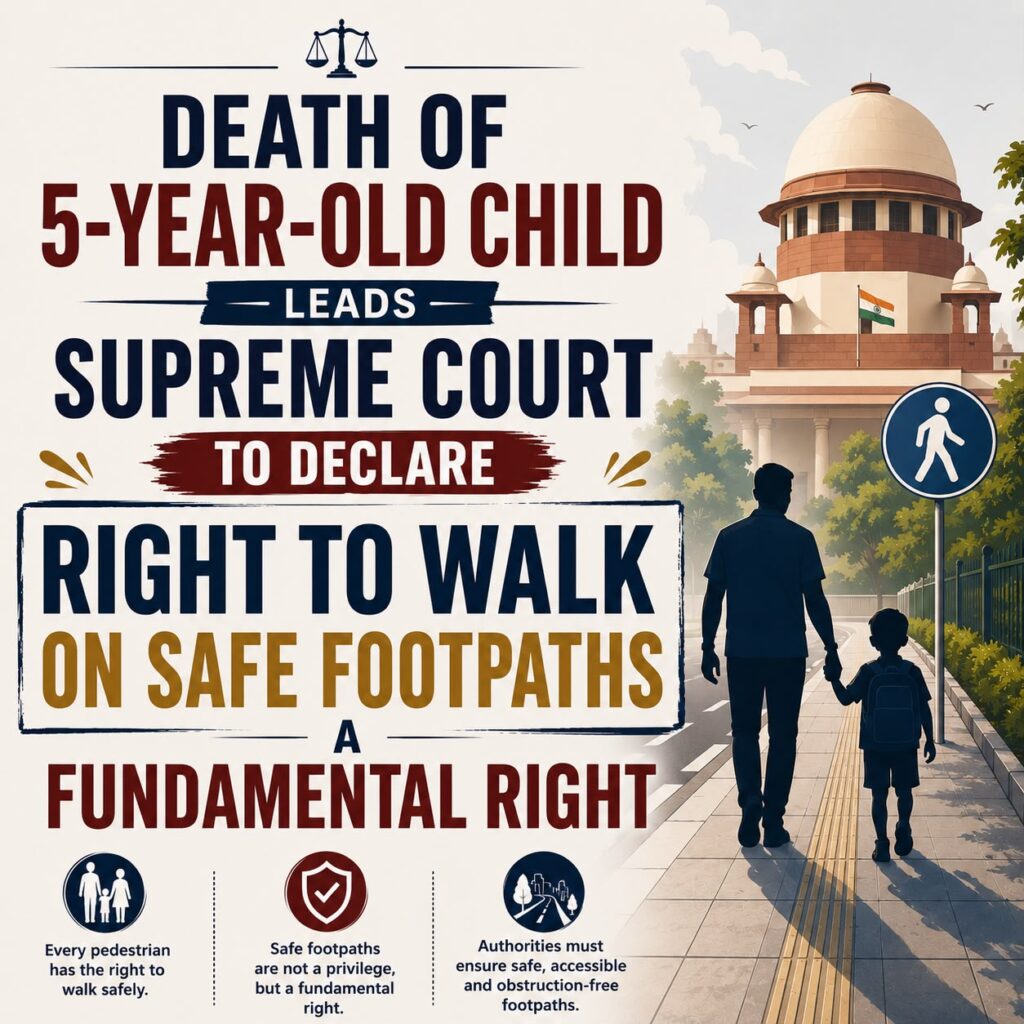
Death of 5-Year-Old Child Leads Supreme Court to Declare Right to Walk on Safe Footpaths a Fundamental Right

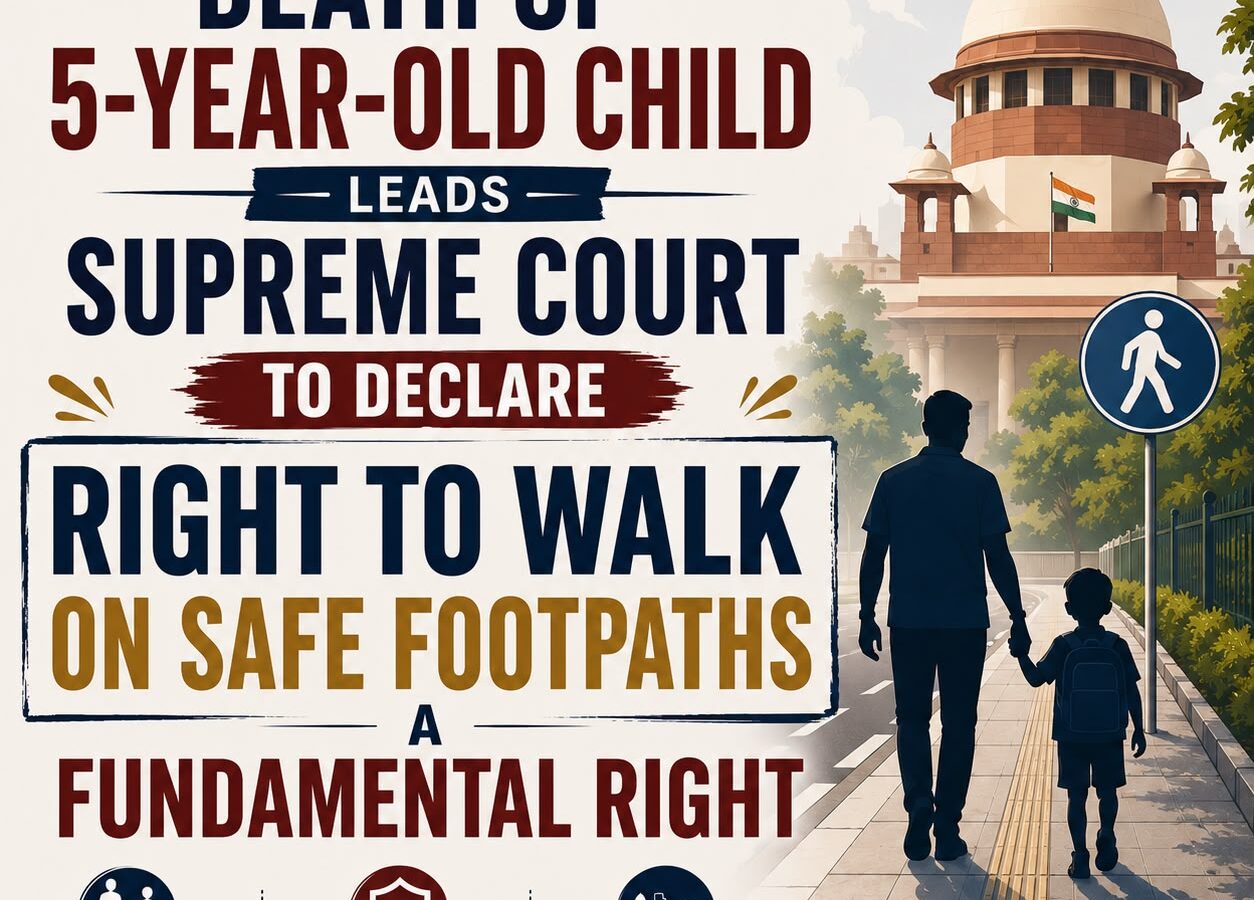
Municipal Bodies Must Construct and Protect Footpaths; Citizens Can Seek Compensation for Failure to Provide Safe Pedestrian Infrastructure
The Supreme Court has declared that the right to walk is a fundamental right guaranteed under Part III of the Constitution and includes the right to access safe, well-maintained and clearly demarcated footpaths.
A Bench comprising Justice Pamidighantam Sri Narasimha and Justice Atul S. Chandurkar held that the right to walk flows primarily from the freedom of movement guaranteed under Article 19(1)(d), read with the rights under Articles 19(1)(a), 19(1)(b), 19(1)(c) and Article 21.
The Court emphasised that the right of pedestrians to use demarcated footpaths is primary and must take precedence over the privilege of motorised vehicles.
It further held that urban development authorities, municipal corporations, municipalities and panchayats have an enforceable duty to construct, maintain and protect footpaths wherever roads exist.
The ruling arose from a motor accident compensation case involving the death of a five-year-old child who was struck by a tanker while walking to school with his father.
Five-Year-Old Child Killed While Walking to School
The child’s father had left home at approximately 9 am to walk him to a nearby school.
While the father and son were walking on the road, a tanker approached from behind and struck the child, crushing his lower body. The child subsequently died from his injuries.
The Court noted that the road had neither a footpath nor a pedestrian crossing.
The father approached the Motor Accident Claims Tribunal seeking compensation of ₹25 lakh.
The Tribunal awarded ₹7.82 lakh with interest at six per cent per annum. However, in appeals filed by the father and the insurance company, the High Court reduced the compensation to ₹4.70 lakh.
The matter thereafter reached the Supreme Court.
Right to Movement Is Not Limited to Motor Vehicles
The Supreme Court observed that the constitutional right to move freely throughout India has increasingly been understood through the lens of motorised travel.
The Court rejected this narrow approach.
It held that walking preceded movement on wheels and remains the most basic form of human mobility. Therefore, the primary right protected under Article 19(1)(d) is the right to walk.
The Court observed that roads and urban infrastructure had historically been designed to serve motor vehicles, frequently treating pedestrians as inconveniences rather than equal users of public spaces.
According to the Court, this approach had pushed pedestrians to the margins and allowed motor vehicles to dominate roads as well as spaces meant for walking.
The judgment declared that this position must change and that the constitutional rights of pedestrians must be expressly recognised and protected.
Footpaths Must Receive Priority Over Motorised Traffic
The Court held that the right to walk cannot remain meaningful unless citizens are provided with safe and properly demarcated footpaths.
Where a road exists, the concerned public authority has a corresponding duty to provide and maintain a footpath.
The judgment declared that the fundamental right to walk on a demarcated footpath overrides the privilege of motorised vehicles.
The Court explained that a wide, continuous and obstruction-free footpath could transform access to cities and towns by enabling citizens to walk safely without fear of being struck by vehicles.
Providing such infrastructure was described as the minimum duty owed by municipal authorities to the public.
Walking Also Protects Speech, Assembly and Association
The Court observed that walking is not merely physical movement.
It has historically played an important role in India’s cultural, religious, political and reformative traditions.
The judgment referred to public processions, pilgrimages, protest marches and social movements to explain how walking may also facilitate expression, peaceful assembly and association.
The Court therefore connected the right to walk with Articles 19(1)(a), 19(1)(b) and 19(1)(c), in addition to Articles 19(1)(d) and 21.
It stated that access to public spaces should not become the monopoly of the motorised population.
Municipalities and Panchayats Have an Enforceable Duty
The Court identified the public authorities responsible for protecting pedestrian rights.
These include:
- urban development authorities;
- municipal corporations;
- municipalities; and
- panchayats.
These bodies must endeavour to demarcate, construct, maintain and safeguard footpaths and other pedestrian infrastructure.
The Court held that this obligation is not merely advisory. It is a correlative and enforceable public duty arising from the fundamental right to walk.
Where authorities fail to provide safe pedestrian infrastructure, affected citizens can seek appropriate constitutional and civil remedies.
Independent Remedy Against Public Authorities
A significant aspect of the judgment is its recognition that violation of the right to walk may give rise to a remedy independent of the Motor Vehicles Act.
The Court held that citizens may invoke constitutional remedies and the provisions governing enforcement of public duties under the Specific Relief Act against municipal bodies and other responsible authorities.
Such remedies may include restitution and compensation.
This means that where a person suffers injury because a public authority failed to construct or maintain a footpath, the claim need not necessarily be confined to compensation from the driver, vehicle owner or insurer under the Motor Vehicles Act.
The concerned public authority may also be held accountable for failing to perform its constitutional duty.
Motor Vehicles Act Does Not Adequately Protect Pedestrian Rights
The Supreme Court observed that the Motor Vehicles Act, 1988, was primarily designed around the regulation of vehicles.
It governs matters such as driving licences, vehicle registration, transport permits, insurance, traffic control and motor accident claims.
Pedestrian interests, according to the Court, remain incidental within this statutory structure.
Although the Motor Vehicles (Driving) Regulations, 2017, require drivers to take special care for vulnerable road users, including pedestrians and children, these provisions do not independently recognise or enforce a fundamental right to walk on demarcated footpaths.
The Court therefore found that the existing motor vehicle framework was insufficient to comprehensively protect pedestrian rights.
Court Calls for Dedicated Law and Regulatory Body
The Supreme Court observed that unlike other fundamental rights, the right to walk presently lacks a specific statutory framework.
It referred to laws such as the Right of Children to Free and Compulsory Education Act, the National Food Security Act and the Right to Information Act, which identify rights, duty bearers, remedies and regulatory institutions.
The Court stated that a similar legal framework was necessary to protect and implement the right to walk.
It recommended the creation of a dedicated regulatory body capable of developing expertise, maintaining institutional memory, collecting data and ensuring accountability in pedestrian planning.
The Registry was directed to forward the judgment to the Ministries of:
- Housing and Urban Affairs;
- Rural Development; and
- Road Transport and Highways.
A copy was also directed to be sent to the Law Commission to examine the need for a statutory framework identifying rights, duties and remedies relating to pedestrian infrastructure.
Compensation Enhanced to ₹11.44 Lakh
The Supreme Court also found that the High Court had erred in reducing the compensation awarded for the child’s death.
Relying on its earlier decision concerning the death of a six-year-old child, the Court assessed the child’s notional monthly income at ₹6,690.
After adding 40 per cent towards future prospects, deducting 50 per cent towards personal expenses and applying a multiplier of 18, the Court calculated the loss of dependency at ₹10,11,528.
It further awarded:
- ₹96,800 towards loss of consortium;
- ₹18,150 towards loss of estate; and
- ₹18,150 towards funeral expenses.
The total compensation was enhanced to ₹11,44,628.
The amount was directed to be paid within two months.
Case Converted Into Constitutional Proceedings
Recognising the wider constitutional significance of the issue, the Supreme Court directed that the matter be renumbered as a petition under Article 32 with the title:
Re: Fundamental Right to Walk and Footpath
The Union Government, through the concerned ministries, was impleaded, and the Additional Solicitor General was requested to assist the Court.
This indicates that the Supreme Court intends to continue examining the broader institutional and statutory measures necessary to protect pedestrian rights across the country.
Supreme Court’s Final Declaration
The Court declared that:
- the right to walk is a fundamental right under Part III of the Constitution;
- it is integral to Article 19(1)(d), read with Articles 19(1)(a), 19(1)(b), 19(1)(c) and Article 21;
- the right includes access to demarcated footpaths;
- pedestrian rights have priority over movement by motorised vehicles;
- public authorities have a duty to construct, maintain and safeguard footpaths wherever roads exist; and
- citizens may seek restitution and compensation for violation of this right, independently of remedies available under the Motor Vehicles Act.
Key Legal Principle
The constitutional freedom of movement primarily protects the right to walk. This right includes safe access to properly demarcated footpaths and imposes an enforceable duty upon municipal and local authorities to provide and protect pedestrian infrastructure.
Failure to discharge this duty may result in constitutional and civil liability, including compensation.
Why the Judgment Matters
The judgment fundamentally changes the legal understanding of roads and public spaces.
Roads can no longer be treated as infrastructure created primarily for motor vehicles. Pedestrians are constitutional rights-holders whose safety and access must receive priority in urban and rural planning.
The decision may enable citizens to challenge:
- absence of footpaths;
- encroachment of pedestrian spaces;
- unsafe or broken footpaths;
- obstruction caused by parked vehicles;
- lack of pedestrian crossings; and
- failure of municipal bodies to maintain walking infrastructure.
It also opens the possibility of holding public authorities financially accountable where injury or death results from the failure to provide safe pedestrian facilities.
Case: Maniyar Iliyaz alias Shaik Riyaz & Another v. P. Ayyappan & Others
Citation: 2026 INSC 647
Court: Supreme Court of India
Case Numbers: Civil Appeal Nos. 4665-4666 of 2025
Bench: Justice Pamidighantam Sri Narasimha and Justice Atul S. Chandurkar
Date: 19 June 2026
Result: Compensation enhanced to ₹11,44,628; right to walk on demarcated footpaths declared a fundamental right