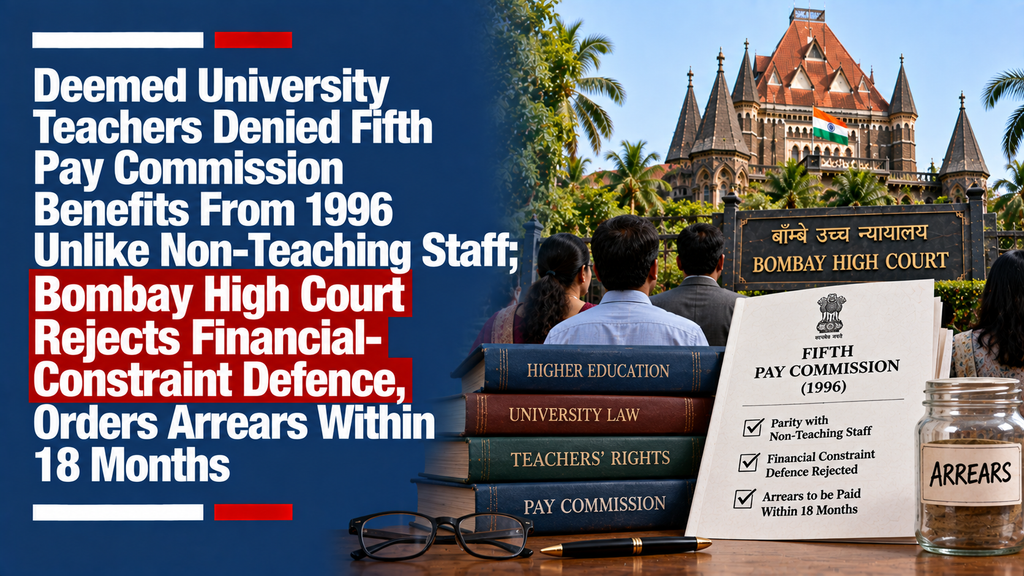
Deemed University Teachers Denied Fifth Pay Commission Benefits From 1996 Unlike Non-Teaching Staff; Bombay High Court Rejects Financial-Constraint Defence, Orders Arrears Within 18 Months

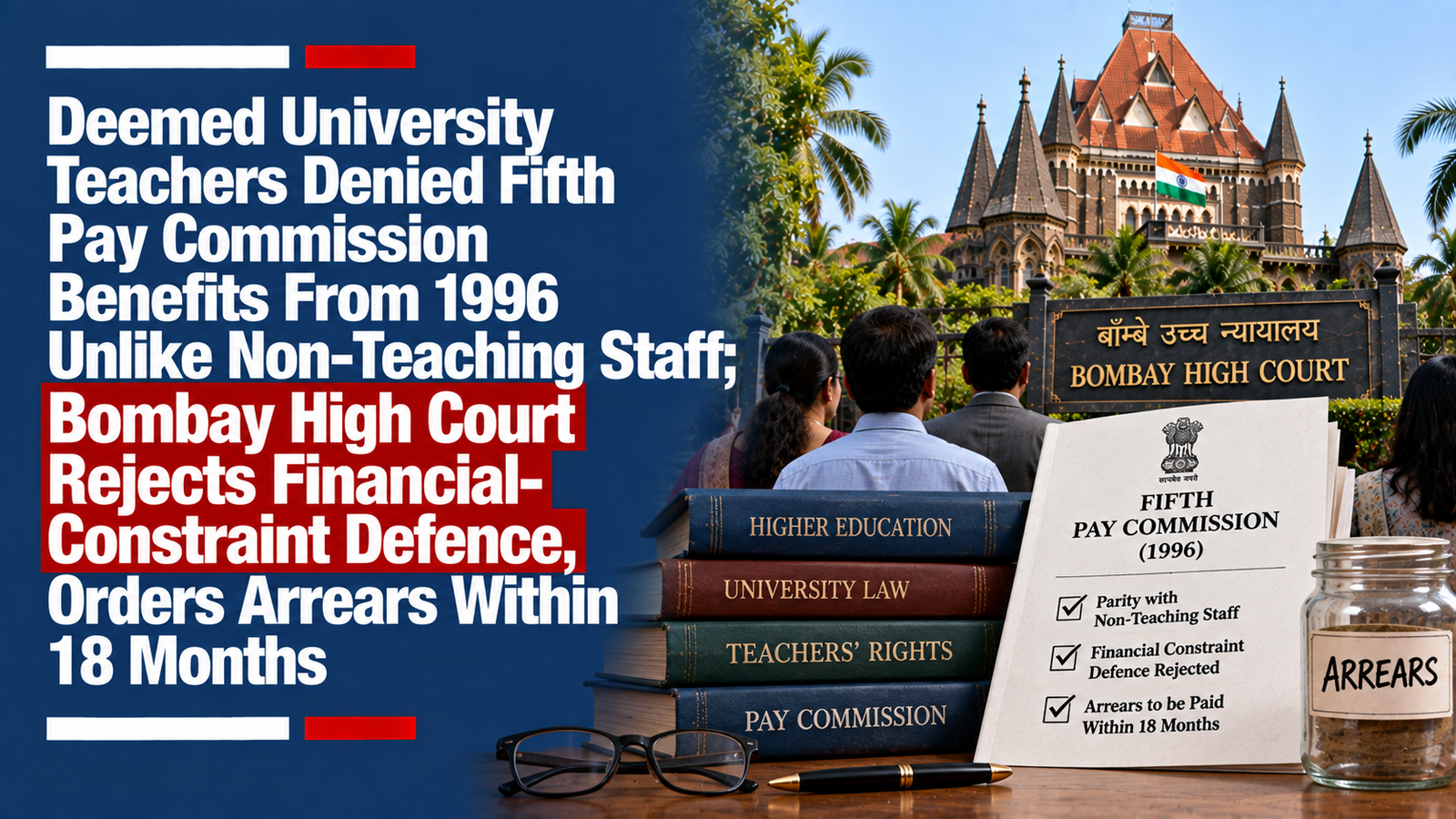
Bombay High Court Grants Deemed University Teachers Fifth Pay Commission Benefits From January 1996, Directs Payment of Arrears Within 18 Months
Facts
The Bombay High Court decided together three long-pending writ petitions concerning the date from which Fifth Pay Commission benefits should apply to teaching and non-teaching employees of certain Deemed Universities in Maharashtra. The petitioners sought implementation from 1 January 1996, instead of the later dates of 1 April 2000/1 April 2002 adopted by the State Government.
The matters included employees of Deccan College Post Graduate and Research Institute, Tilak Maharashtra Vidyapeeth, and junior-college teachers represented in Writ Petition No. 3900 of 2011. Writ Petition No. 7842 of 2009 was specifically detagged because it involved additional issues and was directed to be listed separately.
In the case of Deccan College, Petitioners Nos. 1 to 77 were serving teaching and non-teaching employees, while Petitioners Nos. 78 to 104 were former employees who had retired between 1 January 1996 and 31 March 2002.
Historically, when the Fourth Pay Commission was implemented, the State had extended its benefits to teaching and non-teaching employees of Deemed Universities from 1 January 1986, placing them substantially on the same footing as employees of Non-Agricultural Universities and affiliated colleges.
The anomaly arose with the Fifth Pay Commission. Non-teaching employees of Non-Agricultural Universities and affiliated colleges received the revised scales from 1 January 1996, and the State also granted Fifth Pay Commission benefits to non-teaching employees of the concerned Deemed Universities from that date in relevant cases.
Teachers, however, were given the benefit only from 1 April 2000 or 1 April 2002, depending upon the institution/category. For example, at Tilak Maharashtra Vidyapeeth the teaching staff received the Fifth Pay Commission from 1 April 2002 while non-teaching staff received it from 1 January 1996.
The employees therefore approached the High Court under Article 226, contending that there was no rational basis for denying them the benefit from 1 January 1996.
Issues
The principal issue was whether Maharashtra could validly apply the Fifth Pay Commission to eligible teachers of the concerned Deemed Universities from 1 April 2000/1 April 2002, while granting comparable benefits to non-teaching staff from 1 January 1996.
The Court also examined whether the State’s plea of financial constraints and budgetary resources constituted sufficient justification for selecting the later implementation date; whether its discretion in implementing Pay Commission recommendations was judicially reviewable where the distinction became arbitrary or irrational; and what significance should be attached to the Central Government’s offer to bear 80% of the additional expenditure from 1 January 1996 to 31 March 2000.
Petitioner’s Arguments
The petitioners argued that there was no rational justification for postponing the Fifth Pay Commission benefits for teachers when the corresponding non-teaching staff had been granted revised scales from 1 January 1996.
They emphasized the State’s previous treatment under the Fourth Pay Commission. Teachers and non-teaching employees of the Deemed Universities had both been granted those benefits from 1 January 1986, at par with employees of other Non-Agricultural Universities and affiliated colleges.
According to the petitioners, the State could not depart from this approach under the Fifth Pay Commission merely by invoking financial difficulties without demonstrating a rational policy basis.
They further relied upon the Central Government’s scheme under which 80% of the additional expenditure for implementing revised pay scales from 1 January 1996 to 31 March 2000 was available as Central assistance, leaving the State to bear only 20% during that period.
Accordingly, they argued that financial constraints could not reasonably explain why the State chose a later date instead of availing itself of the available Central assistance.
Respondent’s Arguments
The State of Maharashtra defended the distinction principally as an administrative and policy decision based upon its financial position and budgetary resources.
It argued that sanctioning pay scales for posts sanctioned by the State was within the State Government’s domain. Although the Fifth Pay Commission had been sanctioned for teaching staff, the Government claimed that it was financially unable to implement it from 1 January 1996.
The State also emphasized that Deemed Universities stand on a different statutory footing from Non-Agricultural Universities established under the Maharashtra Universities Act, since Deemed Universities derive their status under the University Grants Commission framework.
It maintained that the decision to extend benefits from a later date was a conscious policy choice. Since the Fifth Pay Commission was ultimately implemented from 2000/2002, according to the State, the question of seeking the earlier 80% reimbursement from the UGC did not arise.
Analysis of the Law
The High Court accepted the general proposition that Pay Commission implementation is substantially a matter of governmental policy and that courts should ordinarily be slow to interfere with such decisions.
The Central Government’s communication dated 27 July 1998 itself permitted States, after considering local circumstances, to introduce different scales or to implement the revised scales from 1 January 1996 or a later date.
But the existence of discretion did not make its exercise immune from constitutional scrutiny.
The Court held that the decision still had to be rational and non-discriminatory. A plea of financial constraints could potentially justify postponement, but it had to be supported by material and form part of a sound policy rationale.
This became particularly important because the State itself had undertaken responsibility for maintenance grants to the concerned Deemed Universities.
The Court found a striking inconsistency: the State had treated teachers and non-teaching employees alike under the Fourth Pay Commission; under the Fifth Pay Commission it granted non-teaching staff benefits from 1 January 1996, but postponed teachers’ benefits until 2000/2002.
The only substantial justification advanced for this differential treatment was financial constraints. The Court found this inadequate in the circumstances.
Precedent Analysis
Avinash Nagra v. Navodaya Vidyalaya Samiti & Others, (1997) 2 SCC 534
The High Court specifically relied upon the Supreme Court’s observations concerning the importance of teachers in the educational system.
The Supreme Court had emphasized that the success of the educational process depends considerably upon teachers and that the quality of a university is closely connected to the quality of its teachers.
The Bombay High Court applied these observations in the context of teachers’ service conditions. It observed that the State, having undertaken responsibility for such conditions, must ensure that teachers are not subjected to discriminatory treatment.
The judgment’s core legal approach was therefore not that every Pay Commission recommendation must automatically operate from its original date. Rather, where the State chooses different dates for similarly situated categories within institutions for which it has assumed financial responsibility, the distinction must rest upon a rational and defensible policy basis.
Court’s Reasoning
The Court expressly acknowledged that there may be situations where a State can legitimately implement revised pay scales from a later date. It therefore did not lay down an absolute rule that every Pay Commission revision must operate retrospectively from 1 January 1996.
What made these cases different was the combination of circumstances.
First, the State had assumed responsibility for providing maintenance grants to the concerned Deemed Universities.
Second, under the Fourth Pay Commission, teaching and non-teaching employees had been treated alike from 1 January 1986.
Third, under the Fifth Pay Commission, non-teaching employees received benefits from 1 January 1996, while teachers were made to wait until 2000/2002. The Court held that although teaching and non-teaching employees cannot necessarily claim complete parity in every respect, there must be “a semblance of uniformity and some rationale” when fixing the date from which revised pay scales operate.
Fourth, and importantly, the Central Government had offered to finance 80% of the additional expenditure between 1 January 1996 and 31 March 2000. Yet the State did not avail itself of that assistance because it had itself decided to implement the revised scales from a later date.
The Court observed that had the scheme been implemented from 1996, the State’s liability during the relevant five-year period would effectively have been only 20%. It therefore found the bare plea of financial constraints insufficient to deprive teachers of the earlier benefit.
Consequently, granting Fifth Pay Commission benefits to teaching and non-teaching staff from different dates merely on the stated ground of financial constraints was held not to be a sound exercise of governmental discretion.
Conclusion
The Bombay High Court allowed Writ Petition Nos. 3900 of 2011, 7771 of 2004 and 10368 of 2004.
It declared that the Fifth Pay Commission benefits for eligible employees of the concerned Deemed Universities would apply from 1 January 1996, instead of 1 April 2000/1 April 2002.
Eligible teaching/non-teaching employees were held entitled to the resulting consequential monetary benefits, and the State was directed to pay the arrears within 18 months.
The Court further permitted Maharashtra to approach the UGC for reimbursement, with any such representation to be considered expeditiously in accordance with policy. It expressed no opinion on the merits of such reimbursement.
Regarding the Career Advancement Scheme, the State was directed to take an appropriate decision expeditiously, if not already taken, and any fresh/revised proposal was to be submitted within six weeks.
Importantly, Writ Petition No. 7842 of 2009 was not decided by this judgment; it was detagged because additional issues arose and was directed to be listed separately on 24 September 2026.
Case Details
Lead Case: Kanishtha Mahavidyalayin Shikshan Annyay Nivaran Kruti Samitee & Ors. v. State of Maharashtra & Anr.
Court: High Court of Judicature at Bombay, Civil Appellate Jurisdiction
Case Numbers: Writ Petition No. 3900 of 2011; Writ Petition No. 7771 of 2004; Writ Petition No. 10368 of 2004 with Civil Application No. 2178 of 2010
Bench: Justice M. S. Karnik and Justice Sandesh D. Patil
Date: 16 September 2026
Neutral Citation: 2026:BHC-AS:37801-DB
Result: Petitions allowed. Fifth Pay Commission benefits directed from 1 January 1996 with consequential benefits; arrears payable within 18 months.