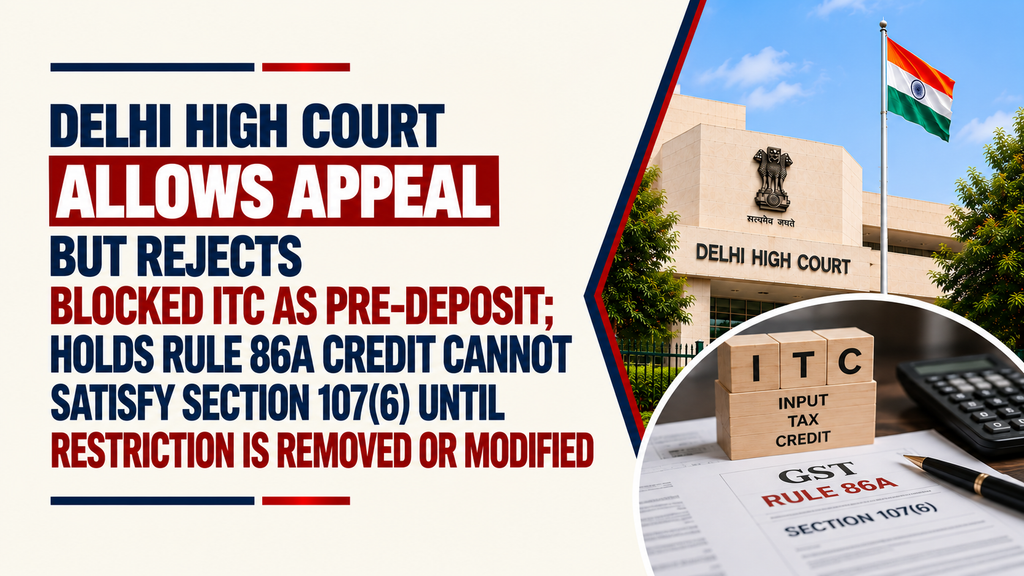
Delhi High Court Allows Appeal but Rejects Blocked ITC as Pre-Deposit; Holds Rule 86A Credit Cannot Satisfy Section 107(6) Until Restriction Is Removed or Modified

Delhi High Court Says Mere Blocking of ITC Is Not Payment; Refuses ₹3.33-Lakh Pre-Deposit Adjustment From Credit Restricted Under Rule 86A
Facts
Spherion Solutions Private Limited was investigated by the Directorate General of GST Intelligence in connection with an alleged network involving M/s N.K. Logistics Pvt. Ltd. and M/s Crimson International Pvt. Ltd. Crimson International was alleged to have issued invoices without actual supply, and Spherion was identified as one of the recipients.
A show-cause notice dated 27 June 2025 alleged wrongful availment of ₹33,32,568 in input tax credit without receipt of corresponding goods or services. The adjudicating authority ultimately confirmed IGST demands of ₹10,40,472 for FY 2020-21 and ₹22,92,096 for FY 2021-22, along with interest and an equivalent penalty.
However, the summary order in FORM GST DRC-07 incorrectly showed the entire ₹66,65,136—tax plus equal penalty—under the head “penalty” and also incorrectly referred to FY 2018-19. As a result, when Spherion attempted to file its appeal, the GST portal calculated the mandatory 10% pre-deposit at ₹6,66,514 instead of ₹3,33,257.
After the writ petition was filed, the authority exercised power under Section 161 CGST Act and issued a corrected DRC-07 on 16 March 2026, separately reflecting tax and penalty. That part of the dispute therefore became infructuous.
The surviving controversy concerned whether ₹3,33,257 could be appropriated from input tax credit already blocked under Rule 86A toward the mandatory pre-deposit required under Section 107(6) for filing the appeal.
Issues
The principal issues were:
- Whether blocked ITC under Rule 86A could be treated as payment of the 10% mandatory pre-deposit under Section 107(6).
- Whether mere blocking of credit amounts to appropriation toward the adjudicated demand.
- Whether the Court could direct use of blocked credit when the subsisting restrictions had been imposed by a Haryana State officer who was not a party.
- Whether ordinarily available ITC in the Electronic Credit Ledger can be used toward a Section 107 pre-deposit.
- Whether the petitioner should receive protection against limitation and recovery because the original DRC-07 error prevented filing of its statutory appeal.
Petitioner’s Arguments
The petitioner argued that ₹17,96,088 was already blocked in its Electronic Credit Ledger, while the statutory pre-deposit was only ₹3,33,257. Requiring an additional cash payment would therefore create a double financial burden.
It relied upon Section 49(4), Rule 86(2), CBIC Circular No.172/04/2022-GST and decisions including Oasis Realty v. Union of India and Yasho Industries Ltd. v. Union of India to argue that an appeal pre-deposit can be made from the Electronic Credit Ledger.
It also challenged successive Rule 86A blocks and pointed to provisional attachment of its bank account, contending that its liquidity had effectively been frozen.
Revenue’s Arguments
The Revenue accepted that ordinarily available credit in an ECL may be used toward the Section 107(6) pre-deposit.
However, it distinguished credit whose utilisation was specifically blocked under Rule 86A. According to the Revenue, such restriction is preventive and does not amount to actual recovery or appropriation.
The Revenue distinguished Oasis Realty and Yasho Industries on the ground that those cases concerned credit actually available for utilisation, not credit under an operative Rule 86A block.
Analysis of the Law
1. Section 107(6) Requires Actual Payment
Section 107(6) requires an appellant to pay the admitted amount in full and 10% of the disputed tax amount before filing an appeal.
The Court therefore treated the statutory requirement as one of actual payment—not merely the existence of an amount notionally standing to the assessee’s credit.
2. Available ITC May Ordinarily Be Used
The Court noted that Section 49(4) permits amounts available in the ECL to be used for specified tax liabilities, subject to statutory conditions and restrictions.
The Revenue itself did not dispute that ordinarily available credit may be used for a Section 107(6) pre-deposit.
The judgment therefore does not hold that every GST appeal pre-deposit must be made through the Electronic Cash Ledger.
3. Blocked Credit Is Different From Available Credit
The decisive distinction was Rule 86A.
Where a Rule 86A restriction is operating, the corresponding credit cannot be debited from the ECL unless the competent authority removes or modifies the restriction.
The Court held that the mere fact that credit is blocked does not mean it has been paid to, or appropriated by, the Government.
4. Mere Blocking Does Not Satisfy Pre-Deposit
This is the central ratio.
The Court held:
“The mere blocking of input tax credit does not amount to its payment or appropriation towards an adjudicated demand.”
Unless the credit is actually debited or appropriated, the statutory pre-deposit requirement cannot be treated as satisfied merely because the taxpayer is prevented from using that credit.
Therefore, ₹3,33,257 from the blocked amount could not automatically be treated as the Section 107(6) pre-deposit.
5. OIO Itself Distinguished Blocking From Appropriation
The Court found support in the adjudication order itself.
In relation to Crimson International, the adjudicating authority had expressly appropriated available ITC against the demand. But no equivalent appropriation order was passed in Spherion’s case.
Accordingly, Spherion’s blocked credit remained merely restricted credit and had never legally been applied against the demand.
6. Court Could Not Modify Haryana Officer’s Restriction in His Absence
The subsisting Rule 86A blocks—₹64,386 and ₹17,31,702—had been imposed by an Excise and Taxation Officer of Haryana.
That officer and the competent State authority had not been impleaded in the writ petition.
None of the existing respondents controlled those restrictions.
A direction permitting appropriation of the blocked credit would therefore effectively alter an order passed by an authority not before the Court.
7. Rule 86A Reasons Must Come From the Officer Who Imposed the Block
The actual Rule 86A orders and reasons were also not placed before the Court.
The Court held that the satisfaction required under Rule 86A is the satisfaction of the particular officer imposing the block. The reasons therefore must emerge from that officer’s record and cannot later be supplied by another authority through an affidavit.
This is an important procedural observation concerning Rule 86A challenges generally.
8. Ledger Did Not Establish Actual Available Balance
The Blocked Credit Ledger merely showed amounts blocked and unblocked on different dates.
It did not establish that the entire ₹17,96,088—or any specific portion—was actually available in the ECL and could have been debited but for the restriction.
That was an additional reason why the Court declined the requested appropriation.
Precedent Analysis
Oasis Realty v. Union of India, 2022 SCC OnLine Bom 11891
Relied upon by the petitioner for the proposition that ITC in the Electronic Credit Ledger may be used toward statutory pre-deposit.
The Delhi High Court did not reject that general proposition.
It distinguished the case because Oasis Realty concerned available credit, whereas Spherion sought to use credit that remained specifically blocked under Rule 86A.
Yasho Industries Ltd. v. Union of India, 2024 SCC OnLine Guj 4390
Similarly distinguished because the issue there concerned credit capable of utilisation rather than credit that could not legally be debited due to an operative Rule 86A restriction.
Jyoti Construction v. Deputy Commissioner of CT & GST
Relied upon by the Revenue in support of its submission concerning the nature and mode of pre-deposit.
KOG-KTV Food Products (India) Pvt. Ltd. v. Joint Commissioner (Appeals)
Also relied upon by the Revenue to distinguish credit available in an ECL from credit legally restricted from utilisation under Rule 86A.
Court’s Reasoning
The Court drew a precise distinction between three concepts:
availability, blocking, and appropriation.
Credit may exist in an Electronic Credit Ledger but still be legally unavailable for debit because of Rule 86A.
Blocking merely immobilises the credit.
Appropriation, by contrast, actually applies the amount toward a tax liability.
Section 107(6) requires payment. Therefore, an amount that has merely been immobilised cannot satisfy the appellate pre-deposit requirement.
At the same time, the Court ensured that the petitioner did not lose its statutory appellate remedy because of the authority’s own mistake in the original DRC-07.
Relief on Limitation and Appeal
The petitioner had attempted to appeal on 24 February 2026 and had promptly sought rectification and raised a GSTN grievance.
The Court found that the erroneous DRC-07 was attributable to the adjudicating authority and was corrected only on 16 March 2026.
Therefore, the petitioner could not be deprived of its statutory appeal because of time lost in obtaining correction and pursuing the writ petition.
It was permitted to file the appeal within four weeks from the judgment, without rejection on limitation, provided Section 107(6) was complied with.
Conclusion
The Delhi High Court disposed of the writ petition with several important directions:
- the DRC-07 rectification issue was treated as infructuous because it had already been corrected;
- the request to appropriate ₹3,33,257 from blocked ITC as pre-deposit was rejected;
- the petitioner was permitted to seek removal/modification of the Rule 86A restrictions separately;
- the petitioner was given four weeks to file its statutory appeal;
- lawfully available and debitable ITC could be used toward the pre-deposit;
- blocked Rule 86A credit could not count unless the restriction was removed or suitably modified;
- GST authorities must assist with electronic filing, and manual filing must be accepted if the portal continued to malfunction; and
- no coercive recovery could take place for four weeks.
The Court expressly left open the merits of both the OIO and the validity of the Rule 86A restrictions.
Case Details
Case: Spherion Solutions Private Limited v. Additional Commissioner Adjudication CGST Delhi North & Ors.
Court: High Court of Delhi at New Delhi
Case Number: W.P.(C) 3418/2026 with CM APPL. 16397/2026 and CM APPL. 16398/2026
Bench: Justice Anil Kshetarpal and Justice Shail Jain
Judgment by: Justice Anil Kshetarpal
Reserved on: 17 August 2026
Date: 3 September 2026
Tax Demand: ₹33,32,568
Mandatory Pre-Deposit: ₹3,33,257
Blocked ITC in dispute: ₹17,96,088
Result: Writ disposed of; blocked ITC cannot be treated as Section 107(6) pre-deposit unless Rule 86A restriction is removed or modified; four weeks granted for statutory appeal with temporary protection from coercive recovery.