


Headnote
Code of Civil Procedure, 1908 – Order VI Rule 17 – Amendment of pleadings – Replacement of affidavit – Procedural defect – Inadvertent error – Electronic evidence – Ends of justice.
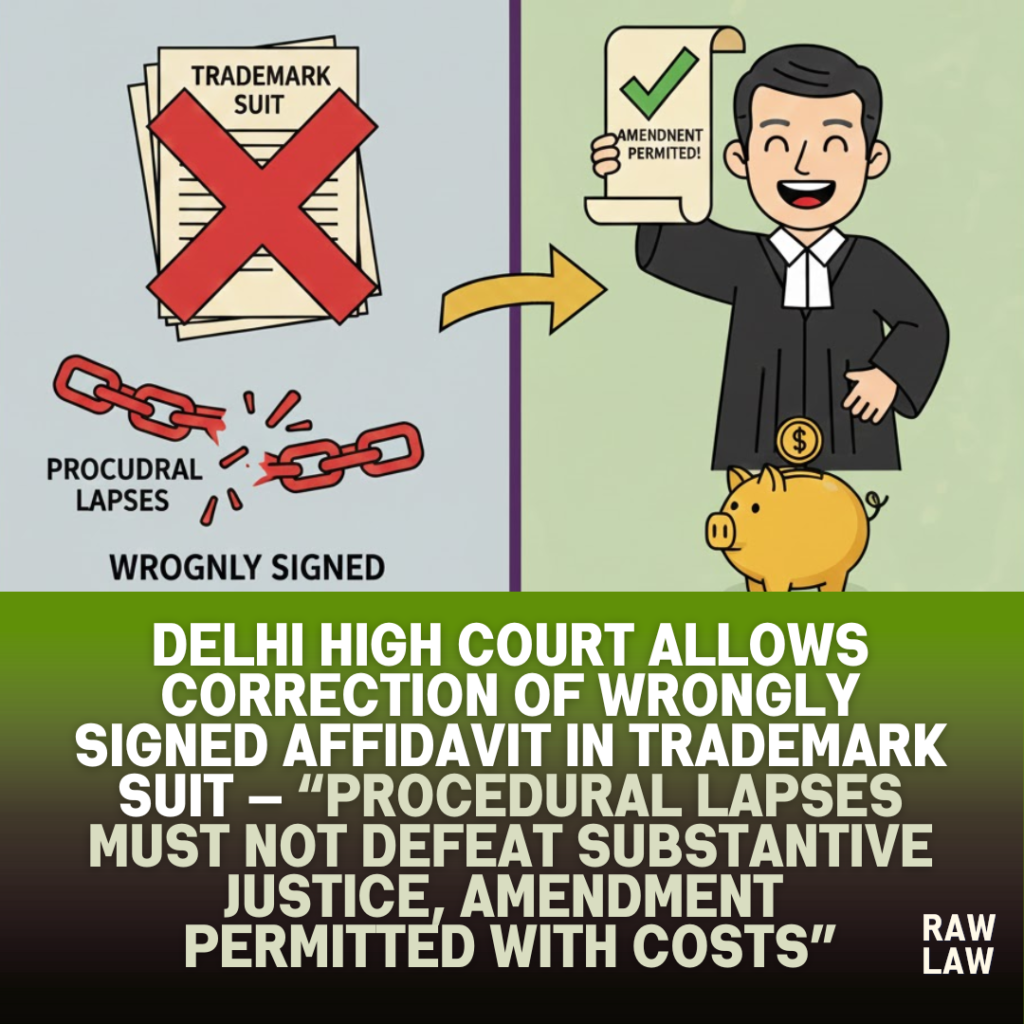
Held, inadvertent filing of an affidavit bearing the signature of an unrelated third party, instead of the authorised representative of the plaintiff, constitutes a curable procedural defect and does not bar amendment of pleadings under Order VI Rule 17 CPC. Where the contents of the affidavit remain unchanged and the correction sought is limited to substituting the erroneous document with the correct affidavit, such amendment does not alter the nature of the suit or prejudice the defendants. Procedural rules are intended to advance justice and not to penalise parties for bona fide mistakes. In the absence of mala fides or advantage gained by the error, courts must adopt a pragmatic approach and permit rectification to enable proper adjudication of disputes. Allowing the amendment subject to costs, the Court reiterated that procedure is a handmaiden of justice and cannot be used to defeat substantive rights.
Court’s decision
The Delhi High Court allowed an application seeking amendment of pleadings in a commercial trademark infringement suit, permitting the plaintiff to replace pages of the plaint containing an erroneously signed affidavit. The Court held that the error was inadvertent and procedural, and that refusal to allow correction would defeat the ends of justice. The amendment was allowed subject to payment of costs.
Facts
The plaintiff instituted a commercial suit seeking a permanent injunction restraining the defendants from using the mark “ARCHIT” and its variants, alleging infringement of the plaintiff’s registered trademarks “ARCHID”, “ARCHIDPLY”, and “ARCHIDLAM”. During scrutiny of the pleadings, it emerged that the affidavit filed in support of electronic records forming part of the plaint bore the signature of a third party unconnected with the litigation.
The plaintiff explained that due to an inadvertent clerical error, pages 50 to 56 of the plaint contained an affidavit signed by a third party, though all other pleadings and affidavits were duly signed by the authorised representative. Upon realising the mistake, the plaintiff promptly moved an application under Order VI Rule 17 CPC seeking substitution of the incorrect affidavit with the correct one, even before the defendants filed their written statement.
Issues
The principal issue before the Court was whether replacement of a wrongly signed affidavit could be permitted under the rubric of amendment of pleadings under Order VI Rule 17 CPC, or whether such substitution amounted to impermissible replacement of documents, as contended by the defendants.
Plaintiff’s arguments
The plaintiff submitted that the error was neither deliberate nor intended to mislead the Court. It was argued that the amendment sought was purely procedural and limited to correcting a clerical mistake, without altering the contents of the plaint or the nature of the suit. The plaintiff emphasised that no advantage had been gained on the basis of the erroneous affidavit and that denial of amendment would unjustly penalise the plaintiff for a bona fide mistake. It was further contended that the amendment was necessary for proper adjudication of the dispute and would cause no prejudice to the defendants.
Defendants’ arguments
The defendants opposed the application, arguing that amendment of pleadings could not be equated with replacement of documents. They contended that the affidavit in question was not merely defective but was signed and notarised by a third party, raising serious doubts about the circumstances under which it was filed. According to the defendants, permitting substitution would amount to allowing a fresh affidavit under the guise of amendment, contrary to the scheme of Order VI Rule 17 CPC. It was also argued that the plaintiff failed to satisfactorily explain how such an error occurred.
Analysis of the law
The Court examined the scope of Order VI Rule 17 CPC and reiterated that the provision empowers courts to allow amendments at any stage to determine the real questions in controversy. Emphasising settled jurisprudence, the Court observed that procedural law is meant to facilitate justice and not to obstruct it. Curable procedural defects, particularly those arising from inadvertence or negligence, should not be allowed to defeat substantive rights unless mala fides, deliberate misconduct, or irreparable prejudice is demonstrated.
The Court relied on Supreme Court precedents underscoring that even negligent omissions can be rectified if no injustice is caused to the opposite party and if the amendment does not change the nature of the case.
Precedent analysis
The Court referred to authoritative rulings of the Supreme Court of India, including Varun Pahwa v. Renu Chaudhary, State of Maharashtra v. Hindustan Construction Co. Ltd., Jai Jai Ram Manohar Lal v. National Building Material Supply, and Uday Shankar Triyar v. Ram Kalewar Prasad Singh. These decisions consistently hold that procedural irregularities which are curable should not be used to deny justice and that amendments should ordinarily be allowed unless they cause irreparable prejudice or are tainted by mala fides.
Court’s reasoning
On facts, the Court noted that except for the disputed pages, all pleadings bore the signature of the authorised representative of the plaintiff. The contents of the affidavit sought to be substituted remained unchanged, and only the signatory was being corrected. The Court found the explanation of inadvertence plausible and observed that the defendants had not demonstrated any prejudice arising from the correction. The amendment was therefore held to be procedural in nature and essential for effective adjudication.
Conclusion
The High Court allowed the amendment application and permitted the plaintiff to replace the erroneously signed affidavit with the correct document. To balance equities, the Court imposed costs of ₹25,000, payable to the Delhi High Court Staff Welfare Fund.
Implications
The ruling reinforces a pragmatic and justice-oriented approach to procedural defects in commercial litigation. It clarifies that courts will not allow technical objections to derail adjudication where errors are bona fide and curable. The decision provides reassurance to litigants that inadvertent procedural lapses, particularly in electronic filings, can be rectified, subject to costs, without jeopardising substantive claims.
Case-law references
- Varun Pahwa v. Renu Chaudhary – Scope of amendment under Order VI Rule 17 CPC.
- Jai Jai Ram Manohar Lal v. National Building Material Supply – Procedure as handmaid of justice.
- Uday Shankar Triyar v. Ram Kalewar Prasad Singh – Curable procedural defects should not defeat rights.
- State of Maharashtra v. Hindustan Construction Co. Ltd. – Liberal approach to amendment of pleadings.
FAQs
1. Can a wrongly signed affidavit be corrected through amendment of pleadings?
Yes, if the error is inadvertent, procedural, and does not change the nature of the case or prejudice the other side.
2. Does replacement of an affidavit amount to filing a new case document?
Not necessarily. Courts may permit substitution if contents remain unchanged and correction is limited to curing a defect.
3. Are costs normally imposed while allowing such amendments?
Yes, courts often impose costs to balance equities and discourage negligence.