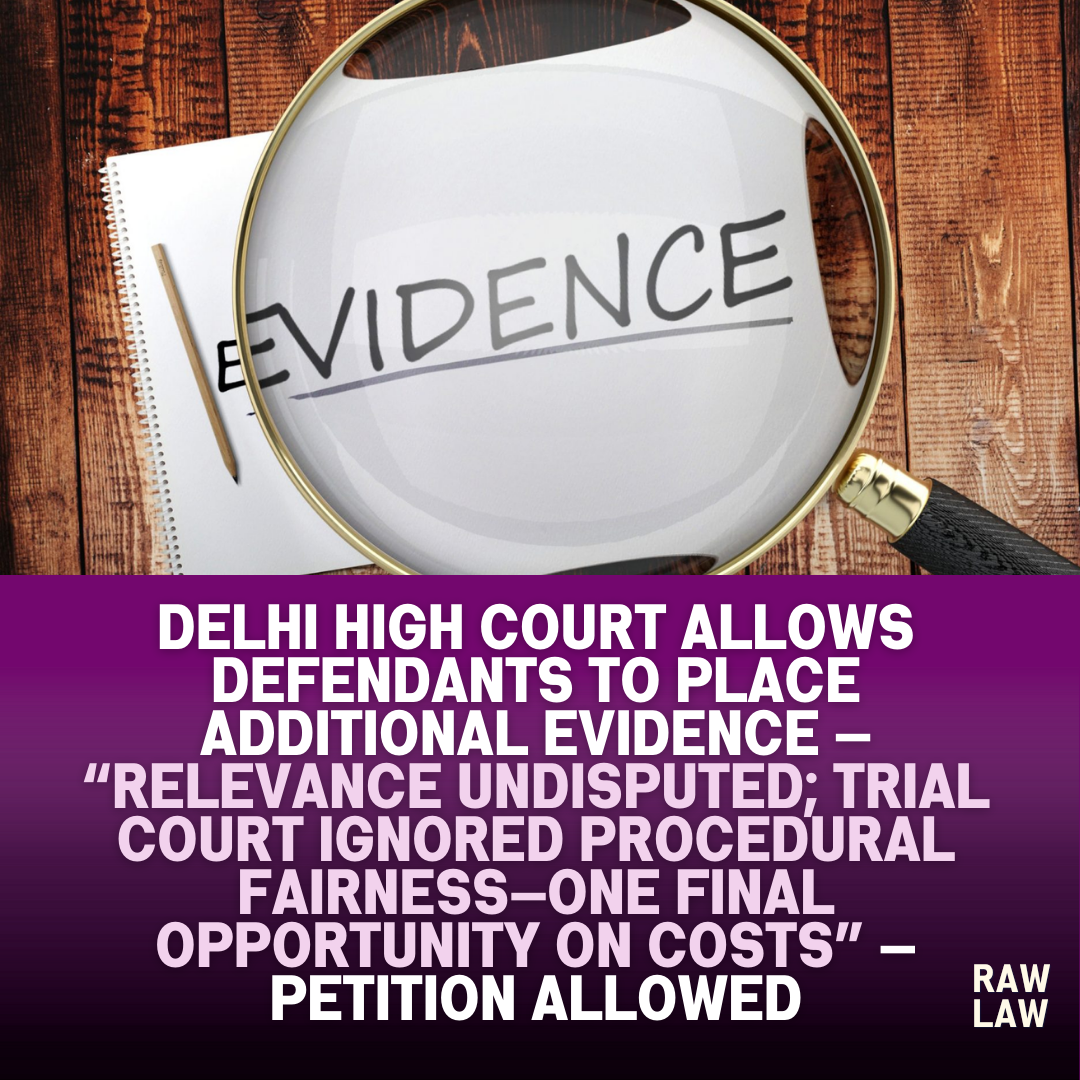
Delhi High Court allows defendants to place additional evidence — “Relevance undisputed; trial court ignored procedural fairness—one final opportunity on costs” — petition allowed

1. Court’s decision
The Delhi High Court has set aside the Commercial Court’s order refusing to accept additional documents filed by the defendants in an ongoing recovery suit concerning interior design and execution work. Observing that the documents sought to be produced—emails, photographs, and audio-video recordings—were concededly relevant and directly connected to the core dispute about quality and extent of work, the Court held that the trial court failed to exercise jurisdiction with due regard to procedural fairness. Considering the peculiar circumstances, including the departure of the counsel handling the case and the plaintiff’s own prior request for production of documents under Order XII Rule 8, the High Court allowed the petition but restricted the defendants to one final opportunity to confront PW1 with the additional evidence. This permission was conditioned upon payment of ₹25,000 as costs.
2. Facts
The underlying commercial suit involves the plaintiff’s claim for recovery of money for work allegedly executed for the defendants under an interior design contract. Issues were framed on 15 April 2024. On 02 November 2024—prior to commencement of trial—the defendants filed an application under Order XI Rule 1(10) seeking leave to place additional documents on record. These documents comprised emails exchanged between the parties, photographs of the site, and audio-video recordings capturing interactions between their representatives. The defendants argued that the documents had always existed but were not traceable because the advocate managing the matter had left the law firm. The Commercial Court dismissed the application, holding that the defendants failed to provide a satisfactory explanation for non-filing at the appropriate time. The defendants then invoked Article 227. The High Court reviewed the trial court record and submissions from both sides.
3. Issues
The High Court considered the following:
- Whether the defendants’ explanation for the delay in filing documents was adequate.
- Whether the trial court erred by dismissing the application despite admitted relevance of the documents.
- Whether the plaintiff’s prior notice under Order XII Rule 8 altered the equities of permitting late production.
- Whether allowing additional documents at this stage would prejudice the plaintiff.
- Whether procedural fairness required limited leave to confront PW1 with the documents.
- Whether supervisory jurisdiction under Article 227 ought to be exercised to prevent failure of justice.
4. Petitioners’ arguments
The defendants argued that the Commercial Court adopted an unduly rigid approach. They emphasised that the plaintiff never disputed relevance of the additional documents and that refusal to accept them would severely prejudice their defence. They reiterated that the documents were misplaced because the counsel handling the matter had left the firm, and became traceable only later. They also pointed to the plaintiff’s own invocation of Order XII Rule 8, asserting that the plaintiff had demanded production of the very documents now sought to be filed—demonstrating their centrality to the dispute. The defendants stressed that the trial had only just begun with the examination-in-chief of PW1 and that permitting them one opportunity to cross-examine the witness using these materials would not prejudice the plaintiff.
5. Respondent’s arguments
The plaintiff argued that the defendants were always in possession of the documents because they consisted primarily of emails and electronic communications. Thus, failure to file them earlier reflected negligence, not inadvertent loss. The plaintiff contended that litigants cannot use change of counsel as a blanket justification for procedural lapses. It was further contended that the documents could have been put to PW1 even without formal exhibition, and therefore their late filing was unnecessary and intended merely to delay proceedings. The plaintiff urged that commercial suits require expeditious disposal and that the High Court should not indulge belated attempts to enlarge the evidentiary record.
6. Analysis of the law
Order XI Rule 1(10) (as applicable to commercial suits) permits production of additional documents but only upon showing “reasonable cause” for non-disclosure at the initial stage. The High Court emphasised that relevance is a crucial factor: where the documents are vital to the core controversy, courts must adopt a practical approach to avoid injustice. Supervisory jurisdiction under Article 227 permits interference where procedural orders result in manifest failure of justice.
While the Court accepted that the documents were indeed within the defendants’ power and possession, it also noted the significance of the plaintiff’s Order XII Rule 8 notice—which required the defendants to search for and produce those very documents. Combined with the timing (before commencement of cross-examination), and the defendants’ willingness to bear costs and limit themselves to a single opportunity, the Court found that the trial court failed to balance procedural rigour with substantive fairness.
7. Precedent analysis
Although the judgment does not cite specific authorities, it implicitly applies the established principles governing late-stage production of documents in commercial suits:
• Courts must prevent injustice even in strict procedural regimes.
• Relevance is a decisive factor in determining whether additional documents should be permitted.
• Supervisory jurisdiction is invoked sparingly but appropriately to correct rigid procedural errors.
• Orders denying opportunities that significantly impair a party’s ability to present an effective defence constitute circumstances warranting Article 227 intervention.
The judgment thus reflects consistent jurisprudence favouring a balanced approach in commercial litigation—maintaining discipline while ensuring parties are not unfairly deprived of critical evidentiary tools.
8. Court’s reasoning
The High Court accepted that the Commercial Court was correct in observing that the documents had always been in the defendants’ possession. However, it held that this factor alone could not justify dismissal when additional contextual facts existed: the plaintiff’s earlier request for production under Order XII Rule 8, the early stage of trial, and the defendant’s readiness to proceed without delay.
Importantly, both sides agreed that PW1 had already deposed in chief but cross-examination had not concluded. Denying the defendants the ability to confront PW1 with documents fundamental to assessing the quality and quantity of work—especially when the plaintiff was aware of their existence—would impair the fairness of adjudication.
Accordingly, the Court set aside the impugned order and allowed the application subject to heavy costs of ₹25,000 and restricted the defendants to one and only one opportunity to confront PW1 with the documents. The Court further directed that defendants’ evidence would not commence on the next day of hearing, ensuring procedural clarity.
9. Conclusion
The High Court allowed the petition, holding that fairness required permitting the defendants to bring on record relevant additional documents, particularly when the plaintiff had earlier sought to inspect them. The impugned order was set aside, costs were imposed, and a single opportunity was granted for confronting PW1 with the documents without disrupting the trial schedule. All pending applications were accordingly disposed of.
10. Implications
This ruling reinforces that commercial courts must blend procedural strictness with substantive justice. It clarifies that:
• Relevance of documents is central.
• Delay may be condoned when no prejudice results and trial efficiency is preserved.
• Article 227 may be invoked to prevent procedural rigidity from undermining fair adjudication.
• Parties who seek to use additional documents must act responsibly and may be restricted to limited opportunities and costs to deter misuse.
The judgment sets a practical precedent for commercial litigation where electronic communications and digital evidence often surface belatedly.
CASE LAW REFERENCES
1. Late-stage document production in commercial suits
Principle: Courts may permit additional evidence when relevance is undisputed and failure to file earlier is reasonably explained.
Applied: Allowed one opportunity with costs.
2. Supervisory jurisdiction under Article 227
Principle: Permits correction of procedural errors that impede justice.
Applied: Trial court’s rigid refusal corrected.
3. Cross-examination rights
Principle: If crucial documents pertain to matters in chief examination, fair trial requires permitting confrontation.
Applied: Defendants granted one final opportunity to confront PW1.
FAQs
1. Why did the Delhi High Court allow late filing of additional documents?
Because the documents were directly relevant to the dispute, and despite delay, their exclusion would compromise fairness. The plaintiff had earlier requested the same documents.
2. Did the Court permit unlimited cross-examination using the new documents?
No. The defendants received one and only one opportunity, ensuring fairness without delaying the suit.
3. Were costs imposed for allowing additional documents?
Yes. The Court imposed ₹25,000 to balance equities and deter casual delays.