Delhi High Court Allows Railway Compensation Claim for Fatal Boarding Fall; Holds Verified Ticket Proved Bona Fide Travel and Accident Constituted Untoward Incident

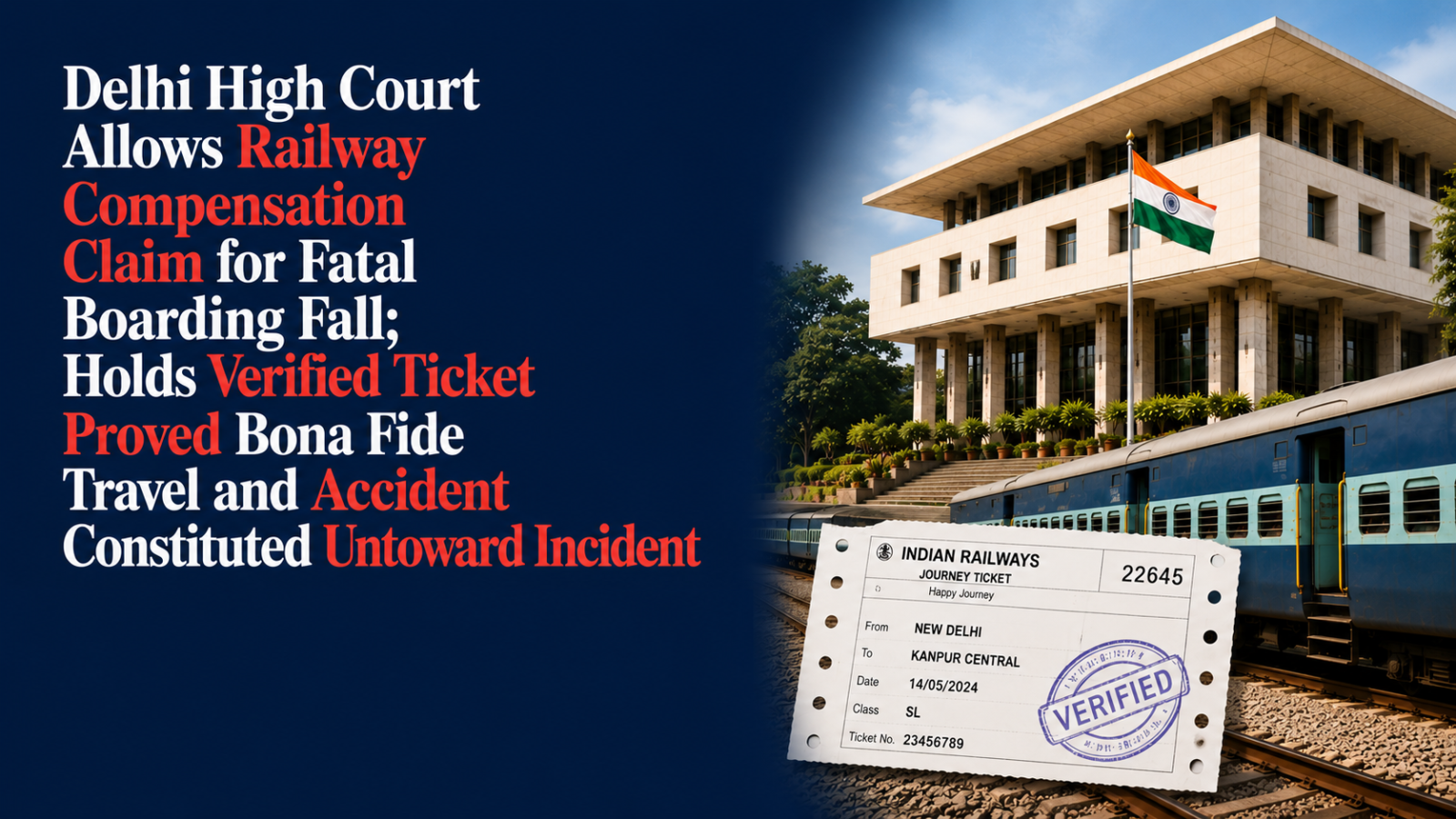
Delhi High Court Says Technical Investigation Lapses Cannot Defeat Genuine Railway Compensation Claim; Verified Ticket and Consistent Evidence Establish Fatal Accidental Fall
Facts
The Delhi High Court considered an appeal filed by Chittar Singh and Amrit Rani, the parents of deceased Devesh Pratap, under Section 23 of the Railway Claims Tribunal Act, 1987. They challenged the Railway Claims Tribunal’s judgment dated 4 November 2025 dismissing their compensation claim.
The deceased was stated to have been travelling on 12 April 2024 from V. Lakshmi Bai, Jhansi to Bhusawal with his two brothers on a valid journey ticket. While boarding Train No. 12716, Sachkhand Express, he allegedly fell from the moving train, sustained grievous injuries and died the following day at Medical College, Jhansi.
The Railway Claims Tribunal rejected the claim on two grounds:
- the deceased was not proved to be a bona fide passenger; and
- the occurrence was not established as an “untoward incident” under the Railways Act, 1989.
The parents therefore approached the High Court.
Issues
The principal issues before the Court were:
- Whether the deceased was a bona fide passenger at the time of the incident.
- Whether the railway tickets subsequently produced by the family could be relied upon despite not being recovered from the deceased immediately after the accident.
- Whether the burden shifted to the Railways once the claimants produced prima facie evidence of bona fide travel.
- Whether the deceased’s accidental fall while boarding the train constituted an untoward incident under Sections 123(c) and 124-A of the Railways Act.
- Whether non-examination of an alleged eyewitness or other investigative deficiencies justified rejection of the claim.
- Whether the case fell within any statutory exception to railway compensation liability.
Appellants’ Arguments
The appellants argued that the Tribunal had failed to properly appreciate the evidence showing that the deceased was travelling on a valid ticket and accidentally fell from the train.
They emphasised that the railway authorities themselves had verified the tickets produced by the family and found them to be genuine.
It was further argued that the Railways had produced:
- no oral evidence;
- no eyewitness contradicting the appellants’ version; and
- no contemporaneous railway material establishing any statutory exception under Section 124-A.
The appellants contended that absence of a seizure memo or other shortcomings in investigation could not defeat an otherwise genuine compensation claim.
Respondent’s Arguments
The Railways argued that no journey ticket had actually been recovered from the deceased at the time of the incident.
It questioned the reliability of the tickets produced later by the appellants.
The Railways also relied upon the fact that the Panchnama did not mention the deceased’s brother as a co-passenger and that his statement had not been recorded during the original investigation. According to the Railways, these circumstances created doubt regarding the manner of occurrence.
Analysis of the Law
Genuine Tickets Established Bona Fide Travel
The appellants produced copies of two tickets bearing Nos. UCE 18644747 and UCE 18644748, covering two persons and one person respectively.
Although those tickets were not produced immediately after the accident, the booking office subsequently verified them and confirmed that they were genuine.
The High Court also examined the Train Signal Register.
It showed that Sachkhand Express departed Jhansi at approximately 7:40 PM, whereas the tickets had been purchased at about 7:30 PM.
The Court held that purchasing the tickets shortly before departure did not create any legitimate doubt regarding their genuineness or the deceased’s bona fide status.
Oral Evidence Supported the Tickets
The testimony of the deceased’s father and his brother Keshvind, who was travelling with him, consistently established that the deceased was travelling on a valid ticket.
The Court found that this oral evidence, coupled with official railway verification of the tickets, sufficiently established bona fide travel.
Burden Shifted to Railways After Prima Facie Proof
Applying Union of India v. Rina Devi, the Court held that the appellants had discharged the initial burden of proving that the deceased was a bona fide passenger.
Once that prima facie burden was satisfied, the evidentiary burden shifted to the Railways to produce cogent evidence showing otherwise.
The Railways failed to discharge that burden.
Accordingly, the deceased was held to be a bona fide passenger.
Untoward Incident
Non-Examination of One Witness Was Not Fatal
The Tribunal had placed weight upon alleged deficiencies regarding eyewitness evidence.
The High Court held that non-examination of a particular witness cannot mechanically lead to an adverse inference.
The entire body of evidence must be considered.
The absence of one witness does not, by itself, establish that the accident did not occur, particularly where the remaining material consistently supports the claim.
Brother’s Statement Was Consistent
The Court specifically relied upon Keshvind’s statement recorded during the DRM inquiry.
He stated that the deceased fell from the train while attempting to board it.
The Court found no material contradiction or circumstance rendering his version inherently unreliable.
Fall While Boarding Train Is an Untoward Incident
The High Court reiterated that an accidental fall of a bona fide passenger from a train, including while boarding or alighting, constitutes an “untoward incident” under Section 123(c) read with Section 124-A of the Railways Act.
This principle follows from Rina Devi and Union of India v. Prabhakaran Vijaya Kumar.
The Railways failed to establish that the case fell within any of the statutory exceptions to compensation liability.
Accordingly, the accident qualified as an untoward incident.
Precedent Analysis
Union of India v. Rina Devi
This Supreme Court decision was central to both major issues.
On bona fide travel, it establishes that once claimants produce prima facie material showing that the deceased was a valid passenger, the burden shifts to the Railways to rebut that case with cogent evidence.
The Delhi High Court applied that principle after finding the tickets genuine and the oral testimony consistent.
The decision also supports the proposition that an accidental fall from a train falls within the statutory concept of an untoward incident, subject to the exceptions under Section 124-A.
Union of India v. Prabhakaran Vijaya Kumar
This precedent supports a liberal interpretation of “accidental falling of any passenger from a train.”
The principle covers accidents occurring while boarding or alighting from a train, rather than being confined only to falls after the passenger has fully entered the compartment.
Beneficial Legislation and Delay Condonation
Before considering the merits, the High Court also dealt with a 173-day delay in filing the appeal.
The Court noted that the Railways Act and Railway Claims Tribunal Act are beneficial and social welfare legislation intended to provide compensation to railway accident victims.
It therefore adopted a liberal and justice-oriented approach, holding that genuine compensation claims should not be defeated on technical grounds.
The delay was accordingly condoned.
Court’s Reasoning
The High Court found that the Tribunal had taken an excessively technical view of the evidence.
The claimants had produced genuine railway tickets whose issuance was verified by the Railways themselves.
The timing of purchase was entirely consistent with the departure time of the train.
The father and co-passenger brother consistently stated that the deceased was travelling with a valid ticket.
Once this evidence was placed on record, the burden shifted to the Railways, which failed to prove otherwise.
On the manner of accident, the deceased’s brother consistently stated that Devesh fell while attempting to board the train.
No statutory exception under Section 124-A was proved.
The High Court therefore concluded that both essential elements of the compensation claim were established:
- bona fide passenger status; and
- death arising from an untoward incident.
Conclusion
The Delhi High Court set aside the Railway Claims Tribunal’s judgment rejecting the parents’ compensation claim.
The matter was remanded to the Tribunal only for determination of the amount of compensation payable.
The Tribunal was directed to assess compensation in accordance with law and direct the authorities to disburse it within two months from receipt of the High Court judgment. The matter was directed to be listed before the Tribunal on 31 August 2026.
The appeal was accordingly allowed.
Case Details
Case: Chittar Singh & Anr. v. Union of India Through General Manager, North Central Railway, Allahabad
Court: Delhi High Court
Case Number: FAO 230/2026
Judge: Justice Manoj Kumar Ohri
Date: 14 August 2026
Result: Appeal allowed; Tribunal’s rejection set aside; deceased held a bona fide passenger who died in an untoward incident; matter remanded for compensation assessment and disbursal within two months