


Court’s decision
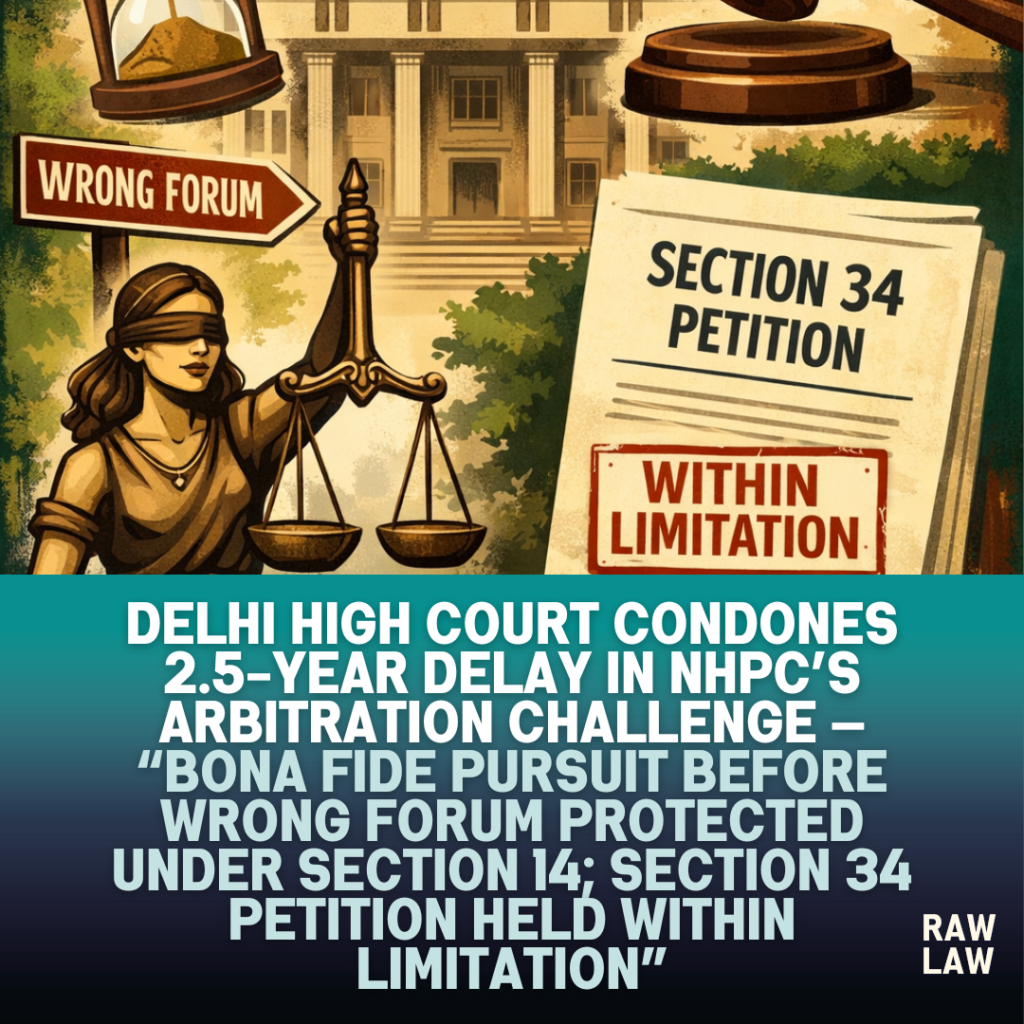
The Delhi High Court condoned a delay of over two years in a public sector undertaking’s challenge to an arbitral award, holding that time spent bona fide pursuing the remedy before courts ultimately found to lack territorial jurisdiction must be excluded under Section 14 of the Limitation Act. The Court ruled that once the Supreme Court authoritatively settled jurisdiction, the challenge was re-filed within the permissible window — “benefit of Section 14 cannot be denied where diligence and good faith are evident”; delay condoned, limitation objection rejected.
Court’s decision
Justice Subramonium Prasad allowed the application seeking exclusion of time under Section 14 of the Limitation Act and dismissed the respondent’s objection that the petition was time-barred. The Court held that the Section 34 petition challenging the arbitral award was filed within limitation after excluding the period spent before the Faridabad and Gurugram courts, and listed the main challenge to the award for further hearing.
Facts
The dispute arose from a 2006 contract awarded for construction works relating to a hydroelectric project in Himachal Pradesh. Disputes between the parties culminated in arbitration, which resulted in an award directing the public sector undertaking to pay over ₹29 crore with interest.
Following a correction under Section 33 of the Arbitration and Conciliation Act, the final award was passed on 18.04.2017. Aggrieved, the undertaking filed a petition under Section 34 of the Act before the District Court at Faridabad, relying on a contractual clause conferring jurisdiction on courts at New Delhi or Faridabad.
The petition was transferred to the Commercial Court at Gurugram, which rejected it in January 2018 for lack of territorial jurisdiction. This triggered a chain of appellate proceedings, eventually reaching the Supreme Court, which in December 2019 conclusively held that only the Delhi High Court had jurisdiction. Thereafter, the petitioner sought return of papers and re-filed the Section 34 petition before the Delhi High Court in January 2020.
Issues
The core issues before the High Court were whether the petitioner was entitled to exclusion of time under Section 14 of the Limitation Act for the period spent prosecuting the Section 34 challenge before courts lacking territorial jurisdiction, and whether the re-filed petition before the Delhi High Court was within the limitation period prescribed under Section 34(3) of the Arbitration and Conciliation Act.
Petitioner’s arguments
The petitioner argued that it had acted with due diligence and in good faith throughout, initially filing the Section 34 petition well within the statutory period before the Faridabad court based on the jurisdiction clause in the contract. It was submitted that the petitioner continued to pursue the matter through appellate remedies, including before the Punjab and Haryana High Court and the Supreme Court, until jurisdiction was finally settled.
It was contended that immediately after the Supreme Court’s judgment, the petitioner took steps to retrieve the case file, reformat the petition as per the Delhi High Court’s requirements, and re-file it without undue delay. Relying on precedent, the petitioner urged that Section 14 squarely applied to arbitration proceedings and protected such bona fide prosecution before an incorrect forum.
Respondent’s arguments
The respondent opposed condonation of delay, asserting that the petitioner was fully aware that the Faridabad and Gurugram courts lacked jurisdiction and yet deliberately chose to litigate there. It was argued that the petitioner’s conduct could not be termed bona fide and that the prolonged delay of more than two years was fatal under the strict limitation regime of Section 34.
The respondent further contended that the re-filed petition was beyond even the extended thirty-day period contemplated by the proviso to Section 34(3) and therefore deserved outright rejection as time-barred.
Analysis of the law
The Court analysed Section 34(3) of the Arbitration and Conciliation Act alongside Section 14 of the Limitation Act, reiterating that while the former prescribes a strict timeline for challenging arbitral awards, Section 14 operates as an exclusionary provision and does not create a fresh period of limitation.
Relying on settled Supreme Court jurisprudence, the Court emphasised that Section 14 applies to arbitration proceedings and is intended to protect litigants who, due to a bona fide mistake, prosecute their remedy before a forum that ultimately lacks jurisdiction. The twin requirements of “due diligence” and “good faith” were highlighted as determinative factors.
Precedent analysis
The Court relied extensively on Supreme Court authority recognising the applicability of Section 14 to Section 34 proceedings, particularly decisions emphasising liberal interpretation of limitation provisions to advance substantial justice. It also drew strength from a coordinate bench ruling involving similar parties, where benefit of Section 14 was extended after jurisdiction was clarified by the Supreme Court. These precedents were applied to conclude that exclusion of time was justified in the present case.
Court’s reasoning
The Court noted that the petitioner had filed the original Section 34 petition within three months of the corrected arbitral award, satisfying the initial limitation requirement. It observed that the petitioner consistently pursued remedies before various forums and that even the Punjab and Haryana High Court had accepted the petitioner’s jurisdictional stand at one stage.
The Court rejected the argument that the petitioner acted mala fide, holding that jurisdictional uncertainty prevailed until the Supreme Court’s authoritative pronouncement. It further found that the re-filing before the Delhi High Court within twenty-five days of the Supreme Court’s judgment demonstrated diligence. In these circumstances, denial of Section 14 protection would be unjust and contrary to the object of the provision.
Conclusion
The Delhi High Court allowed the application seeking exclusion of time under Section 14 of the Limitation Act and dismissed the respondent’s plea that the Section 34 petition was barred by limitation. The Court held that the arbitral award challenge was maintainable and directed that the main petition be listed for further proceedings on merits.
Implications
This judgment reinforces the liberal and justice-oriented application of Section 14 of the Limitation Act in arbitration matters, particularly in complex jurisdictional disputes. It provides significant reassurance to litigants, especially public authorities and infrastructure entities, that bona fide pursuit of remedies before an incorrect forum will not extinguish substantive rights. The ruling also underscores that strict limitation under Section 34 must be balanced against fairness where jurisdictional confusion is later clarified by higher courts.
Case law references
- Applicability of Section 14 to arbitration: Time spent prosecuting a Section 34 petition before a court lacking jurisdiction can be excluded if pursued with diligence and good faith. Applied to condone delay.
- Section 34 limitation framework: Section 14 excludes time but does not create a fresh limitation period. Applied to hold petition within time.
- Bona fide jurisdictional mistake: Litigation pursued under contractual jurisdiction clauses and conflicting judicial views qualifies for Section 14 protection. Applied to reject limitation objection.
FAQs
1. Can delay in filing a Section 34 petition be condoned beyond the statutory period?
Yes, by excluding time under Section 14 of the Limitation Act if the party bona fide pursued the remedy before a court lacking jurisdiction.
2. Does Section 14 apply to arbitration proceedings?
Yes. Courts have consistently held that Section 14 applies to applications under the Arbitration and Conciliation Act, including Section 34 challenges.
3. What must a party show to get benefit of Section 14?
The party must demonstrate due diligence and good faith in prosecuting the earlier proceedings and that the failure was due to jurisdictional or similar defects.