


1. Court’s decision
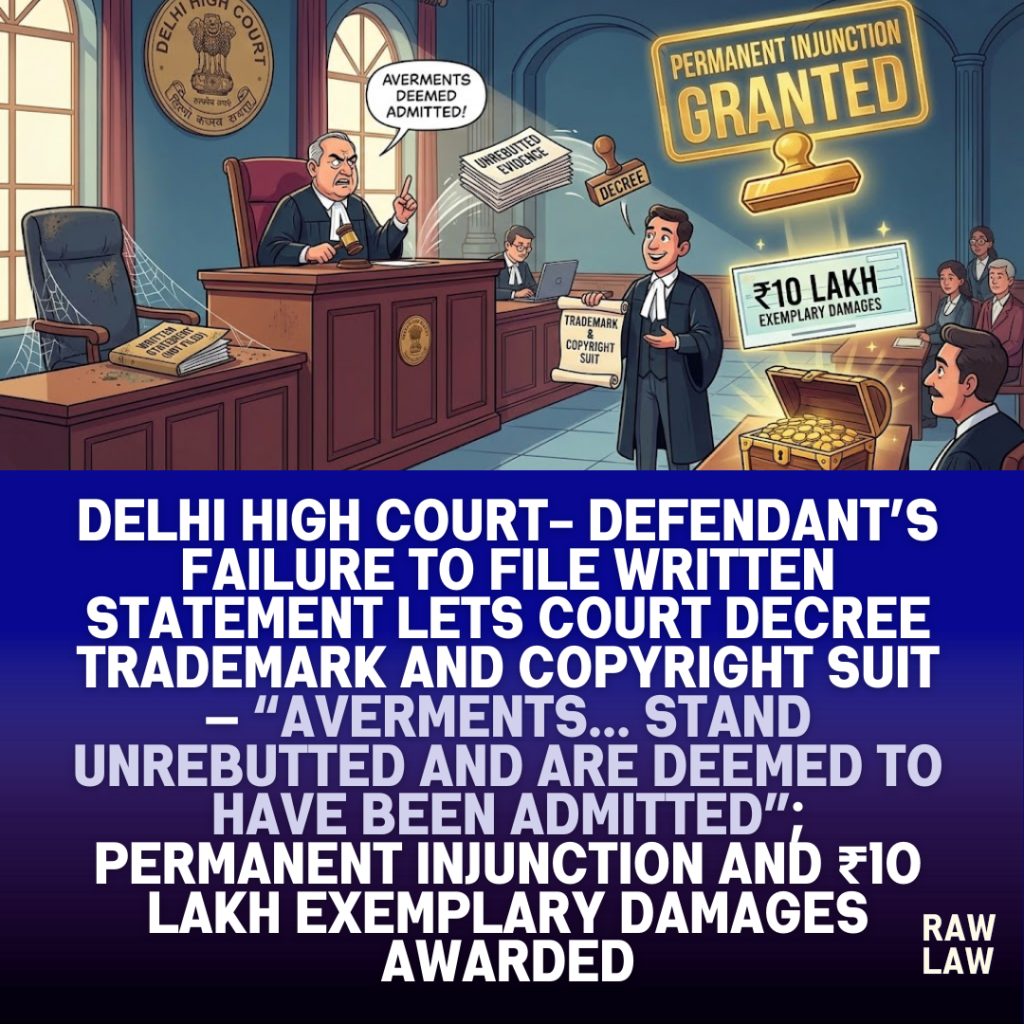
The Delhi High Court granted a plaintiff-led application seeking a decree after the defendant repeatedly failed to bring its written statement and replies on record within the mandatory timelines. Treating the plaint averments as unrebutted, the Court held that a clear case of trademark infringement, copyright infringement, and passing off had been made out in relation to green building certification services. It permanently restrained the defendant from using the impugned marks, including a green building council name and a commonly used abbreviation, and from using copied website content. The Court also imposed ₹10,00,000 as exemplary damages and directed award of actual costs under the commercial litigation framework.
2. Facts
The plaintiff is a well-known certification body offering green ratings and certification services for buildings and real estate projects. It pleaded trademark registrations for multiple marks associated with its certification ecosystem, and asserted substantial use and reputation in India, supported by a list of certified projects across years and locations. It also relied on its long-standing website and social media presence as part of its public-facing identity and dissemination of information about its services.
The defendant, a private certification entity, offered identical green building certification services and adopted marks that the plaintiff alleged were confusingly similar, including a council-style logo and a name and abbreviation that echoed the plaintiff’s branding. The plaintiff also alleged that the defendant’s website reproduced substantial portions of the plaintiff’s website content, presenting it as the defendant’s own explanatory material for certification credentials and sustainability standards.
3. Issues
The core issue was not a full trial on infringement but whether the Court could pronounce judgment against the defendant under the procedural powers in civil law and commercial litigation when the defendant failed to file a valid written statement within the prescribed 120-day period and repeatedly defaulted in curing filing defects. Flowing from that was whether the plaint and documents were of an unimpeachable character enabling the Court to grant final relief—permanent injunction, damages, and costs—without evidence being led, given the defendant’s persistent non-compliance and dilatory conduct.
4. Petitioner’s arguments
The plaintiff argued that the defendant’s marks were deceptively similar in their essential features—particularly a circular logo format, the placement and stylisation of central leaf imagery, and the overall look-and-feel that would lead consumers to assume an association with the plaintiff. It further contended that confusion risk was aggravated by overlapping customers, pointing to both entities offering certification services to major institutional users. Separately, the plaintiff highlighted side-by-side website content comparisons to show that the defendant copied the plaintiff’s original literary work, amounting to copyright infringement, and urged the Court to decree the suit because the written statement was never brought on record despite repeated directions.
5. Respondent’s arguments
The defendant’s stand, as recorded, was not a substantive defence on similarity or copyright. Instead, it claimed it had made efforts to amicably resolve the dispute and stated it did not want to contest the suit due to personal constraints. It also asserted it had stopped using the impugned marks and the infringing website pursuant to an earlier injunction order. Even so, it sought “some time” to gather documents and take steps to place its written statement on record—without demonstrating any concrete compliance with the multiple procedural directions issued over the course of the litigation.
6. Analysis of the law
The Court approached the matter through the lens of commercial litigation discipline and the statutory tightening of timelines for filing pleadings. In commercial suits, the written statement must be filed within a strict outer limit, and failure can trigger closure of the right and enable the Court to proceed on the basis that the plaint stands admitted. The Court treated the prolonged “under objections” status of the written statement—and the defendant’s failure to remove defects—as functionally equivalent to non-filing for the purpose of progressing the case.
Equally important, the Court stressed that a judgment under the procedural power to pronounce judgment for non-filing is not automatic. It must be exercised with caution: the plaint and accompanying documents must be sufficiently clear and unimpeachable so that the Court is not compelled to record evidence to prove foundational facts. In other words, the power is meant to curb dilatory tactics, but it still requires the Court to satisfy itself on the merits from the record as it stands.
7. Precedent analysis
The Court relied on a prior Delhi High Court decision explaining the scope of the power to pronounce judgment when a defendant fails to file a written statement. That precedent emphasises two things: first, the provision is designed to expedite justice and stop defendants from delaying proceedings by withholding pleadings; second, courts must remain cautious and ensure the plaint and documents are of such a nature that they do not require evidence to prove their contents. Applying this framework, the Court treated the case as fit for exercise of this jurisdiction because the defendant’s defaults were persistent and the plaintiff’s documentary foundation on trademarks, similarity, and website copying was placed on record.
8. Court’s reasoning
On procedure, the Court traced a long record of non-compliance. The defendant entered appearance early and claimed to have filed a written statement, but it remained “under objections” for an extended period, with the defendant repeatedly failing to remove defects despite specific directions. Replies to applications and written submissions were also not properly placed on record. The Court found the overall conduct indicative of dilatory tactics aimed at derailing adjudication. As a result, the plaint averments stood unrebutted and were deemed admitted, satisfying the procedural precondition for moving forward.
On merits, the Court held that the plaintiff proved it was the registered proprietor of its marks and had built goodwill and reputation through extensive use. It found that the defendant’s marks closely imitated dominant features, including the shape, overall stylisation, and central leaf imagery. The Court also accepted that the defendant’s website content had been significantly copied from the plaintiff’s website, constituting copyright infringement. It concluded that the defendant attempted to ride on the plaintiff’s goodwill, creating a strong likelihood that unwary consumers would be misled into believing the defendant’s services originated from, or were associated with, the plaintiff.
9. Conclusion
Given the defendant’s repeated procedural defaults and the Court’s findings on infringement and passing off from the unrebutted record, the High Court granted a permanent injunction in terms of the principal prayers seeking restraint against use of the infringing marks, including as a trade name or domain name, and against use of copied website content. The Court recorded that the defendant had undertaken that the impugned website was no longer operational and that it was not using the impugned name and abbreviation. Even so, it decreed the suit and directed that the defendant’s restraint would bind all persons acting on its behalf.
10. Implications
This ruling is a sharp reminder that commercial suits—especially intellectual property disputes—are governed by unforgiving pleading timelines. Defendants cannot keep written statements “under objections” indefinitely and expect courts to pause adjudication. For plaintiffs, the judgment shows how well-documented trademark portfolios, evidence of goodwill, and clear comparative material (like side-by-side website content) can support final relief where the defendant chooses delay over defence. The exemplary damages award also signals that repeated disobedience, non-compliance with court directions, and litigation misconduct can translate into monetary consequences beyond injunctions, including actual costs proceedings before the taxing officer.
Case law references
Nirog Pharma Pvt. Ltd. v. Umesh Gupta (Delhi High Court)
- What it held: The power to pronounce judgment for non-filing of a written statement exists to curb dilatory tactics and expedite justice, but courts must exercise caution and ensure the plaint and documents are unimpeachable and do not require evidence to prove their contents.
- How it was applied: The Court used this principle to justify proceeding to decree the suit because the defendant persistently failed to cure defects and place pleadings on record, leaving the plaintiff’s infringement and copyright material unrebutted, and enabling final relief on the existing record.
FAQs
1. What happens in a commercial suit if the defendant does not file a written statement within 120 days?
In commercial litigation, failure to file a valid written statement within the statutory outer limit can lead to closure of the defendant’s right to file it. The court may then proceed to pronounce judgment based on the plaint and documents, treating the plaintiff’s averments as unrebutted and deemed admitted, subject to the court’s satisfaction on merits.
2. Can a court grant a permanent injunction in a trademark case without a full trial?
Yes, in limited circumstances. If the defendant defaults procedurally and does not file its pleadings, the court can decree the suit under procedural rules, but it must still examine whether the plaint and documents establish infringement and passing off clearly enough that evidence is not necessary.
3. Does copying website text amount to copyright infringement in business disputes?
It can. Where a website contains original literary work and another entity reproduces substantial portions without permission—especially while offering identical services—courts may treat it as copyright infringement, alongside trademark infringement and passing off if the copied material contributes to consumer deception.