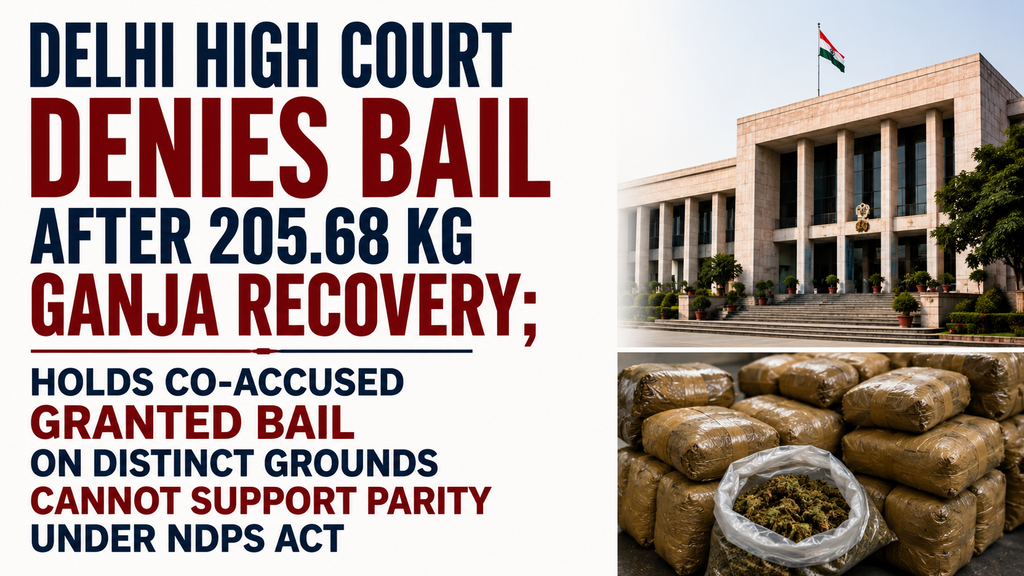
Delhi High Court Denies Bail After 205.68 Kg Ganja Recovery; Holds Co-Accused Granted Bail on Distinct Grounds Cannot Support Parity Under NDPS Act

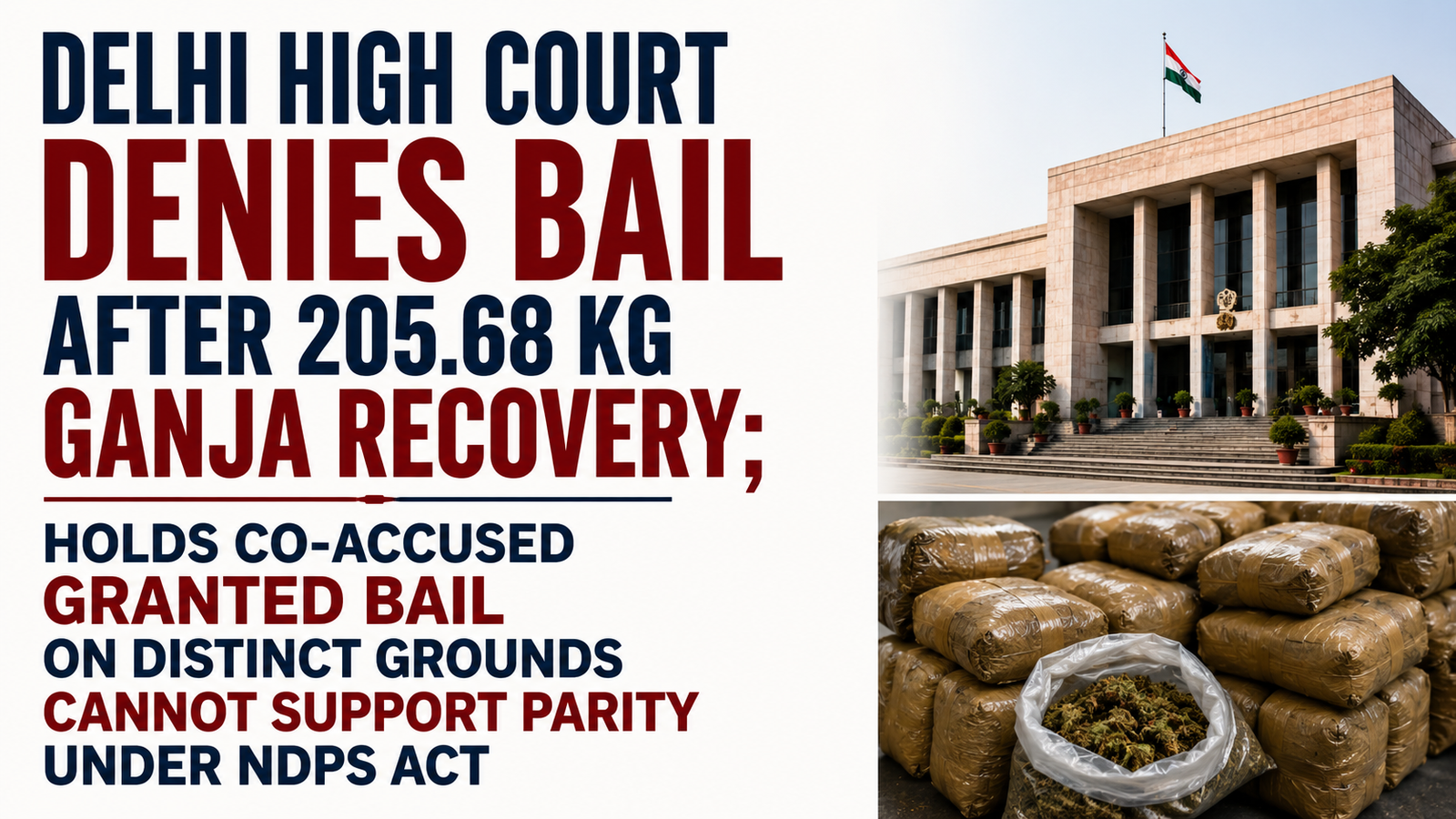
Delhi High Court Refuses Parity Bail in NDPS Case; Holds Recovery Over Ten Times Commercial Quantity Attracts Rigours of Section 37
Facts
The petitioner, Sumit Sharma, sought regular bail in FIR No. 32/2023, Police Station Ambedkar Nagar, registered for offences under Sections 20 and 25 of the Narcotic Drugs and Psychotropic Substances Act, 1985.
According to the prosecution, 205.68 kg of ganja was recovered from a car being driven by the petitioner. He had earlier filed two bail applications, which were withdrawn with liberty to approach the Trial Court again after the testimony of two recovery witnesses had been recorded. His subsequent bail application before the Trial Court was dismissed.
Before the Delhi High Court, the petitioner sought bail solely on the ground of parity with two co-accused, Anisha and Arvind, who had already been granted bail. No other ground for bail was urged.
Issues
The principal issue was whether Sumit Sharma was entitled to regular bail on the ground of parity with co-accused Anisha and Arvind.
The Court was required to determine whether the circumstances in which those co-accused obtained bail were sufficiently similar to the petitioner’s case to justify parity.
A further issue was the effect of the alleged recovery of 205.68 kg ganja, being more than ten times the statutory commercial quantity, upon the applicability of the stringent bail requirements under Section 37 of the NDPS Act.
Petitioner’s Arguments
The petitioner’s argument was confined to parity.
He submitted that co-accused Anisha and Arvind had already been granted bail, and therefore he should also receive similar relief.
Significantly, the judgment records that no other ground for grant of bail was raised on behalf of the petitioner.
Respondent’s Arguments
The State opposed the application and submitted that there was no parity whatsoever between Sumit Sharma and the two co-accused.
Regarding Arvind, the State pointed out that no contraband was recovered from him or at his instance. His implication arose only because he was the registered owner of the car which the petitioner was allegedly driving while carrying the contraband.
Regarding Anisha, although she was allegedly sitting beside the petitioner in the car at the time of recovery, she had obtained bail on a specific technical defect concerning her personal search.
The lady constables who conducted Anisha’s personal search had not been authorised by the concerned ACP under Section 42 of the NDPS Act. No comparable defect existed in Sumit Sharma’s case.
Analysis of the Law
The Court’s analysis focused on two principles: parity in bail and the statutory restrictions governing bail in commercial quantity NDPS cases.
Parity Is Not Mechanical
The judgment demonstrates that parity does not arise merely because persons are named as co-accused in the same criminal case.
For parity to operate, their respective roles, allegations and circumstances relevant to bail must be materially comparable.
Here, Arvind’s position was fundamentally different because no contraband was recovered from him or at his instance. His connection with the case was based upon his status as the registered owner of the vehicle.
Anisha’s position was also different because her bail resulted from a technical irregularity in her personal search, namely the lack of requisite authorisation for the lady constables who searched her. That defect was absent in Sumit Sharma’s case.
Therefore, the favourable bail orders of the two co-accused could not automatically be extended to the petitioner.
Section 37 NDPS Act
The quantity involved was decisive.
The Court recorded that:
- Small quantity of ganja: 1 kg;
- Commercial quantity: 20 kg;
- Quantity allegedly recovered in the petitioner’s case: 205.68 kg.
Thus, the alleged recovery was more than ten times the commercial quantity.
Consequently, the stringent conditions or “rigours” of Section 37 of the NDPS Act were attracted.
Since the petitioner’s sole argument was parity, and that parity itself was found to be unavailable, there was no basis before the Court to overcome the statutory restrictions imposed by Section 37.
Precedent Analysis
The judgment does not cite or analyse any judicial precedent on parity, Section 37 of the NDPS Act, or the principles governing regular bail.
The Court decided the application directly on the factual distinctions between the petitioner and his co-accused and the statutory consequence of the quantity allegedly recovered.
Therefore, no precedent should be attributed to this judgment beyond what the Court itself expressly considered.
Court’s Reasoning
The Court found that the petitioner’s reliance on parity was fundamentally misplaced.
First, Arvind stood on a materially different footing. No narcotic substance was recovered from him or at his instance. His involvement arose only from being the registered owner of the car.
In contrast, the prosecution specifically alleged that Sumit Sharma was driving the car from which 205.68 kg of ganja was recovered.
Second, Anisha’s bail was granted on a technical ground concerning the legality of her personal search. Since no equivalent technical irregularity existed in the petitioner’s case, her bail order could not provide him a ground for parity.
Third, the alleged recovery of 205.68 kg of ganja was extraordinarily above the statutory commercial quantity of 20 kg. This directly attracted Section 37’s stringent bail restrictions.
The Court therefore concluded that the petitioner had no parity at all with either Anisha or Arvind.
Conclusion
The Delhi High Court dismissed Sumit Sharma’s regular bail application.
It held that he could not claim parity merely because two co-accused had been granted bail when the factual and legal grounds underlying their bail were materially different.
Arvind faced no recovery of contraband, while Anisha received bail because of a technical defect in her personal search. Sumit Sharma, on the other hand, was allegedly driving the vehicle from which 205.68 kg of ganja—more than ten times the commercial quantity—was recovered.
Accordingly, the rigours of Section 37 NDPS Act applied, and the Court found no basis to grant bail on parity.
Case Details
Case: Sumit Sharma v. The State (NCT of Delhi) & Anr.
Court: High Court of Delhi at New Delhi
Case Number: BAIL APPLN. 2644/2026; CNR No. DLHC010296922026
Judge: Justice Girish Kathpalia
Date: 25 August 2026
Result: Regular bail dismissed. The Court rejected parity with both co-accused and held that recovery of 205.68 kg ganja attracted the rigours of Section 37 NDPS Act.