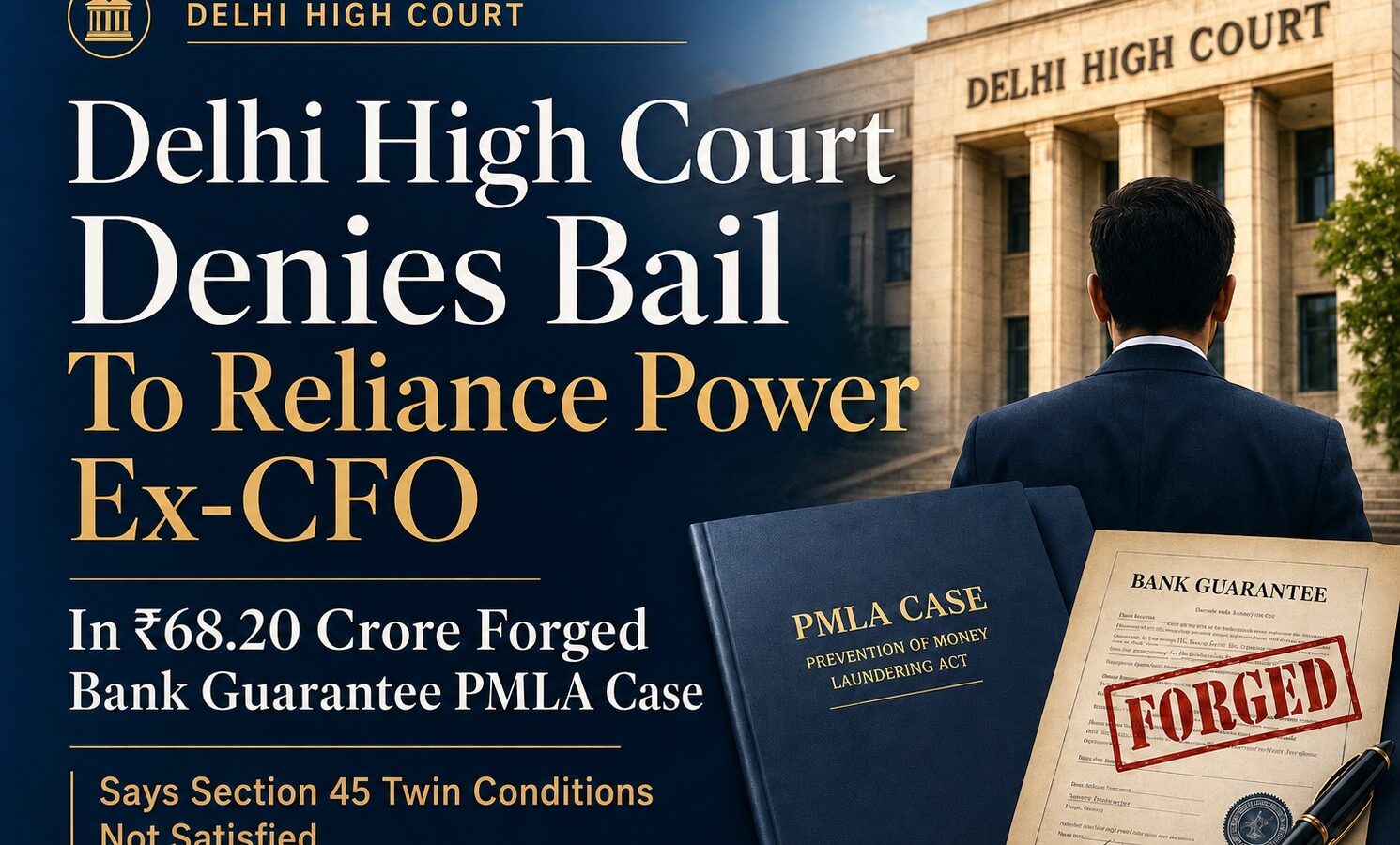
Delhi High Court Denies Bail To Reliance Power Ex-CFO In ₹68.20 Crore Forged Bank Guarantee PMLA Case

Court’s Decision
The Delhi High Court dismissed the regular bail application filed by Ashok Kumar Pal, former Chief Financial Officer of Reliance Power Limited, in a money laundering case registered by the Directorate of Enforcement under the Prevention of Money Laundering Act, 2002.
The Court held that, at the stage of bail, it could not ignore the material relied upon by the Enforcement Directorate, including Section 50 PMLA statements, documentary material, email exchanges, WhatsApp communications, agreements, and alleged electronic evidence relating to forged bank guarantees and endorsements.
The Court found that it was unable to record satisfaction that there were reasonable grounds for believing that the applicant was not guilty of the alleged offence. Therefore, the twin conditions under Section 45 of the PMLA were not satisfied.
Accordingly, the applications for regular bail and interim bail were dismissed.
Facts
The applicant, Ashok Kumar Pal, was working as Chief Financial Officer of Reliance Power Limited from 29 January 2023 to 11 October 2025. He was also an authorised signatory of Reliance NU BESS Limited, formerly known as Maharashtra Energy Generation Limited, a subsidiary of Reliance Power Limited.
On 26 June 2024, Solar Energy Corporation of India Limited issued a Request for Selection for setting up a 1000 MW/2000 MWh Stand-alone Battery Energy Storage System project. The bidders were required to submit a bank guarantee of ₹68.20 crore.
Reliance Power Limited entered into a Cooperation Agreement dated 29 July 2024 with Biswal Tradelink Private Limited for arranging the bank guarantee. A Supplementary Agreement dated 2 August 2024 provided for payment of commission/service charges at 6.5% of the bank guarantee amount. Later, by a letter dated 6 August 2024, the commission was increased from 6.5% to 8%, and the tenure was revised from two years to one year.
A bank guarantee dated 12 August 2024 for ₹68.20 crore was allegedly issued by ACE Investment Bank Limited, Malaysia and furnished before SECI. SECI later informed Reliance NU that the bank was not a Scheduled Commercial Bank and asked it to furnish a revised bank guarantee from a Scheduled Commercial Bank recognised by the RBI.
According to the prosecution, the accused persons thereafter arranged an alleged forged endorsement on the letterhead of State Bank of India, CAG Branch, Gole Market, New Delhi, in relation to another bank guarantee purportedly issued by FirstRand Bank, Philippines. SECI later informed Reliance NU that the SBI endorsement was not genuine.
On 16 October 2024, the applicant, on behalf of Reliance NU, lodged a complaint before the Economic Offences Wing against Biswal Tradelink Private Limited and its directors. This led to registration of FIR No. 0131/2024. Later, another FIR No. 0079/2025 was registered at the instance of SECI in respect of substantially the same transaction.
On the basis of the predicate offence, the Directorate of Enforcement registered ECIR/STF/14/2025 under the PMLA. The applicant’s statements were recorded under Section 50 PMLA on 11 August 2025 and 12 August 2025. He was later summoned on 7 October 2025 and arrested on 10 October 2025.
The Enforcement Directorate filed a supplementary prosecution complaint dated 5 December 2025, arraying the applicant as an accused. His applications for default bail and regular bail were dismissed by the Trial Court on 11 March 2026. He then approached the High Court seeking regular bail.
Issues
The principal issue before the Delhi High Court was whether the applicant was entitled to regular bail in a PMLA case involving alleged forged bank guarantees, forged SBI endorsements, and alleged proceeds of crime connected with payments made to Biswal Tradelink Private Limited.
The Court also had to consider whether the applicant satisfied the twin conditions under Section 45 of the PMLA.
Applicant’s Arguments
The applicant argued that he had been in custody since 10 October 2025 and that the trial was unlikely to begin or conclude soon, especially since the prosecution had cited 72 witnesses and arrayed 11 accused persons.
It was argued that continued detention would amount to pre-trial punishment.
The applicant further submitted that he himself had lodged the complaint which led to registration of the first FIR, and therefore he was a victim of the alleged fraud, not a beneficiary.
He contended that no proceeds of crime accrued either to him or to Reliance Power Limited, as the tender process was ultimately cancelled and no contract was awarded.
The applicant also submitted that Reliance Power Limited had engaged Biswal Tradelink Private Limited to arrange the bank guarantee and that there was no material to show that he knew the bank guarantee was forged or fabricated.
He relied on his cooperation with the investigation and submitted that his statements had already been recorded under Section 50 PMLA. He also argued that he had no criminal antecedents, was not a flight risk, and had deep roots in society.
Respondent’s Arguments
The Enforcement Directorate opposed bail and argued that the case involved serious allegations relating to forged bank guarantees, forged SBI endorsements, and fabricated confirmations furnished before SECI.
The ED submitted that the applicant, while functioning as CFO of Reliance Power Limited, had executed the Cooperation Agreement dated 29 July 2024, the Supplementary Agreement dated 2 August 2024, and the letter dated 6 August 2024 revising the commission payable to Biswal Tradelink Private Limited.
The ED alleged that the proceeds of crime were quantified at ₹11.73 crore, comprising payments made by Reliance Power Limited and Rosa Power Supply Company Limited to Biswal Tradelink Private Limited.
The ED also relied on electronic evidence, WhatsApp communications, email communications, documentary material, and statements recorded under Section 50 of the PMLA.
It was argued that the applicant did not satisfy the twin conditions under Section 45 PMLA and that economic offences of this nature required a stricter approach at the stage of bail.
Analysis
The Court noted that the applicant was not pressing, in the present proceedings, the plea relating to further investigation allegedly being conducted without leave of the Court and the consequential plea for default bail. The Court therefore confined itself only to the question of regular bail.
The Court reiterated that bail under the PMLA is governed by Section 45, under which the Court must be satisfied that there are reasonable grounds for believing that the accused is not guilty and that he is not likely to commit any offence while on bail.
The Court examined the material relied upon by the Enforcement Directorate, including the Cooperation Agreement, Supplementary Agreement, communication dated 6 August 2024, Section 50 PMLA statements, emails, WhatsApp communications and other material collected during investigation.
The Court specifically noted the ED’s reliance on the statement of Amar Nath Dutta, according to which ACE Investment Bank allegedly did not issue hard copies of bank guarantees, but the applicant allegedly insisted on obtaining a hard copy of the bank guarantee.
The ED also relied upon WhatsApp communications to contend that the applicant forwarded a revised draft of the bank guarantee and suggested modification of the issuing bank’s particulars from “FirstRand Investment Limited, USA” to “FirstRand Bank, Manila, Philippines.”
The Court further noted the ED’s argument that even after SECI raised objections regarding the endorsements and confirmations, additional steps were allegedly taken to obtain fresh endorsements and confirmations.
The Court clarified that the evidentiary weight and correctness of this material would be examined during trial. However, at the bail stage, the material could not be completely ignored.
Precedents Relied Upon
The applicant relied upon judgments including:
- Arvind Dham v. Directorate of Enforcement
- Udhaw Singh v. Directorate of Enforcement
- Syed Iftikhar Andrabi v. National Investigation Agency
- Prem Prakash v. Union of India
- Arvind Kejriwal v. Directorate of Enforcement
- Pankaj Bansal v. Union of India
The Enforcement Directorate relied upon judgments including:
- Rohit Tandon v. Directorate of Enforcement
- Tarun Kumar v. Directorate of Enforcement
- Satyender Kumar Jain v. Directorate of Enforcement
- Vijay Madanlal Choudhary v. Union of India
- Union of India v. Kanhaiya Prasad
Reasoning
The Court held that the applicant’s arguments — that he had no knowledge of the alleged forgery, that he acted only in his official capacity, that he lodged the complaint, and that no proceeds of crime accrued to him — were matters requiring appreciation of evidence at trial.
Similarly, the correctness of the statements, documentary material and electronic communications relied upon by the ED would also have to be tested during trial.
However, for the purpose of bail, the Court was required to assess whether the material disclosed a prima facie case and whether the applicant satisfied Section 45 PMLA.
The Court concluded that, considering the nature of allegations and the material placed by the ED, it could not record satisfaction that there were reasonable grounds for believing that the applicant was not guilty of the alleged offence.
Therefore, the twin conditions under Section 45 of the PMLA were not satisfied.
Conclusion
The Delhi High Court dismissed the bail application filed by Ashok Kumar Pal in the PMLA case arising out of the alleged forged bank guarantee transaction connected with the SECI tender.
The Court held that no ground for regular bail or interim bail was made out.
The Court also clarified that its observations were only for deciding the bail application and should not be treated as an expression on the merits of the case.
Implications
This judgment reinforces that in PMLA bail matters, the Court must apply the twin conditions under Section 45 strictly.
Even where the accused claims cooperation with investigation, absence of direct personal gain, no criminal antecedents, or that he acted in an official capacity, bail may still be refused if the prosecution places prima facie material showing possible involvement in the alleged transaction.
The decision also highlights that electronic communications, Section 50 PMLA statements, and documentary material can be considered at the bail stage, although their final evidentiary value will be tested during trial.
The key takeaway is that in money laundering cases involving alleged economic offences, the Court will not conduct a mini-trial at the bail stage, but it will examine whether the material placed by the ED is sufficient to prevent satisfaction of the Section 45 twin conditions.