Delhi High Court Denies Railway Compensation for Passenger’s Death; Finds Ticket Purchased Four Hours After Train Departed, Failing to Prove Bona Fide Journey

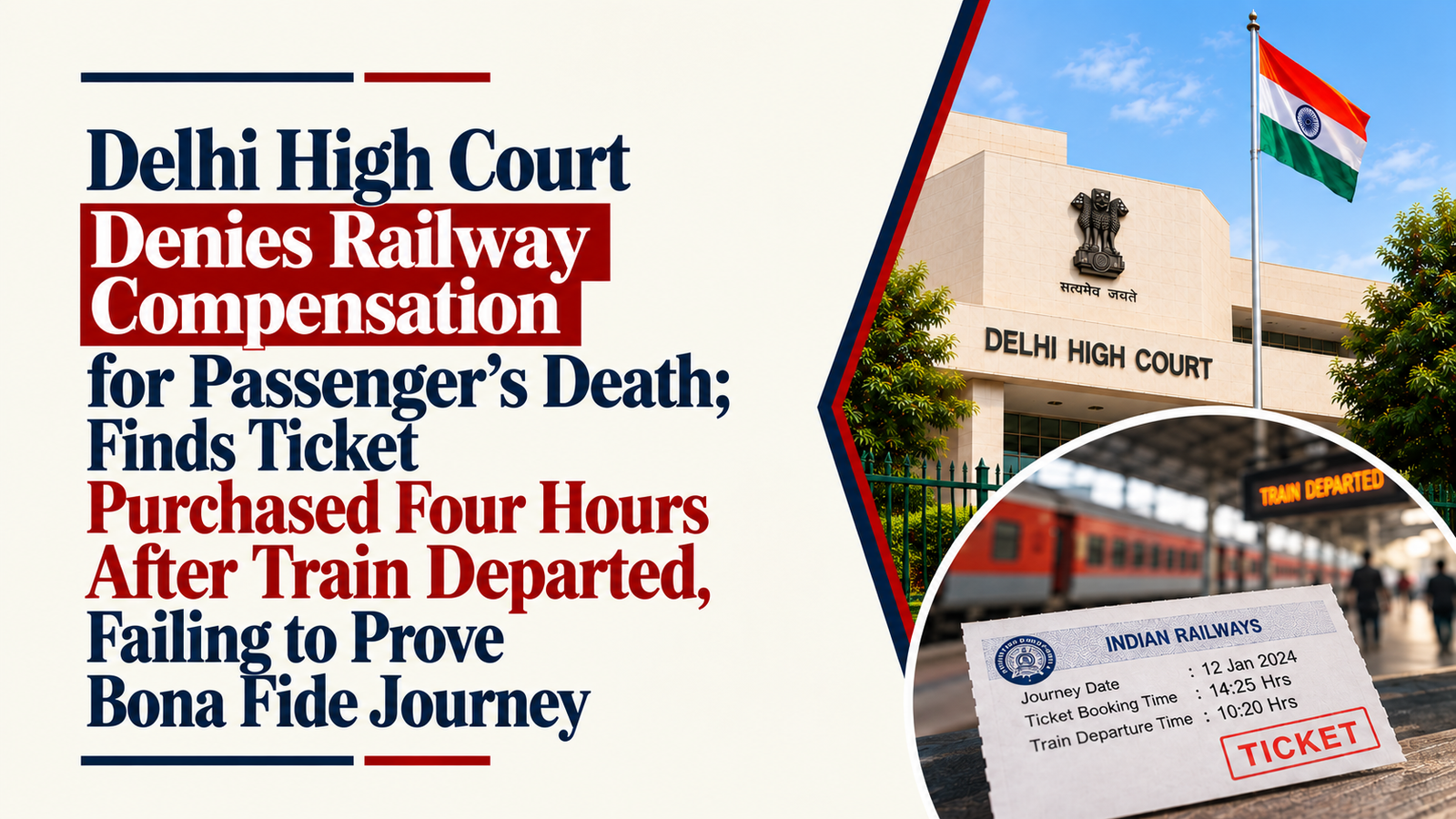
Delhi High Court Upholds Rejection of Railway Death Claim; Says Ticket Timing Made Deceased’s Alleged Journey on Brahmaputra Mail Impossible to Establish
Facts
The appeal was filed by Sunaina Devi under Section 23 of the Railway Claims Tribunal Act, 1987, challenging the Railway Claims Tribunal’s judgment dated 21 January 2014 dismissing her compensation claim arising from the death of her husband, Shambhu Manjhi.
According to the appellant, on 17 April 2011, her husband was travelling from Patna Junction to New Delhi by Train No.4055, Brahmaputra Mail, on a second-class superfast ticket.
She claimed that the general compartment was heavily crowded and that the deceased was standing near the gate. While the train was near Sachiwalaya Halt, a sudden jerk and jostling among passengers allegedly caused him to fall from the running train. He was taken to PMCH, Patna, where he later died.
The crucial difficulty was the timing recorded on the ticket relied upon by the claimant.
The ticket was purchased at 17:47 hours on 17 April 2011, whereas the Station Manager’s report based on the TSR record established that Train No.4055 had departed Patna Junction at 13:18 hours that day.
Thus, the ticket was purchased more than four hours after the very train on which the deceased was alleged to have travelled had already departed.
Issues
The principal issues were:
- Whether Shambhu Manjhi was proved to be a bona fide passenger of Brahmaputra Mail on 17 April 2011.
- Whether recovery of a railway ticket from the deceased was sufficient to establish bona fide passenger status.
- What effect should be given to the fact that the relied-upon ticket was purchased more than four hours after the alleged train had departed.
- Whether inconsistencies concerning the deceased’s treatment and date of death further weakened the claim.
- Whether the alleged fall could attract compensation under Section 124-A of the Railways Act as an “untoward incident” without first establishing bona fide passenger status.
Appellant’s Arguments
The appellant argued that her husband was a bona fide passenger because the railway ticket was found on his person and was also referred to in the police papers.
She relied upon:
- the journey ticket;
- the statement of Rajendra Manjhi, the deceased’s cousin;
- the inquest report;
- the FIR; and
- other police documents.
She contended that these materials supported the case that her husband suffered injuries after falling from the train.
The appellant further argued that the fact that she herself had not witnessed the accident could not be used against her.
Given the beneficial nature of railway compensation legislation, she relied upon the Supreme Court’s decision in Union of India v. Rina Devi, (2019) 3 SCC 572.
Railways’ Arguments
The Union of India contended that the appellant had failed to establish that the deceased had actually travelled by Train No.4055.
The strongest piece of evidence was the timing discrepancy:
- ticket purchased: 17:47 hours;
- Brahmaputra Mail departure from Patna: 13:18 hours.
Accordingly, the ticket relied upon could not establish travel on the train pleaded in the claim.
The Railways also pointed out that the appellant gave detailed particulars about a journey she had not witnessed without identifying the source of that information.
Further, Rajendra Manjhi’s police statement did not establish either that the deceased had boarded Train No.4055 or the precise manner in which he allegedly fell.
There was also a contradiction regarding the date of death: the appellant stated that her husband died at PMCH on 17 April 2011, whereas Rajendra’s statement recorded his death on 18 April 2011. No PMCH admission record or death certificate was produced.
Analysis of the Law
1. Non-Recovery of Ticket Is Not Automatically Fatal
The High Court reaffirmed the settled principle that mere non-recovery of a railway ticket from an injured or deceased passenger does not by itself establish that the person was not a bona fide passenger.
This reflects the beneficial character of the railway compensation regime.
2. Claimant Still Bears Initial Burden
However, beneficial legislation does not eliminate the claimant’s initial burden of establishing the foundational facts of the journey.
The claimant must first place sufficient material before the Tribunal to show that the deceased was actually travelling as a bona fide passenger.
3. This Was Not a Mere “Missing Ticket” Case
The Court emphasised an important distinction.
The problem was not that the ticket was missing.
Rather, the very ticket relied upon by the appellant affirmatively contradicted her case because its purchase time was later than the train’s departure time.
The Court observed that this circumstance:
“goes to the root of the appellant’s case”.
Therefore, there was no satisfactory basis to conclude that Shambhu Manjhi boarded Brahmaputra Mail on the strength of that ticket.
4. Contradictory Evidence Regarding Death Further Weakened Claim
The appellant said that the deceased was taken to PMCH and died on 17 April 2011.
Rajendra Manjhi’s police statement, however, recorded that he died at PMCH on 18 April 2011.
No hospital admission record or death certificate was produced to resolve the discrepancy.
Although the ticket discrepancy itself was sufficient, this inconsistency further weakened the factual foundation of the claim.
5. Bona Fide Passenger Status Is a Threshold Requirement
The Court clarified that the question was not simply whether the deceased happened to possess a railway ticket.
The relevant question was whether he was a bona fide passenger of the particular train pleaded by the claimant.
On the evidence, the appellant failed to discharge that initial burden.
6. “Untoward Incident” Question Became Irrelevant
Once bona fide passenger status remained unproved, compensation under Section 124-A could not be awarded.
The Court therefore held that even if the alleged fall could otherwise fall within the definition of an “untoward incident,” that issue could not rescue the claim.
The statutory compensation claim itself depended upon establishing that the deceased was a bona fide passenger.
Precedent Analysis
Union of India v. Rina Devi, (2019) 3 SCC 572
The appellant relied upon Rina Devi in support of the beneficial interpretation of railway compensation law and the principle that non-recovery of a ticket is not necessarily fatal.
The Delhi High Court did not disagree with that principle.
Instead, it distinguished the present case because this was not a case of mere non-recovery of a ticket. The ticket actually produced by the claimant was inconsistent with the journey alleged.
Mohammad Azam v. Union of India, 2026 SCC OnLine Del 6413
The High Court found this decision more directly applicable.
In Mohammad Azam, the Court distinguished between:
- a case where a ticket is simply not recovered; and
- a case where the ticket relied upon was demonstrably issued after the occurrence or relevant journey.
The Court adopted the same approach in Sunaina Devi’s case.
Court’s Reasoning
The decisive factual calculation was straightforward:
Train departure: 13:18 hrs
Ticket purchase: 17:47 hrs
Difference: 4 hours 29 minutes
Accordingly, the relied-upon ticket could not establish that the deceased boarded the 13:18 Brahmaputra Mail from Patna.
The Court therefore refused to infer bona fide passenger status merely because a railway ticket was allegedly recovered from the deceased.
The additional discrepancy concerning whether he died on 17 or 18 April 2011, coupled with the absence of PMCH records, reinforced the Tribunal’s conclusion.
Conclusion
The Delhi High Court held that the appellant had failed to prove that the deceased was a bona fide passenger of Train No.4055.
Consequently, the foundational requirement for compensation under Section 124-A of the Railways Act was not established.
The Court found no reason to interfere with the Railway Claims Tribunal’s judgment and dismissed the appeal.
Case Details
Case: Sunaina Devi v. Union of India & Anr.
Court: High Court of Delhi at New Delhi
Case Number: FAO 322/2014
Judge: Justice Manoj Kumar Ohri
Reserved on: 25 August 2026
Date: 3 September 2026
Tribunal Case: Claim Application No. OA/II(u)/463/2011
Impugned Judgment: Railway Claims Tribunal, Principal Bench, Delhi, dated 21 January 2014
Deceased: Shambhu Manjhi
Alleged Train: Train No.4055, Brahmaputra Mail
Result: Appeal dismissed; Railway Claims Tribunal’s rejection of compensation upheld because the claimant failed to establish that the deceased was a bona fide passenger.