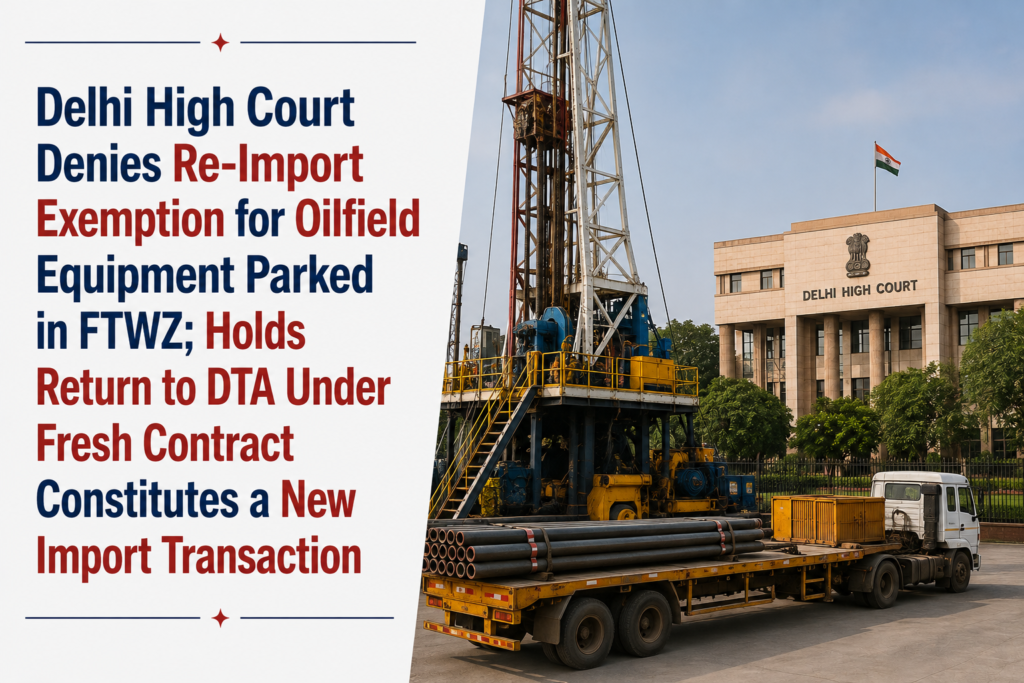
Delhi High Court Denies Re-Import Exemption for Oilfield Equipment Parked in FTWZ; Holds Return to DTA Under Fresh Contract Constitutes a New Import Transaction

Delhi High Court Upholds Advance Rulings on Oilfield Equipment; Says FTWZ Warehousing Between Indian Projects Breaks Continuity Required for Re-Import Exemption
Facts
The Delhi High Court decided four connected customs appeals filed by Baker Hughes Oilfield Services India Pvt. Ltd., Baker Hughes Singapore Pte., BJ Services Company Middle East Ltd. and Halliburton Offshore Services Inc. against separate advance rulings of the Customs Authority for Advance Rulings (“CAAR”). The common issue concerned eligibility for exemption under Serial No. 5 of Notification No. 45/2017-Customs dated 30 June 2017 when petroleum equipment was moved from a Special Economic Zone/Free Trade Warehousing Zone (“FTWZ”) back into the Domestic Tariff Area (“DTA”).
The appellants provided technical, mining and allied services as subcontractors to oil and gas exploration companies, including ONGC and Cairn India. CAAR had ruled that they were not entitled to exemption from Basic Customs Duty, IGST and compensation cess under Notification 45/2017 when equipment earlier moved from DTA to FTWZ was subsequently cleared back into DTA.
The proposed commercial structure was that specialised equipment would initially be imported into India for petroleum operations under Notification No. 50/2017-Customs (“NN-50”), with nil Basic Customs Duty and concessional IGST, against an Essentiality Certificate issued for a particular contract.
After completion of that project, instead of physically exporting the equipment outside India, the appellant proposed to move the same equipment, without manufacturing or processing, to an FTWZ for storage until another Indian petroleum contract was secured. No drawback, rebate or export incentive would be claimed on the DTA-to-FTWZ movement.
Once a fresh contract was secured and a new Essentiality Certificate issued, the same equipment would be brought from FTWZ back into DTA. The appellants proposed simultaneously to claim the concessional import treatment under NN-50 and the re-import exemption under Serial No. 5 of NN-45.
The diagram reproduced on page 13 of the judgment illustrated precisely this sequence: foreign import into India, deployment at a customer site, return to the appellant, movement to FTWZ for storage and eventual clearance back into DTA under a new Essentiality Certificate.
Issues
The principal questions before the Delhi High Court were:
- Whether movement of equipment from DTA to FTWZ and its subsequent clearance back into DTA constitutes a “re-import” for Serial No. 5 of Notification 45/2017.
- Whether the legal fiction under the Special Economic Zones Act, 2005, treating an SEZ/FTWZ as outside the customs territory for specified purposes, necessarily converts every FTWZ-to-DTA movement into a re-import.
- Whether Section 30 of the SEZ Act, which treats DTA clearance as chargeable to customs duty as if imported into India, also establishes entitlement to a specific re-import exemption.
- Whether Rule 48(3) of the SEZ Rules, 2006, which treats certain DTA goods supplied back from an SEZ as re-imported goods, applied to equipment merely held in custody by an FTWZ logistics provider.
- Whether an importer can characterise the same FTWZ-to-DTA movement as an “import” under NN-50 and a “re-import” under NN-45 to claim separate fiscal benefits.
- Whether a fresh contract and fresh Essentiality Certificate create a distinct import transaction notwithstanding that the physical equipment remains the same.
Appellants’ Arguments
The appellants argued that Section 20 of the Customs Act recognises re-importation as a fresh import and that once the same goods return to India for a second time, the transaction should qualify as a re-import.
They relied upon Sections 30 and 53 of the SEZ Act to contend that an SEZ or FTWZ is treated as outside the customs territory and that movement of goods from SEZ to DTA is treated, for customs purposes, as an import.
Accordingly, they argued that once DTA-to-FTWZ movement is treated as an export, the reverse movement must logically constitute a re-import.
They also relied heavily upon Rule 48(3) of the SEZ Rules, which states that goods procured from DTA by an SEZ unit and subsequently supplied back to DTA, either as-is or without substantial processing, shall be treated as re-imported goods and subjected to normal re-import procedures.
The appellants relied upon Roxul Rockwool Insulation India Pvt. Ltd. v. Union of India and Adani Power Ltd. v. Union of India to support the proposition that SEZ-to-DTA clearances are treated as imports for customs purposes.
They also relied upon CBIC Circular No. 21/2019-Customs, arguing that it recognised the availability of Serial No. 5 of NN-45 where goods were taken outside India without claiming export incentives and subsequently returned.
From a commercial perspective, the appellants submitted that physically exporting expensive oilfield equipment abroad after each domestic project, merely to bring it back again for another Indian project, would involve unnecessary logistical expense. FTWZ storage was therefore said to be a practical substitute for physical export.
Respondents’ Arguments
The Customs authorities argued that the proposed transaction was a fresh import rather than a re-import.
According to the Revenue, the initial import under NN-50 was made against an Essentiality Certificate connected to a particular petroleum contract. When that contract ended and the equipment was moved to FTWZ, the original concessional transaction stood completed.
A subsequent clearance into DTA would arise only when:
- another petroleum contract was obtained; and
- a fresh Essentiality Certificate was issued.
The later clearance therefore had a new commercial and statutory basis and could not be treated as merely reversing the earlier export.
The Revenue further argued that the SEZ statutory fiction did not automatically establish eligibility under every customs exemption notification.
It also contended that Rule 48(3) did not assist the appellants because the FTWZ operator merely held the goods temporarily and did not actually procure them in the substantive sense contemplated by the Rule.
Analysis of the Law
Notification 50 Already Provides a Redeployment Mechanism
A major feature of the Court’s reasoning was Condition No. 48(c) of NN-50.
The Court noted that this condition itself contemplates transfer of concessionally imported petroleum equipment from one eligible person to another.
The transferor must inform customs and obtain discharge, while the transferee assumes the obligations of the notification as though it were the importer.
This was important because it demonstrated that NN-50 already recognised the practical possibility that equipment imported for one petroleum operation might later be required for another.
The notification itself therefore provided a statutory bridge for continued eligible use.
The Court held that the equipment did not need to be converted artificially into an export-and-re-import cycle merely to enable redeployment for another Indian petroleum project.
Applying the principle expressum facit tacitum cessare—where the law expressly provides how something is to be done, an alternative materially different route should not ordinarily be implied—the Court refused to read an additional FTWZ route into the exemption scheme.
Commercial Routing Cannot Create an Additional Fiscal Exemption
The High Court found that accepting the appellants’ interpretation would create an anomalous outcome.
A person using the express transfer mechanism under Condition 48(c) would remain subject to NN-50’s conditions.
But a person inserting an intermediate FTWZ storage step could potentially secure an additional re-import exemption under NN-45.
The Court rejected that result.
It observed that fiscal concessions are matters of legislative prescription, not commercial structuring, and that adoption of a more circuitous procedural route cannot enlarge an exemption which the notification itself does not confer.
SEZ/FTWZ Legal Fiction Has Limited Purpose
The appellants placed substantial reliance upon the legal fiction under the SEZ Act.
The High Court accepted that, for statutorily specified purposes:
- FTWZ/SEZ is treated as outside the customs territory; and
- goods cleared from an SEZ into DTA may be subjected to customs duty as if they were imported.
However, the Court held that such deeming provisions do not operate as a universal declaration that every movement into FTWZ constitutes an export for all fiscal purposes and every return to DTA constitutes a re-import under every exemption notification.
A legal fiction, the Court said, must remain confined to the purpose for which the legislature created it.
It cannot be expanded to override the conditions of a separate exemption notification or manufacture an additional exemption under NN-45.
Substance of Transaction Prevails
The Court also considered the substantive commercial reality.
The equipment was never intended to be deployed abroad.
It remained physically within India and under the appellants’ ownership and operational control. It was moved to an FTWZ only as an intervening warehousing arrangement between two domestic petroleum contracts.
The statutory fiction associated with an FTWZ could not obscure that substantive reality.
Thus, merely moving the equipment into an FTWZ did not automatically generate the export continuity necessary for a later re-import exemption.
Meaning of “Re-Import”
The Court examined the ordinary and legal meaning of “re-import”.
It held that the prefix “re” necessarily conveys a return to an earlier position or place. In the context of goods, re-import ordinarily involves goods having gone out and subsequently being brought back.
However, identity of the physical goods is not enough.
There must also be continuity between the earlier outward movement and the subsequent return.
The later movement must genuinely be a restoration or reversal of the earlier export.
It cannot constitute a completely independent transaction founded upon a new commercial and legal basis.
Fresh Essentiality Certificate Creates a New Transaction
The Court found the necessary continuity absent in these cases.
The original equipment entered India against an Essentiality Certificate tied to a particular petroleum project.
After completion of that project, the equipment was required to leave that contractual deployment.
Its later return to DTA would take place only after:
- a different domestic contract was secured; and
- a fresh Essentiality Certificate was issued.
Thus, the later inward movement was not a reversal of the earlier outward movement but the beginning of another independent petroleum-services transaction.
The Court described the original transaction as a “closed transaction”.
Completion of the original contractual deployment exhausted the purpose of the first Essentiality Certificate. The subsequent Essentiality Certificate was a fresh statutory and commercial foundation for importation.
Accordingly, the mere fact that the physical equipment happened to be identical could not merge two independent transactions into one continuing transaction.
Simultaneous Reliance on NN-50 and NN-45
Another decisive issue was the appellants’ attempt to invoke both notifications for the same inward movement.
NN-50 applies to goods “imported” for qualifying petroleum operations.
NN-45 applies to qualifying “re-imported” goods.
The Court held that these expressions occupy different legal fields.
An importer cannot characterise the same FTWZ-to-DTA movement as an “import” for one component of customs liability and simultaneously as a “re-import” for another simply to obtain separate exemptions.
The legal character of the transaction must first be identified; the fiscal consequences then follow from that character.
Allowing otherwise would permit the same movement to possess two inconsistent legal identities and unlock fiscal concessions not expressly granted by either notification.
Precedent Analysis
Roxul Rockwool Insulation India Pvt. Ltd. v. Union of India and Adani Power Ltd. v. Union of India
The appellants relied on these Gujarat High Court decisions for the proposition that clearance from SEZ into DTA is treated as import for customs purposes.
The Delhi High Court did not dispute the broad proposition concerning assessment of SEZ-to-DTA clearances.
However, it distinguished between:
(i) treating goods as imported for the purpose of charging customs duty; and
(ii) deciding whether those goods satisfy the specific requirements of an exemption applicable only to “re-imported goods”.
Section 30 of the SEZ Act deals with the manner and incidence of customs assessment. It does not independently answer the separate question of entitlement under NN-45.
Thus, the authorities did not establish that every deemed import from an SEZ must also be treated as a re-import.
Rule 48(3) of the SEZ Rules
Rule 48(3) expressly states that where goods procured from DTA by an SEZ unit are supplied back to DTA without substantial processing, they may be treated as re-imported goods.
The Court held that the appellants could not obtain the benefit of this provision because the FTWZ unit had not substantively procured the equipment.
It was merely a logistics custodian holding the appellants’ equipment temporarily at their instruction and ultimately returning it to them.
Further, Rule 48(3) was a general procedural provision and could not displace the specific conditions imposed by NN-50 concerning concessionally imported petroleum equipment.
CBIC Circular No. 21/2019-Customs
The appellants also relied upon the 2019 Circular concerning goods exported outside India for purposes such as exhibition or consignment and later returned.
The Court distinguished it factually and legally.
That circular dealt with goods actually sent outside India for temporary purposes.
The present arrangement involved equipment remaining physically within India, merely placed in an FTWZ under the special SEZ statutory fiction, and later returned because a fresh domestic contract had been obtained.
The Circular therefore did not assist the appellants.
Court’s Reasoning
The High Court’s reasoning ultimately rested on four connected propositions.
First, NN-50 itself provides a comprehensive mechanism for continued deployment, transfer and eventual disposal of concessionally imported petroleum equipment. An importer cannot devise an alternative FTWZ route and thereby obtain an additional fiscal benefit not contemplated by the notification.
Second, SEZ statutory fictions must be confined to their legislative purpose. They cannot automatically transform temporary FTWZ warehousing into an export and subsequent DTA clearance into a re-import for every customs exemption.
Third, the concept of re-import requires more than physical identity of goods. There must be legal and commercial continuity between the outward movement and the return.
Fourth, that continuity was broken because completion of the original petroleum contract concluded the first Essentiality Certificate transaction. A new contract and fresh Essentiality Certificate initiated an entirely new transaction.
The Court therefore held that the proposed FTWZ-to-DTA clearance had to be treated as a fresh import.
Conclusion
The Delhi High Court upheld the Customs Authority for Advance Rulings and dismissed all four appeals.
It held that movement of the petroleum equipment from FTWZ into DTA pursuant to a subsequent Essentiality Certificate constitutes a fresh import and not a re-import under Serial No. 5 of Notification No. 45/2017-Customs.
The original transaction based upon the first Essentiality Certificate concluded when the original contractual deployment ended. Any subsequently issued Essentiality Certificate creates a distinct transaction even if exactly the same equipment is involved.
The Court further held that an appellant cannot give the same FTWZ-to-DTA movement two inconsistent legal characters—“import” under NN-50 and “re-import” under NN-45—to secure separate fiscal exemptions.
Nor could the special legal fiction governing FTWZ/SEZ transactions be expanded to create an exemption that the applicable customs notifications themselves did not provide.
Key Ratio
Temporary parking of petroleum equipment in an FTWZ between two separate domestic contracts does not create the continuity necessary for a re-import; clearance under a fresh Essentiality Certificate is a new import, and SEZ statutory fictions cannot be used to obtain an additional exemption under Notification 45/2017.
Case Details
Case: Baker Hughes Oilfield Services India Pvt. Ltd. v. Customs Authority for Advance Rulings & Anr., with Baker Hughes Singapore Pte., BJ Services Company Middle East Ltd. and Halliburton Offshore Services Inc. v. Customs Authority for Advance Rulings & Anr.
Court: High Court of Delhi at New Delhi
Case Numbers: CUSAA 43/2023, 62/2023, 63/2023 and 66/2023
Judges: Justice Anil Kshetarpal and Justice Shail Jain
Judgment by: Justice Anil Kshetarpal
Reserved on: 29 July 2026
Date: 19 August 2026
Result: All four appeals dismissed; CAAR’s denial of Notification 45/2017 re-import exemption upheld. FTWZ-to-DTA clearance under a fresh Essentiality Certificate held to be a fresh import rather than a re-import