

Court’s Decision
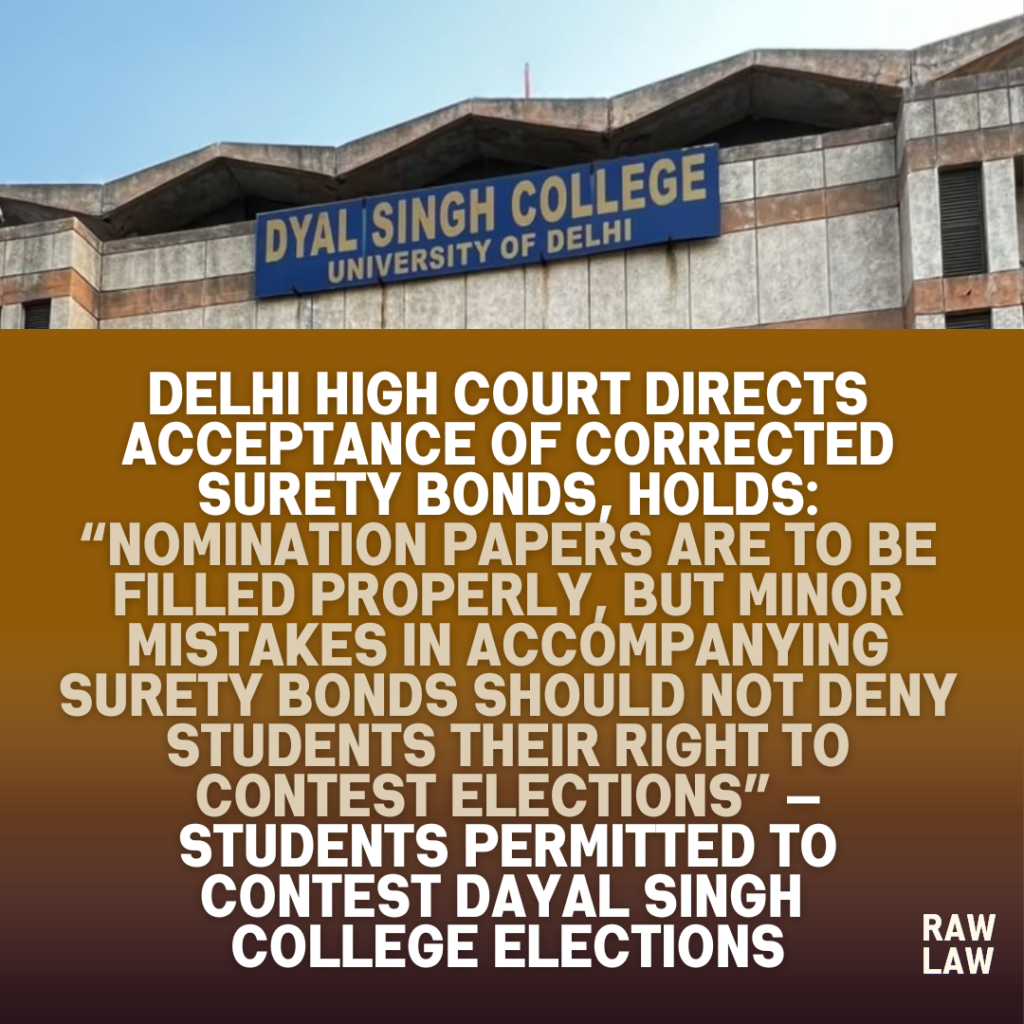
The Delhi High Court allowed the writ petition filed by two bona fide students of Dayal Singh College, University of Delhi, challenging the rejection of their nomination forms for the upcoming student body elections. Justice Mini Pushkarna directed the Election Committee of Dayal Singh College to scrutinize the corrected surety bonds submitted by the petitioners and, if found in order, to accept their nomination papers. The Court further directed that the students be allowed to contest elections for the posts of President and Vice-President and that their names be included in the Electronic Voting Machines (EVMs) for the election scheduled the very next day.
Facts
The petitioners, both students of Dayal Singh College, had filed nomination papers to contest the student body elections scheduled for 18 September 2025. Their names were initially included in the provisional list of candidates but omitted from the final list issued on 13 September 2025 without any explanation.
Upon inquiry, the petitioners were informed on 15 September 2025 that their candidature was rejected due to a clerical error in the surety bonds accompanying their nomination forms. Instead of mentioning their own names, the surety bonds incorrectly reflected the names of their mothers.
The students approached the High Court under Article 226 of the Constitution, seeking urgent intervention. They argued that the mistake was minor, unintentional, and had no bearing on their eligibility to contest elections. They also submitted corrected surety bonds before the Court.
Issues
- Whether rejection of nomination forms on account of clerical errors in surety bonds, despite no defect in the nomination forms themselves, was legally sustainable.
- Whether students could be denied the right to contest elections in cases where minor mistakes were corrected in time.
- Whether the Court could intervene with directions so close to the election date to ensure fairness and protect democratic rights.
Petitioner’s Arguments
The petitioners argued that they were academically eligible and had duly submitted their nomination papers. The only discrepancy was a clerical error in the surety bonds where their mothers’ names were written instead of their own. They contended that such a trivial mistake could not justify rejection of their candidature, especially when the nomination forms were otherwise correct.
They further submitted that corrected surety bonds had been prepared and submitted promptly, both along with the petition and before the Court. They argued that the principle of fairness and natural justice required their candidature to be considered and not rejected for a minor mistake.
Respondent’s Arguments
The Election Committee of the college defended its decision by stating that surety bonds are a mandatory requirement and must be correctly filled. Since the petitioners’ surety bonds carried incorrect names, their candidature had to be rejected.
The University of Delhi, represented through counsel, submitted that while elections were scheduled for the very next day, if the Court permitted the petitioners to contest, the college would need to make necessary arrangements to include their names in the EVMs. This indicated that though technically challenging, it was logistically possible to accommodate the petitioners if the Court so directed.
Analysis of the Law
The Court analyzed the importance of nomination papers and accompanying documents. It observed that while nomination papers must be properly filled with correct details, surety bonds, being separate documents, serve as supportive undertakings and not as the core nomination itself.
The Court emphasized that a minor clerical mistake in the surety bond, particularly one that did not affect the identity or eligibility of the candidates, should not deprive students of their right to contest elections. The Court also stressed that the corrected bonds were produced promptly and that there was no mala fide intent behind the error.
Precedent Analysis
Though no specific precedents were directly cited in the judgment, the Court’s reasoning aligns with principles established in prior election-related jurisprudence:
- Natural justice: Procedural fairness demands that trivial or clerical errors should not override substantive rights.
- Substance over form: Courts have repeatedly held that minor technical irregularities should not invalidate an otherwise valid claim when substantial compliance exists.
The High Court applied these principles in the context of student elections, extending constitutional protections of fairness and equality into the academic-democratic framework.
Court’s Reasoning
The Court noted that there was no anomaly in the nomination forms of the petitioners, and the only discrepancy lay in the surety bonds. Since the corrected surety bonds had been duly produced and handed over to the Election Committee, the Court held that the rejection of candidature was unjustified.
Justice Pushkarna cautioned the students to exercise greater care in future while filling forms but held that their minor mistake should not lead to their exclusion. The Court directed that if the corrected bonds were found in order, their candidature must be accepted and their names included in the EVMs.
The Court also clarified that once their nominations were accepted, the college must issue a revised list of candidates including their names for the posts of President and Vice-President.
Conclusion
The High Court disposed of the writ petition with directions to the Election Committee of Dayal Singh College to scrutinize and accept the corrected surety bonds of the petitioners. It ordered that they be allowed to contest the student elections scheduled for the next day, with necessary arrangements made for inclusion of their names in the EVMs.
The judgment reaffirmed that procedural errors should not deprive students of democratic rights within academic institutions and emphasized that courts will intervene to ensure fairness when exclusion results from minor mistakes.
Implications
This ruling strengthens democratic processes within universities by ensuring that minor technical lapses do not become tools for unfair exclusion from elections. It underscores judicial sensitivity towards student rights and fair electoral processes. The judgment also signals to election committees across academic institutions that they must prioritize fairness and substance over rigid adherence to form, especially where corrective action is promptly taken.
FAQs
1. Can nomination papers for student elections be rejected for minor clerical errors?
The Court held that minor errors, particularly in supporting documents like surety bonds, cannot justify rejection if the nomination form itself is correct and the error is rectified promptly.
2. What did the Court say about corrected surety bonds?
The Court directed the Election Committee to accept corrected surety bonds if found in order, noting that the petitioners’ mistake was minor and unintentional.
3. How did the Court balance procedure with fairness?
While cautioning students to fill forms carefully, the Court emphasized that fairness and democratic rights must prevail over trivial procedural lapses in elections.


