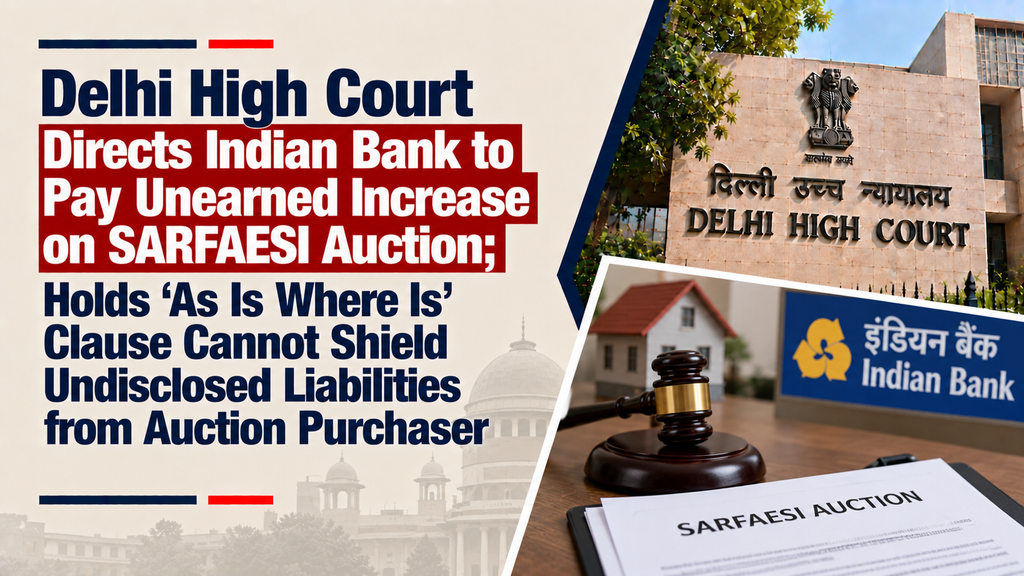
Delhi High Court Directs Indian Bank to Pay Unearned Increase on SARFAESI Auction; Holds ‘As Is Where Is’ Clause Cannot Shield Undisclosed Liabilities from Auction Purchaser

Delhi High Court Orders Indian Bank to Pay Unearned Increase and DDA to Execute Conveyance Deeds for ₹8.01-Crore Auction Purchaser
Facts
Jaishree Industries Ltd. approached the Delhi High Court seeking directions to the Delhi Development Authority (“DDA”) and Indian Bank for execution of conveyance deeds concerning four plots—Nos. 43, 44, 45 and 46 at Block A-1, WHS, Kirti Nagar, New Delhi. In the alternative, it had sought refund of the ₹8.01-crore auction consideration with interest and incidental charges.
The plots had originally been allotted by DDA to M/s Saket Tiles Pvt. Ltd., stated to be a subsidiary of M/s Saket India Ltd. Indian Bank had extended financial assistance to Saket India against mortgage of these properties. After default, the Bank proceeded under the SARFAESI Act, 2002 and auctioned the properties on 28 December 2009.
Jaishree Industries purchased the properties for ₹8.01 crore, paid the entire consideration by March 2010 and received sale certificates. It thereafter approached DDA for conversion from leasehold to freehold.
DDA informed the purchaser that unearned increase (“UEI”) equivalent to 50% of the plot value was payable and also sought proof concerning the relationship between Saket India and Saket Tiles because DDA’s records showed Saket Tiles as the allottee. The purchaser consequently called upon Indian Bank to pay approximately ₹2.25 crore towards UEI.
The difficulties continued for years because DDA sought documents concerning possession and the corporate relationship between Saket India and Saket Tiles, while the Bank allegedly failed to furnish the material required for mutation and conveyance.
Before the High Court, however, the petitioner ultimately pressed only prayers seeking execution of conveyance deeds and payment by the Bank of the DDA levies; it did not press the alternative refund prayer.
Issues
The principal issues were:
- Whether the writ petition was maintainable despite the alleged alternative remedy under Section 17 of the SARFAESI Act.
- Whether the petition suffered from delay and laches.
- Whether Indian Bank could rely upon the auction condition “as is where is and as is what is” to avoid liability for DDA’s unearned increase and other known charges.
- Whether a secured creditor conducting a SARFAESI auction must disclose material defects, encumbrances and liabilities known to it.
- Whether an undisclosed liability such as UEI could subsequently be imposed upon the auction purchaser.
- Whether DDA could be directed to execute the conveyance deeds after the Bank discharged the UEI.
Petitioner’s Arguments
Jaishree Industries argued that Indian Bank had failed to deliver a marketable and perfected title despite retaining the entire ₹8.01-crore sale consideration.
It contended that the Bank knew:
- that the properties stood in the name of Saket Tiles rather than Saket India;
- that the lease contained restrictions upon transfer;
- that DDA permission was required; and
- that DDA could demand unearned increase.
Yet the auction documents did not state that the purchaser would have to bear the UEI or other such levies.
The petitioner relied upon Sections 13(4), 13(6), 13(7) and 35 of the SARFAESI Act, Rules 8 and 9 of the Security Interest (Enforcement) Rules, 2002, and Section 55(1)(a) of the Transfer of Property Act to argue that the Bank could not hide behind an “as is where is” clause where known defects or liabilities had not been specifically disclosed.
It further argued that such non-disclosure offended the modern caveat venditor principle—placing responsibility upon the seller to disclose material information—rather than allowing complete reliance on caveat emptor.
Indian Bank’s Arguments
Indian Bank contended that the auction notice expressly provided that the properties were being sold on an “as is where is and as is what is” basis.
It further argued that the sale notice disclosed that the plots were owned by Saket Tiles Pvt. Ltd., a subsidiary of Saket India, and that the purchaser was expected to undertake its own due diligence, including examination of the perpetual lease deed.
The Bank therefore maintained that Jaishree Industries should itself bear the consequences of the lease conditions and DDA’s UEI demand.
It also raised a maintainability objection, arguing that an auction purchaser qualified as an “aggrieved person” under Section 17 SARFAESI and should approach the DRT rather than invoke Article 226.
DDA’s Arguments
DDA contended that the petitioner had not furnished all requisite documents, particularly proof concerning:
- the relationship between Saket India and Saket Tiles; and
- the relevant possession particulars.
It maintained that conveyance could not be executed until the necessary documentation and charges were dealt with.
Maintainability
Delay and Laches
The High Court rejected the delay objection.
Although the petitioner knew about the UEI issue years earlier, the Court found that it had continuously pursued the matter, sought documents from the Bank and corresponded with DDA in an attempt to resolve the title and corporate-relationship issues.
The petitioner therefore could not be characterised as having slept over its rights.
Alternative Remedy Before DRT
The Court also rejected the Section 17 objection.
It held that the dispute was not confined to a measure taken by Indian Bank under SARFAESI. The relief sought against DDA and the relief against Indian Bank were intertwined, and DRT could not issue the necessary directions against DDA for execution of conveyance deeds.
The High Court therefore considered comprehensive adjudication in writ jurisdiction appropriate.
Analysis of the Law
1. “As Is Where Is” Protection Is Not Absolute
The High Court relied significantly upon its recent Division Bench decision in Bank of Maharashtra v. Jai Kumar Bansal, 2026 SCC OnLine Del 667.
That judgment recognized that although a purchaser in a SARFAESI auction ordinarily takes the property in its existing state, an “as is where is” clause does not confer absolute immunity upon the secured creditor.
A seller remains bound by Section 55(1)(a) of the Transfer of Property Act to disclose material defects in the property or title which:
- are known to the seller;
- are not known to the purchaser; and
- could not ordinarily be discovered through reasonable care.
The SARFAESI Rules reinforce this obligation by requiring disclosure of material information necessary for an intending purchaser to assess the nature and value of the property.
Known Liabilities Cannot Be Hidden Behind Auction Clauses
The Court distilled the governing proposition succinctly:
An “as is where is and as is what is” clause cannot operate as a shield for hidden charges known to the auction seller.
The High Court held that the auction seller is obliged to disclose material facts and defects affecting the property.
This did not mean that every liability discovered after a SARFAESI auction automatically falls upon the Bank. The crucial distinction is whether the liability or material defect was known to the secured creditor and adequately disclosed in the auction documents.
What the Auction Notice Actually Disclosed
The sale notice did contain two significant disclosures:
- the properties were being sold on an “as is where is and as is what is” basis; and
- the plots were owned by M/s Saket Tiles Pvt. Ltd., a subsidiary of Saket India.
Therefore, the Court did not proceed on the basis that the identity of Saket Tiles had been wholly concealed.
The decisive issue was narrower: the auction documents did not specifically shift the liability for the DDA’s UEI to the purchaser.
That distinction ultimately determined liability.
Bank Knew About DDA’s Unearned Increase
The High Court found that Indian Bank possessed the title documents and knew the conditions of the perpetual lease when the mortgage was created.
It was also aware that:
- DDA enjoyed the right to charge unearned increase;
- prior DDA permission was relevant to dealings with the properties; and
- the mortgage itself had been permitted by DDA under a communication dated 5 October 1990.
The Court therefore treated the UEI as a material liability of which the Bank had relevant prior knowledge.
SARFAESI Rules and Encumbrances
The Court considered Rules 9(9) and 9(10) of the Security Interest (Enforcement) Rules, 2002.
Rule 9(9) contemplates delivery of the property free from encumbrances known to the secured creditor, while Rule 9(10) requires the sale certificate to specify whether the secured asset has been purchased free of known encumbrances.
From this statutory framework, the Court held that known dues, charges or encumbrances affecting the property must be categorically disclosed to the auction purchaser.
That had not been adequately done regarding the UEI.
Precedent Analysis
Bank of Maharashtra v. Jai Kumar Bansal
This was the central contemporary authority on SARFAESI auction conditions.
The High Court adopted the principle that an “as is” clause does not dispense with the secured creditor’s statutory disclosure obligations.
At the same time, Jai Kumar Bansal also recognized that where a sale notice expressly warns the purchaser about particular dues, the purchaser cannot later seek reimbursement for a liability contractually assumed.
The distinction was critical here: no comparable express clause transferred UEI liability to Jaishree Industries.
Monoflex India (P) Ltd. v. CIT
The Court expressly followed the approach in Monoflex, noting that the Single Judge’s decision had been affirmed in appeal.
The principle applied was that where UEI liability has not been disclosed as the purchaser’s liability, it cannot subsequently be fastened upon the auction purchaser.
Section 55(1)(a), Transfer of Property Act
The statutory seller’s duty to disclose material defects in title or property reinforced the Court’s conclusion that SARFAESI auction terms cannot completely override disclosure obligations.
Rules 8 and 9, Security Interest (Enforcement) Rules
These provisions were treated as creating a statutory disclosure framework independent of the contractual “as is where is” wording.
Court’s Reasoning
The Court ultimately drew a distinction between:
a purchaser assuming the ordinary condition and risks of a property knowingly sold “as is”, and
a secured creditor attempting to pass on a specific, known and undisclosed statutory liability after completion of the auction.
Indian Bank could rely on the former proposition but not the latter.
The Bank had retained ₹8.01 crore paid by the petitioner and had sold the properties through a statutory SARFAESI process. The Court held that it could not simultaneously fail to perfect the title and then require the purchaser to bear a material charge that was not stipulated as the purchaser’s responsibility.
The Court expressly stated that the Bank could not be allowed to unjustly enrich itself by failing to perfect the title of property sold to an auction purchaser.
Conclusion
The Delhi High Court allowed the writ petition and held that the settled legal position did not absolve Indian Bank, as auction seller, from liability to pay the unearned increase.
The Court issued a mandamus directing:
- DDA to raise the UEI demand upon Indian Bank;
- Indian Bank to pay the requisite UEI within four weeks of DDA’s demand;
- thereafter, upon completion of the other formalities, DDA and Indian Bank to execute the conveyance deeds in favour of Jaishree Industries within a further four weeks; and
- Indian Bank would remain at liberty to pursue any appropriate legal remedy available to it.
Thus, the Court did not order refund of the ₹8.01 crore, because that alternative relief was not pressed. Instead, it preserved the auction transaction and directed the Bank to discharge the undisclosed UEI so that title could be perfected in the purchaser’s favour.
Case Details
Case: Jaishree Industries Ltd. v. Delhi Development Authority & Anr.
Court: Delhi High Court
Case Number: W.P.(C) 10860/2017
Judge: Justice Jasmeet Singh
Reserved On: 13 May 2026
Pronounced On: 8 September 2026
Properties: Plot Nos. 43, 44, 45 and 46, Block A-1, WHS, Kirti Nagar, New Delhi
Auction Consideration: ₹8.01 crore
Secured Creditor/Auction Seller: Indian Bank
Principal Liability: DDA unearned increase (“UEI”)
Result: Writ allowed; DDA directed to raise UEI demand on Indian Bank; Bank directed to pay it within four weeks; DDA and Bank thereafter directed to execute conveyance deeds in favour of Jaishree Industries within four weeks.