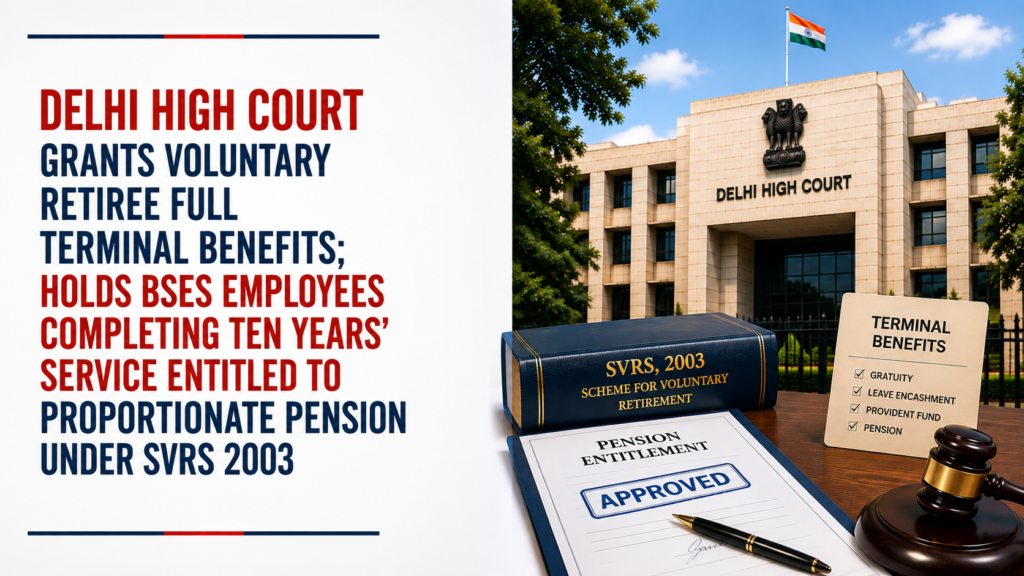
Delhi High Court Grants Voluntary Retiree Full Terminal Benefits; Holds BSES Employees Completing Ten Years’ Service Entitled to Proportionate Pension Under SVRS 2003

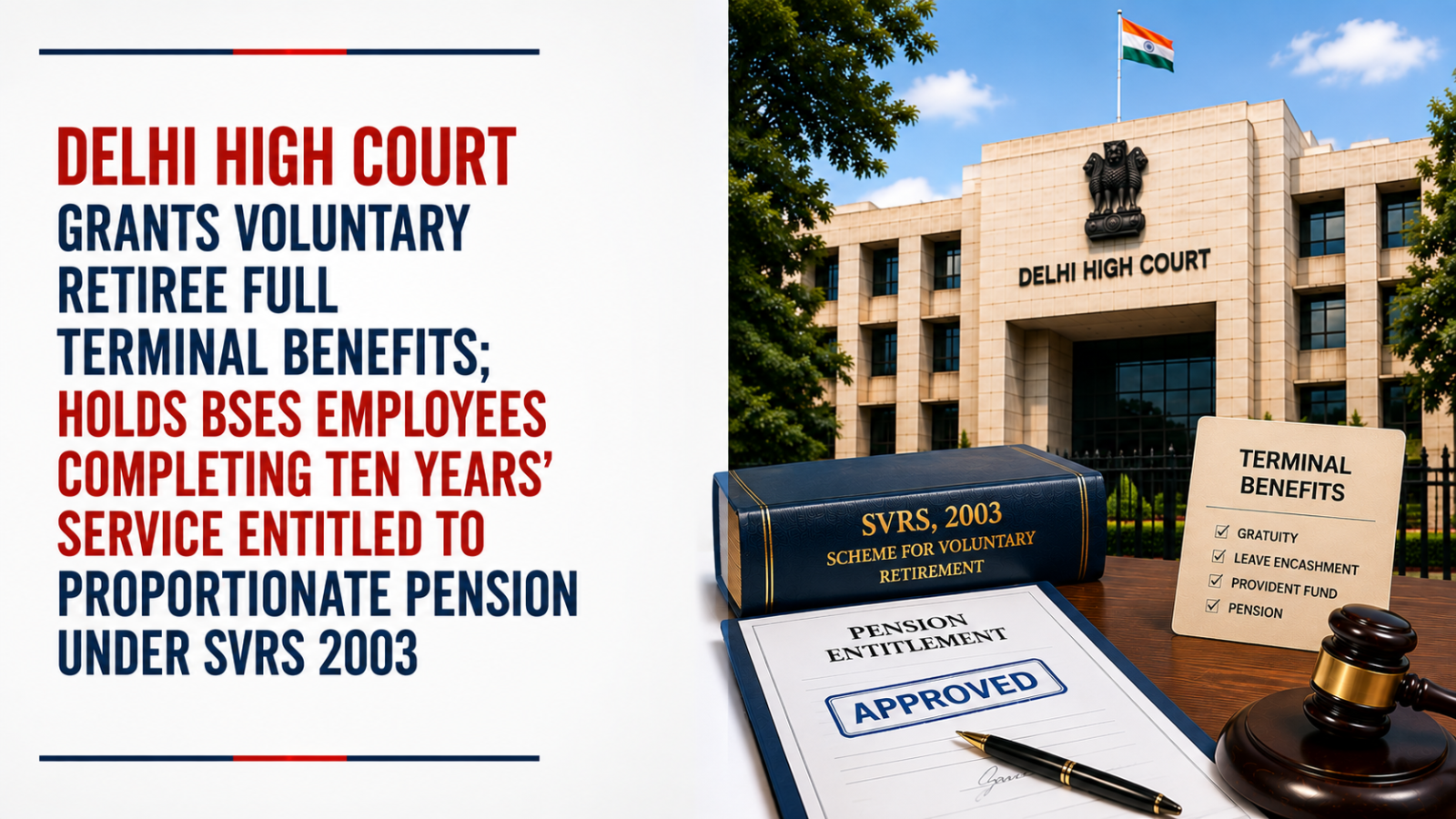
BSES Employee Completing Ten Years’ Service Entitled to Proportionate Pension Under SVRS, Holds Delhi High Court
Facts
The petitioner, Bijender Singh, joined the erstwhile Delhi Electric Supply Undertaking (DESU) on 7 December 1983. Following restructuring of the electricity distribution sector, his services stood transferred to BSES Yamuna Power Limited under the Delhi Electricity Reforms (Transfer Scheme) Rules, 2002.
On 18 December 2003, BSES introduced a Special Voluntary Retirement Scheme (SVRS). The petitioner opted for voluntary retirement, which was accepted, and he retired from service on 31 December 2003. Although he began receiving pension and his General Provident Fund (GPF) was released, several terminal benefits, including gratuity, leave encashment and full pensionary benefits, were withheld.
Aggrieved by non-payment of these benefits, the petitioner approached the Delhi High Court seeking directions for release of all terminal benefits together with interest.
Issues
- Whether the petitioner, who retired under the Special Voluntary Retirement Scheme, 2003, was entitled to pension and other terminal benefits after completing more than ten years of service.
- Whether the issue stood concluded by the earlier Division Bench judgment in BSES Rajdhani Power Ltd. v. Kewal Krishan & Ors.
- Whether the petitioner was entitled to identical relief as granted to similarly situated employees.
Petitioner’s Arguments
The petitioner contended that:
- he had rendered more than twenty years of qualifying service before opting for voluntary retirement;
- under the SVRS 2003, employees completing ten years of service were expressly made eligible for voluntary retirement benefits;
- despite retirement being accepted under the Scheme, his gratuity, leave encashment, pension and other terminal dues had not been released;
- the controversy was fully covered by the Division Bench judgment in BSES Rajdhani Power Ltd. v. Kewal Krishan & Ors., which had recognised entitlement of similarly placed employees to pension and other retirement benefits.
Respondents’ Arguments
The respondents did not dispute that the controversy involved in the present writ petition was identical to that decided by the Division Bench in BSES Rajdhani Power Ltd. v. Kewal Krishan & Ors.
The Court also noted that the Review Petition filed against that Division Bench judgment had already been dismissed on 10 July 2026, thereby affirming the earlier decision.
Analysis of the Law
The Court examined:
- the Special Voluntary Retirement Scheme (SVRS), 2003;
- the CCS (Pension) Rules, 1972, particularly Rules 3(q), 48A and 49;
- the principles governing qualifying service for pension; and
- the binding effect of the earlier Division Bench judgment.
The Court observed that the Division Bench had already interpreted the SVRS as a special scheme prevailing over the general provisions of the CCS (Pension) Rules insofar as employees opting for voluntary retirement under the Scheme were concerned. Employees completing ten years of qualifying service were therefore entitled to proportionate pension and other retirement benefits.
Precedent Analysis
The judgment is entirely founded upon the earlier Division Bench decision in:
- BSES Rajdhani Power Ltd. v. Kewal Krishan & Ors. (LPA 575/2023).
The Division Bench had held that:
- qualifying service under Rule 3(q) means service rendered while on duty and is not confined to service after becoming a member of the Pension Trust;
- the SVRS 2003, being a special scheme, overrides the general provisions of Rules 48A and 49 of the CCS (Pension) Rules;
- employees retiring under the Scheme after completing 10 to 20 years of service are entitled to proportionate pension;
- liability for pension up to the age of sixty years would initially rest upon the SVRS Retirement Benefit Trust Fund, subject to reimbursement by the DVB Pension Trust, with subsequent liability governed by the applicable Pension Rules.
The Court further noted that the Review Petition against the Division Bench judgment had already been dismissed.
Court’s Reasoning
The High Court observed that both parties accepted that the controversy raised in the present writ petition was squarely covered by the Division Bench decision in BSES Rajdhani Power Ltd. v. Kewal Krishan & Ors.
Since the legal issue had already attained finality after dismissal of the Review Petition, there was no reason to examine the matter afresh.
The Court therefore held that the petitioner was entitled to the same relief as granted to the employees in the earlier Division Bench judgment and that his claim for pension and other terminal benefits had to be governed by those directions.
Conclusion
The Delhi High Court disposed of the writ petition by directing that the petitioner’s claim be governed by the Division Bench judgment in BSES Rajdhani Power Ltd. v. Kewal Krishan & Ors.
Accordingly, the petitioner became entitled to the same benefits recognised in that decision, including proportionate pension and other terminal retirement benefits under the Special Voluntary Retirement Scheme, 2003, in accordance with the directions already issued by the Division Bench.
Case Details
Case: Bijender Singh v. Government of NCT of Delhi & Anr.
Court: Delhi High Court
Case Number: W.P.(C) 21619/2005
Judge: Justice Neena Bansal Krishna
Date: 4 August 2026
Result: Writ petition disposed of in terms of the Division Bench judgment in BSES Rajdhani Power Ltd. v. Kewal Krishan & Ors. The petitioner was held entitled to the same relief regarding proportionate pension and terminal benefits under the Special Voluntary Retirement Scheme, 2003.