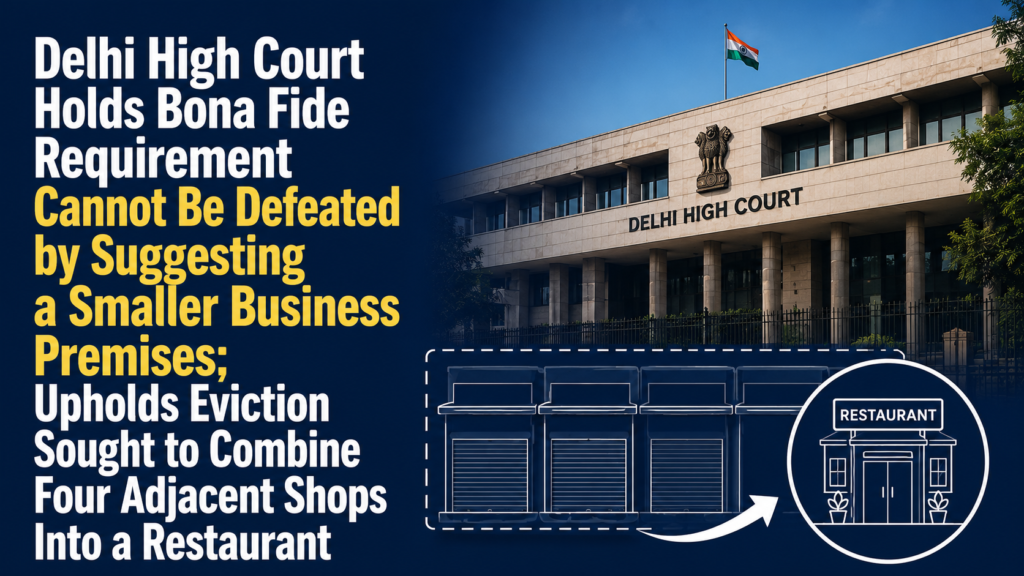
Delhi High Court Holds Bona Fide Requirement Cannot Be Defeated by Suggesting a Smaller Business Premises; Upholds Eviction Sought to Combine Four Adjacent Shops Into a Restaurant

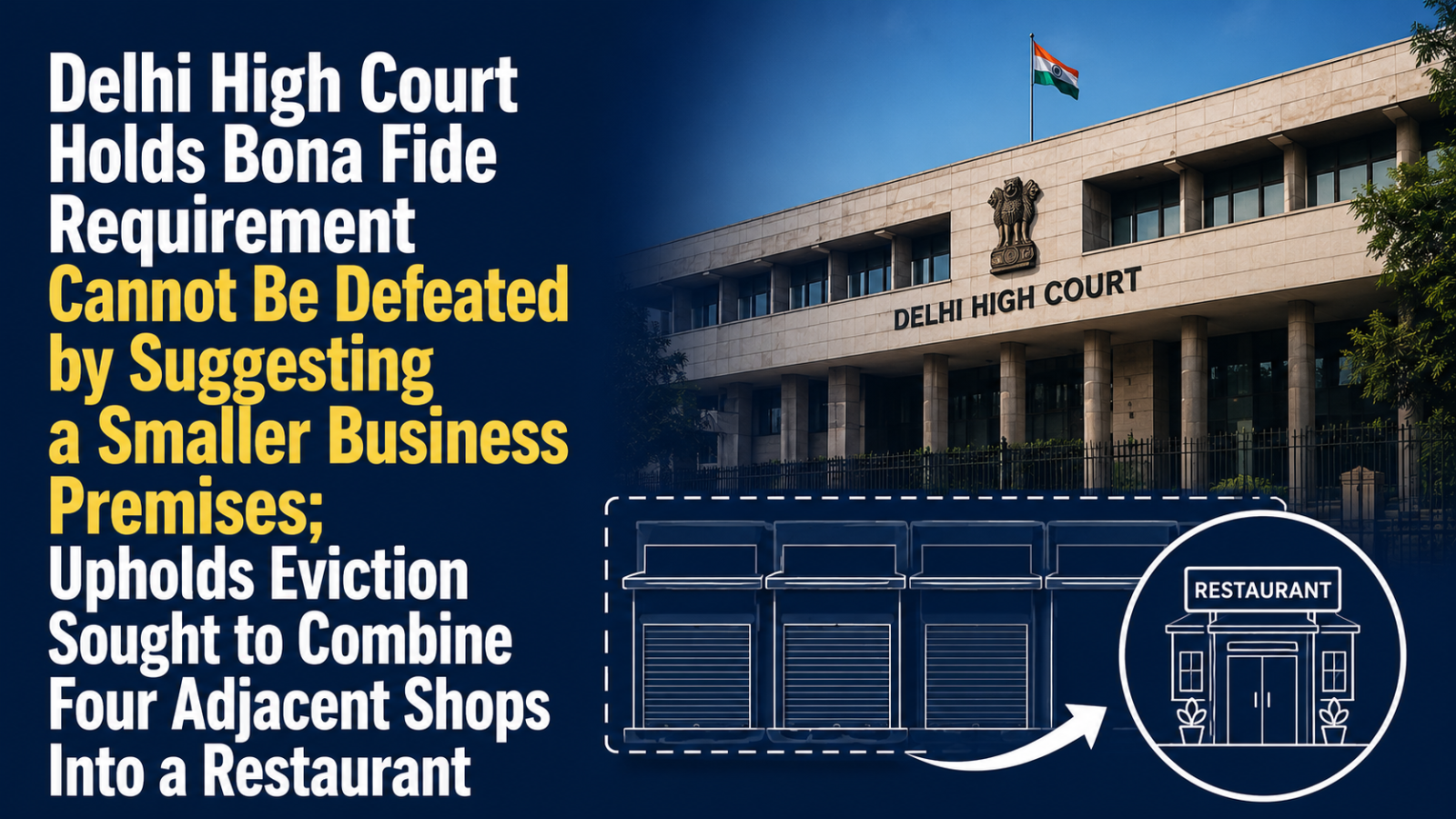
Landlord Wanted All Four Adjacent Shops for a Restaurant; Delhi High Court Says Tenant Cannot Dictate Business Size
Facts
The petitioner-tenant challenged an eviction order passed by the Senior Civil Judge-cum-Rent Controller, Karkardooma Courts, under Section 25B of the Delhi Rent Control Act, 1958. The Rent Controller had dismissed the tenant’s application for leave to defend and ordered eviction from Shop No. 4 situated at Property No. 129/4, J & K Block, Near Narula Bakery, Laxmi Nagar, Delhi.
The landlord had sought eviction on the ground of bona fide requirement, asserting that he and his son intended to establish a restaurant by combining Shops Nos. 1 to 4. Shop No. 4 was in the tenant’s occupation, while the remaining three shops were already available with the landlord.
Before the High Court, the tenant principally contended that the landlord had taken inconsistent stands regarding his alleged requirement. In an earlier eviction petition, which had been withdrawn, the landlord had pleaded that he and his son wished to start a restaurant or business from the ground floor. In the subsequent petition, the landlord stated that the restaurant would be run through his son and explained how each of the four shops would be utilised. According to the tenant, these differing pleadings destroyed the claim of bona fide requirement and at least raised a triable issue warranting leave to defend.
The tenant further argued that the landlord already possessed Shops Nos. 1 to 3, which were sufficient for the proposed restaurant, and therefore Shop No. 4 was not genuinely required. The landlord, on the other hand, maintained that all four adjoining shops were necessary to establish the proposed restaurant and supported the Rent Controller’s findings.
Issues
- Whether the landlord had taken inconsistent pleas regarding his bona fide requirement so as to raise a triable issue entitling the tenant to leave to defend.
- Whether the availability of Shops Nos. 1 to 3 constituted suitable alternative accommodation defeating the landlord’s eviction petition.
- Whether the Rent Controller’s order suffered from any jurisdictional error, perversity or material irregularity warranting interference under Section 25B(8) of the Delhi Rent Control Act.
Petitioner’s Arguments
The tenant argued that the landlord had changed his case between the earlier withdrawn eviction petition and the subsequent petition. The earlier petition merely referred to a desire to start a restaurant or business, whereas the later petition projected a different requirement by stating that the restaurant would be run through the landlord’s son and describing the proposed utilisation of each shop.
According to the tenant, these inconsistent pleadings undermined the genuineness of the alleged requirement and themselves constituted a triable issue.
The tenant further submitted that Shops Nos. 1 to 3 were already available with the landlord and were sufficient to establish the proposed restaurant. Consequently, Shop No. 4 was not genuinely required.
It was also argued that the Rent Controller had failed to properly appreciate the material demonstrating the availability of alternative suitable accommodation.
Respondent’s Arguments
The landlord contended that there was no inconsistency between the two eviction petitions. Both petitions consistently disclosed the intention to establish a restaurant by obtaining possession of Shop No. 4 and combining it with the adjoining shops.
The subsequent petition merely explained in greater detail how the restaurant would be operated and how the four shops would be utilised. Such elaboration did not amount to a change in the nature of the bona fide requirement.
The landlord also submitted that it was for him to determine the extent of accommodation necessary for his proposed business and that the tenant could not dictate the size or manner in which the restaurant should be established.
Finally, it was argued that the revision petition merely sought a re-appreciation of evidence, which was impermissible within the limited revisional jurisdiction under Section 25B(8) of the Delhi Rent Control Act.
Analysis of the Law
The Court reiterated that the High Court’s jurisdiction under the proviso to Section 25B(8) of the Delhi Rent Control Act is supervisory and revisional, not appellate. Interference is permissible only where the Rent Controller’s order suffers from jurisdictional error, patent illegality, perversity, material irregularity or failure to consider a material issue. The High Court cannot reassess evidence merely because another view is possible.
Examining the landlord’s pleadings, the Court found that both eviction petitions consistently asserted the same underlying requirement—obtaining possession of Shop No. 4 to establish a restaurant by combining all four adjoining shops. The later petition merely elaborated the proposed business arrangement by specifying that the restaurant would be run through the landlord’s son and explaining the intended use of each shop. Such additional particulars did not amount to contradictory pleadings or create a triable issue.
On the issue of alternative accommodation, the Court held that the tenant failed to establish the existence of any other reasonably suitable premises. The mere availability of Shops Nos. 1 to 3 did not defeat the landlord’s case because his stated requirement was to operate a restaurant across all four adjoining shops. A tenant cannot compel a landlord to conduct business from a smaller space or dictate the manner in which the business should be organised.
The Court concluded that the Rent Controller had properly considered both objections raised by the tenant and had correctly applied the settled principles governing bona fide requirement.
Precedent Analysis
Sarla Ahuja v. United India Insurance Co. Ltd. (1998) 8 SCC 119
The Supreme Court held that a landlord’s bona fide requirement should ordinarily receive due weight and that courts should not substitute their own assessment of the landlord’s business needs unless the claim lacks genuineness. The High Court relied upon this principle while considering the landlord’s requirement.
Hindustan Petroleum Corporation Ltd. v. Dilbahar Singh (2014) 9 SCC 78
The Supreme Court clarified that revisional jurisdiction under rent control statutes is narrower than appellate jurisdiction and does not permit reassessment of evidence. The High Court relied on this decision to emphasise the restricted scope of interference.
Abid-Ul-Islam v. Inder Sain Dua (2022) 6 SCC 30
The Supreme Court held that Section 25B(8) confers only supervisory jurisdiction over the decision-making process. Unless there is an apparent error, jurisdictional defect or perversity, the High Court cannot substitute its own conclusions for those of the Rent Controller. This formed the principal basis for rejecting the tenant’s revision.
Pankaj Pahwa v. Prem Wati & Ors. (2024:DHC:9322)
The Delhi High Court reiterated that revisional scrutiny is confined to examining whether the Rent Controller’s decision suffers from an error apparent on the face of the record and does not permit a fresh evaluation of evidence.
Sanjeev Hiranandani v. Sunny Grover (2025:DHC:11285)
The Court reaffirmed the limited scope of revisional jurisdiction under Section 25B(8) and held that the High Court should not interfere merely because another interpretation of the evidence is possible.
Court’s Reasoning
The Court found no inconsistency between the landlord’s two eviction petitions. In both cases, the landlord consistently sought possession of Shop No. 4 to combine it with the adjoining shops for establishing a restaurant. The subsequent petition merely provided additional particulars regarding the proposed business arrangement and therefore did not undermine the bona fide requirement.
The Court also accepted the Rent Controller’s reasoning that the landlord required all four adjacent shops for the proposed restaurant. Since Shop No. 4 formed part of the same row of shops, it was not for the tenant to dictate that the landlord should operate the restaurant only from Shops Nos. 1 to 3.
The High Court observed that both objections raised by the tenant had already been specifically considered by the Rent Controller. Entertaining the tenant’s submissions would require a fresh appreciation of the factual record, which was impermissible in the exercise of revisional jurisdiction.
Finding no jurisdictional error, perversity, material irregularity or patent illegality in the Rent Controller’s order, the Court declined to interfere.
Conclusion
The Delhi High Court dismissed the revision petition, holding that the landlord’s bona fide requirement remained consistent despite additional details in the subsequent eviction petition. It further held that the tenant had failed to establish any triable issue or demonstrate the availability of suitable alternative accommodation. As no jurisdictional error or perversity was found in the Rent Controller’s order, the eviction order and rejection of leave to defend were upheld.
Case Details
Case: Shyam Lal Goyal v. Hari Om Rastogi
Court: High Court of Delhi
Case No.: RC.REV. 177/2026 & CM APPL. 34635/2026
Judge: Justice Harish Vaidyanathan Shankar
Date of Decision: 23 July 2026
Relevant Provisions: Section 25B(8), Delhi Rent Control Act, 1958
Result: Revision petition dismissed; eviction order and rejection of leave to defend upheld.