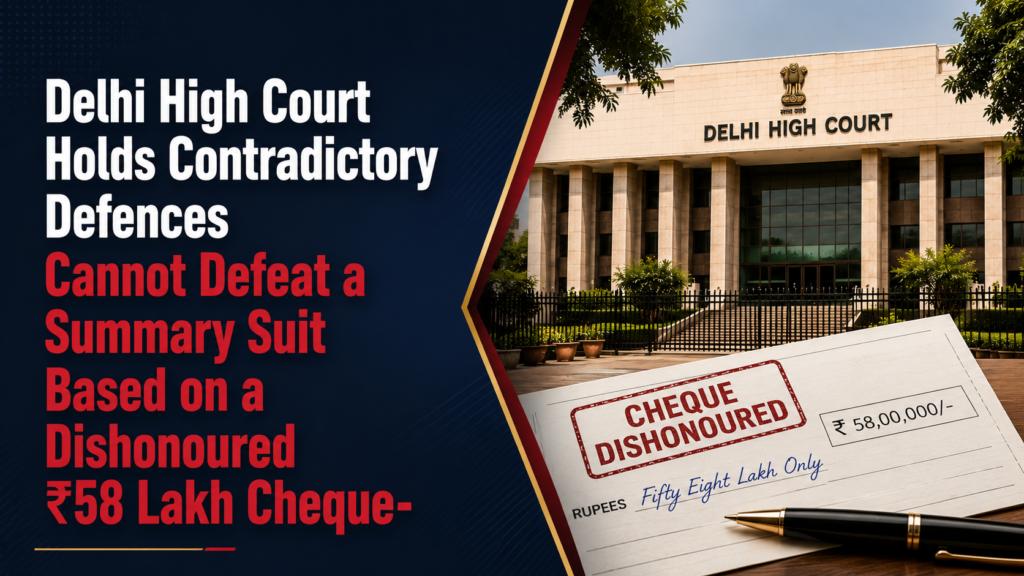
Delhi High Court Holds Contradictory Defences Cannot Defeat a Summary Suit Based on a Dishonoured ₹58 Lakh Cheque

Dishonoured ₹58 Lakh Cheque Led to Summary Suit; Delhi High Court Holds Borrower’s Contradictory Defences Were Sham
Facts
The respondent, Anil Grover, instituted a summary suit under Order XXXVII CPC seeking recovery of ₹58 lakh from the appellant, Nitin Khurana, based on a dishonoured cheque.
The parties shared a close personal relationship. Following the death of the appellant’s father, the respondent financially assisted the appellant and his wife for starting a business.
Between 2018 and 2019, the respondent advanced:
- ₹30 lakh, acknowledged through a notarised receipt dated 10 October 2018; and
- an additional ₹20 lakh.
The respondent claimed that after accounting for repayments of ₹9.20 lakh, the parties reconciled accounts in March 2022 and agreed that:
- principal outstanding remained unpaid;
- interest of ₹17.20 lakh had accrued;
- total outstanding stood at ₹58 lakh.
To discharge this liability, the appellant issued a cheque dated 9 March 2022 for ₹58 lakh.
The cheque was dishonoured on 10 March 2022 for “Insufficient Funds.”
After issuance of a legal notice and failure to repay, the respondent filed:
- proceedings under Section 138 of the Negotiable Instruments Act; and
- the present summary suit.
The Trial Court dismissed the appellant’s application for Leave to Defend and decreed recovery of ₹58 lakh with pendente lite and future interest at 9% per annum.
The appellant challenged that decree before the Delhi High Court.
Issues
The High Court considered:
- Whether the appellant disclosed bona fide triable issues warranting leave to defend under Order XXXVII Rule 3(5) CPC.
- Whether the defence that ₹30 lakh represented earnest money under an Agreement to Sell raised a genuine dispute.
- Whether repayment of ₹46 lakh had been prima facie established.
- Whether the dishonoured cheque had been misused after being handed over blank.
- Whether the summary suit was maintainable under Order XXXVII CPC.
- Whether the Trial Court rightly refused leave to defend.
Appellant’s Arguments
The appellant admitted receiving ₹50 lakh, but contended that:
- ₹30 lakh was not a loan but earnest money under an Agreement to Sell for property worth ₹2.50 crore;
- because the respondent allegedly failed to complete the purchase within six months, the earnest money stood forfeited;
- ₹20 lakh was merely interest-free financial assistance;
- substantial repayments had already been made, leaving only ₹4 lakh outstanding;
- the respondent had illegally retained gold jewellery belonging to his family;
- no agreement existed for payment of interest;
- the cheque had been handed over blank for payment of utility bills and was later misused.
He further challenged:
- maintainability of the summary suit;
- territorial jurisdiction;
- court fees.
According to him, these issues required a full-fledged trial.
Respondent’s Arguments
The respondent submitted that:
- the appellant consistently admitted receiving ₹50 lakh;
- the notarised receipt acknowledged receipt of ₹30 lakh;
- the alleged Agreement to Sell never existed in the manner now claimed;
- the appellant repeatedly changed his version regarding the transaction;
- no evidence whatsoever supported repayment of ₹46 lakh;
- the appellant himself produced documents showing entries relating to interest payments.
The respondent therefore argued that:
- the defence was sham, illusory and self-contradictory;
- no triable issue arose;
- leave to defend was rightly refused.
Analysis of the Law
Summary Suit Was Maintainable
The Court rejected the objection regarding maintainability.
Since the suit was founded upon a dishonoured cheque, it squarely fell within Order XXXVII Rule 1 CPC, which permits summary suits based upon bills of exchange and negotiable instruments.
The objections relating to territorial jurisdiction and court fees were also rejected, as the entire cause of action arose in Delhi.
Admission of ₹50 Lakh Financial Assistance
The Court observed that the appellant had repeatedly admitted receipt of ₹50 lakh.
Even in his reply to the legal notice, he expressly admitted receiving financial assistance, though he attempted to describe it as financial aid rather than a loan.
The Court held that mere change of terminology could not erase the admitted receipt of money.
Repayment Defence Was Unsupported
The appellant claimed to have repaid ₹46 lakh.
The Court found that:
- no bank statements;
- no receipts;
- no payment details;
- no documentary evidence
had been produced to substantiate this assertion.
On the contrary, the respondent admitted receiving only ₹9.20 lakh, which was the only repayment supported by the record.
Accordingly, the plea of repayment was held to be entirely unsupported.
Agreement to Sell Defence Was Self-Contradictory
The Court found serious inconsistencies in the appellant’s defence.
In his reply to the legal notice:
- he denied existence of any Agreement to Sell;
- he stated that the receipt had merely been executed as security.
However, while seeking leave to defend, he completely changed his stand by asserting:
- an Agreement to Sell existed;
- ₹30 lakh constituted earnest money;
- the amount stood forfeited.
The Court observed that:
- no Agreement to Sell was ever produced;
- no notice of forfeiture was ever issued;
- no contemporaneous document supported the alleged property transaction.
These contradictions convinced the Court that the defence was not bona fide.
Interest Liability
The appellant denied any agreement regarding payment of interest.
However, the Court relied upon documents filed by the appellant himself, which contained entries such as:
- “July Int.”
- “August Int.”
- “September Int.”
These entries clearly demonstrated an understanding between the parties regarding payment of interest.
The Court therefore rejected the plea that the transaction was interest-free.
Blank Cheque Defence
The appellant argued that the cheque had been handed over blank and later misused.
The Court found this explanation wholly improbable because:
- no complaint was ever lodged;
- no stop-payment instructions were issued;
- no demand for return of the alleged blank cheques was made.
Even assuming the cheque had been signed blank, the Court held that the law permits the holder to fill in the amount where liability exists.
Accordingly, the defence did not raise any genuine triable issue.
Precedent Analysis
Bir Singh v. Mukesh Kumar
The Supreme Court held that where a person voluntarily signs and hands over a blank cheque, the payee may lawfully fill in the particulars, and such filling does not invalidate the cheque or extinguish liability.
The Delhi High Court relied upon this judgment to reject the appellant’s plea that the cheque had been misused merely because the amount was not filled in by him.
Court’s Reasoning
The High Court found that every defence raised by the appellant suffered from serious contradictions.
The Court observed that:
- receipt of ₹50 lakh stood admitted;
- repayment of ₹46 lakh was unsupported;
- the alleged Agreement to Sell was inconsistent with the appellant’s earlier stand;
- the plea regarding forfeiture lacked any documentary basis;
- interest liability was corroborated by the appellant’s own records;
- the blank cheque defence was contrary to settled law.
The Court concluded that the appellant had failed to disclose any bona fide defence requiring trial.
Instead, the defences were found to be illusory, sham and moonshine, making the appellant ineligible for leave to defend under Order XXXVII CPC.
Conclusion
The Delhi High Court dismissed the appeal.
It upheld the Trial Court’s order:
- refusing leave to defend;
- decreeing recovery of ₹58 lakh; and
- awarding pendente lite and future interest at 9% per annum.
The Court held that the appellant’s contradictory and unsupported defences did not raise any genuine triable issue warranting a full trial.
Key Takeaways
- A summary suit based on a dishonoured cheque is maintainable under Order XXXVII CPC.
- Leave to defend will be refused where the defence is sham, illusory or unsupported by evidence.
- Contradictory pleas taken at different stages seriously undermine a defendant’s credibility.
- Mere assertions of repayment without documentary proof cannot defeat a summary suit.
- A voluntarily signed blank cheque does not absolve the drawer of liability if the cheque is later completed for a legally recoverable debt.
- Courts will closely scrutinize whether a defence raises a genuine triable issue before granting leave to defend.
Case Details
Case: Nitin Khurana v. Anil Grover
Court: Delhi High Court
Case Number: RFA 43/2024
Judge: Justice Neena Bansal Krishna
Reserved On: 24 April 2026
Date of Decision: 24 July 2026
Result: Appeal dismissed. The High Court upheld the Trial Court’s refusal to grant leave to defend under Order XXXVII CPC and affirmed the decree directing recovery of ₹58 lakh with pendente lite and future interest at 9% per annum.