


Court’s decision
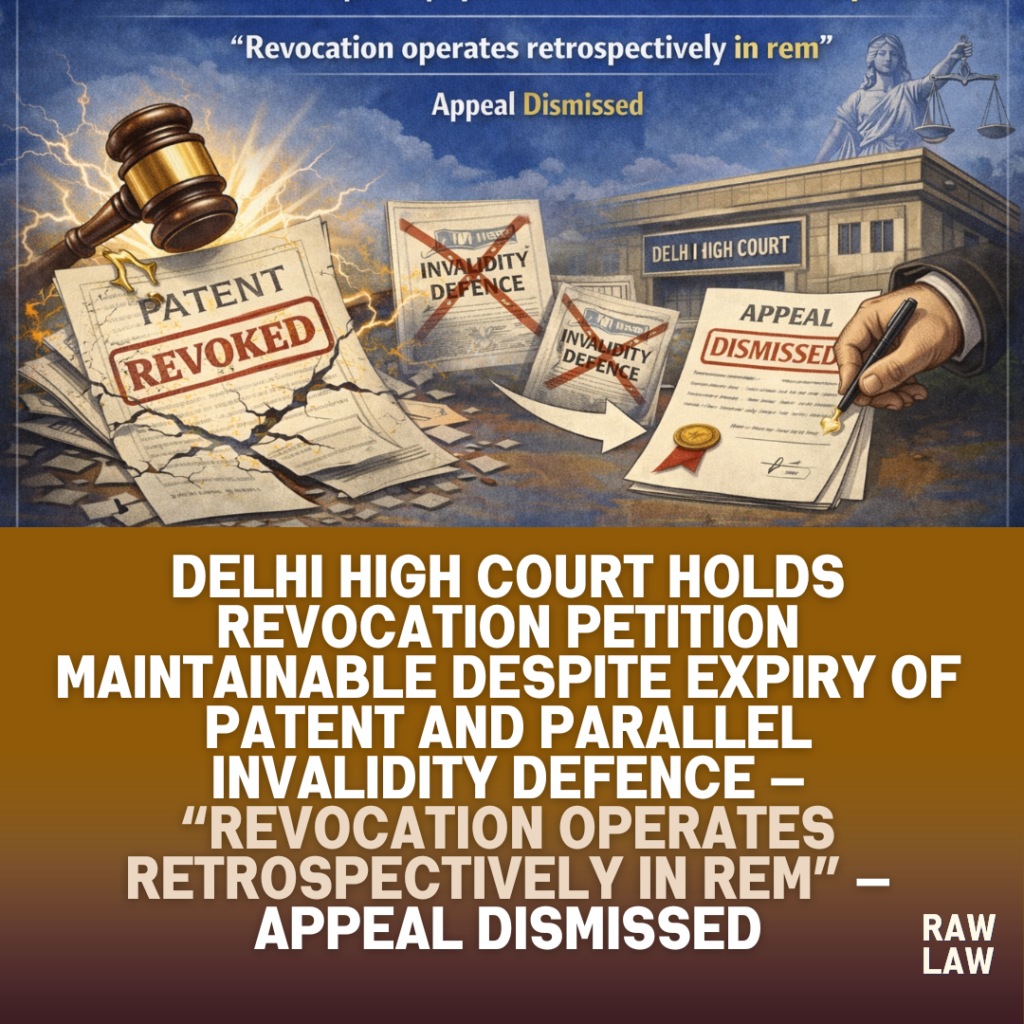
The Delhi High Court dismissed an appeal filed by Boehringer Ingelheim Pharma GmbH challenging the maintainability of a revocation petition filed by Macleods Pharmaceuticals under Section 64 of the Patents Act. The Division Bench held that (i) a revocation petition can survive even after the patent has expired, and (ii) the filing of an invalidity defence under Section 107 in an infringement suit does not bar continuation of a revocation petition. Emphasising that revocation operates retrospectively and in rem, the Court affirmed the Single Judge’s ruling and rejected the appellant’s objections.
Facts
The dispute concerned Indian Patent IN 243301 relating to Linagliptin, granted with a priority date of 21 August 2002. Macleods filed a revocation petition under Section 64 of the Patents Act before the Delhi High Court seeking invalidation of the patent.
Subsequently, Boehringer instituted an infringement suit before the Himachal Pradesh High Court alleging infringement of the same patent. In its written statement, Macleods raised an invalidity defence under Section 107(1) of the Patents Act.
During pendency, the patent expired by efflux of time on 18 August 2023. Boehringer moved applications seeking dismissal of the revocation petition on two grounds: first, that the petition could not survive after expiry of the patent; second, that once invalidity had been pleaded in the suit, the revocation petition could not continue.
Both objections were rejected by the Single Judge, leading to the present appeal.
Issues
The Division Bench framed two pure questions of law:
- Whether a revocation petition under Section 64 can be instituted or continued once the petitioner has raised invalidity as a defence under Section 107(1) in an infringement suit.
- Whether a revocation petition can be maintained after expiry of the patent sought to be revoked.
The case required interpretation of Sections 64, 107, 151 and related provisions of the Patents Act, 1970.
Appellant’s arguments
Boehringer argued that revocation presupposes a subsisting patent and that once the patent expires, there is nothing left to revoke. It contended that Section 64 should be read as applying only to patents “in force,” and that revocation post-expiry would serve no practical purpose.
On the second issue, reliance was placed on the Supreme Court’s decision in Aloys Wobben v. Yogesh Mehra, to argue that once an infringement suit is filed, the defendant’s remedies are confined to a counter-claim or Section 107 defence. Allowing simultaneous continuation of a revocation petition would create multiplicity and risk conflicting decisions by different High Courts.
It was also argued that the expression “person interested” is dynamic and cannot survive once the patent expires, as no enforceable monopoly remains.
Respondent’s arguments
Macleods contended that revocation proceedings and Section 107 invalidity defences are conceptually distinct. A successful revocation petition results in effacement of the patent from the register, operating in rem. In contrast, a Section 107 defence merely results in an inter partes finding without automatic deletion from the register.
It was further argued that expiry does not extinguish accrued rights or liabilities. Since damages were claimed in the infringement suit for acts during the patent’s life, Macleods retained a live interest in having the patent revoked ab initio.
The respondent emphasised that Section 64 uses the term “a patent” and not “a patent in force,” and courts cannot supply words omitted by Parliament.
Analysis of the law
The Court undertook a detailed examination of Section 64, noting that revocation may be sought either by a standalone petition or by way of counter-claim. The provision uses the word “or,” indicating alternative remedies but not cumulative ones.
On retrospective effect, the Bench reasoned that the grounds under Section 64—lack of novelty, obviousness, ineligibility, misrepresentation—strike at the root of the grant itself. If established, they imply that the patent ought never to have been granted.
The Court held that revocation operates retrospectively from the date of grant and in rem, meaning it nullifies the patent as against the world. This interpretation was reinforced by comparative jurisprudence, including the UK Supreme Court’s reasoning in Virgin Atlantic Airways Ltd v. Zodiac Seats UK Ltd, recognising retrospective invalidation.
On the meaning of “patent,” the Court held that a patent once granted continues to remain a patent for purposes of Section 64, even after expiry, though it becomes unenforceable prospectively.
Precedent analysis
The Court closely analysed Aloys Wobben v. Yogesh Mehra. It clarified that the Supreme Court only barred simultaneous pursuit of both a revocation petition and a counter-claim for the same relief. It did not hold that a Section 107 defence bars a revocation petition.
The Bench emphasised that a Section 107 defence is distinct from a counter-claim. While a counter-claim under Section 64 results in revocation, a Section 107 defence only produces a declaratory finding of invalidity inter partes, reflected in a supplemental record under Section 151(2).
Thus, Aloys Wobben did not preclude continuation of the revocation petition in the present case.
Court’s reasoning
The Court held that:
- Revocation under Section 64 nullifies the patent from inception.
- Expiry of a patent does not erase accrued liabilities or claims for damages.
- Since Boehringer’s suit claimed damages for past infringement, Macleods remained a “person interested.”
- Section 64 does not restrict revocation to patents “in force.”
- A Section 107 defence and a revocation petition are legally distinct remedies.
- The Supreme Court’s ruling in Aloys Wobben prohibits simultaneous revocation petition and counter-claim, not revocation petition and invalidity defence.
The Court therefore affirmed that both objections raised by Boehringer lacked merit.
Conclusion
The Delhi High Court dismissed the appeal, holding that the revocation petition was maintainable despite expiry of the patent and notwithstanding the invalidity defence raised in the parallel infringement suit.
The ruling clarifies that revocation proceedings under Section 64 operate retrospectively and in rem, and that patent expiry does not extinguish the right of a “person interested” to seek revocation.
Implications
This judgment has significant implications for Indian patent litigation:
- Revocation remains a viable remedy even after patent expiry.
- Defendants in infringement suits can maintain revocation petitions alongside Section 107 defences.
- Revocation nullifies patents retrospectively, potentially defeating damages claims.
- The decision reinforces the doctrinal distinction between declaratory invalidity and formal revocation.
The ruling strengthens procedural clarity in patent challenges and affirms the standalone character of Section 64.
Case law references
- Aloys Wobben v. Yogesh Mehra (2014) 15 SCC 360
Held that a party cannot simultaneously pursue both a revocation petition and a counter-claim for revocation. The Court clarified that Section 64 remedies are alternative. - Virgin Atlantic Airways Ltd v. Zodiac Seats UK Ltd (UK Supreme Court)
Recognised that patent revocation operates retrospectively, nullifying rights from inception. - Ajay Industrial Corporation v. Shiro Kanao (Delhi High Court)
Discussed implications of patent expiry and rights arising during patent life.
These precedents were harmonised to conclude that revocation is retrospective and independent of patent expiry.
FAQs
1. Can a patent be revoked after it has expired?
Yes. The Delhi High Court has held that revocation operates retrospectively and can be pursued even after expiry, particularly where damages claims are pending.
2. Does raising an invalidity defence under Section 107 bar a revocation petition?
No. A Section 107 defence is distinct from a revocation petition under Section 64. Both can coexist, though a counter-claim and revocation petition cannot be pursued simultaneously.
3. What is the difference between invalidity and revocation?
Invalidity under Section 107 is inter partes and declaratory. Revocation under Section 64 removes the patent from the register and operates in rem.