


HEADNOTE
Zuber Ali alias Mohd Zuber & Ors. v. State (NCT of Delhi) & Anr.
Court: High Court of Delhi
Bench: Hon’ble Mr. Justice Ravinder Dudeja
Date of Decision: December 10, 2025
Case Number: CRL.M.C. 8819/2025
Laws Involved:
Sections 498A, 406, 34 IPC; Section 4, Dowry Prohibition Act, 1961; Section 528, Bharatiya Nagarik Suraksha Sanhita, 2023 (corresponding to Section 482 CrPC)
Keywords: FIR quashing, matrimonial dispute, settlement, Section 528 BNSS, Section 498A IPC, Talaq-e-hasan
Summary
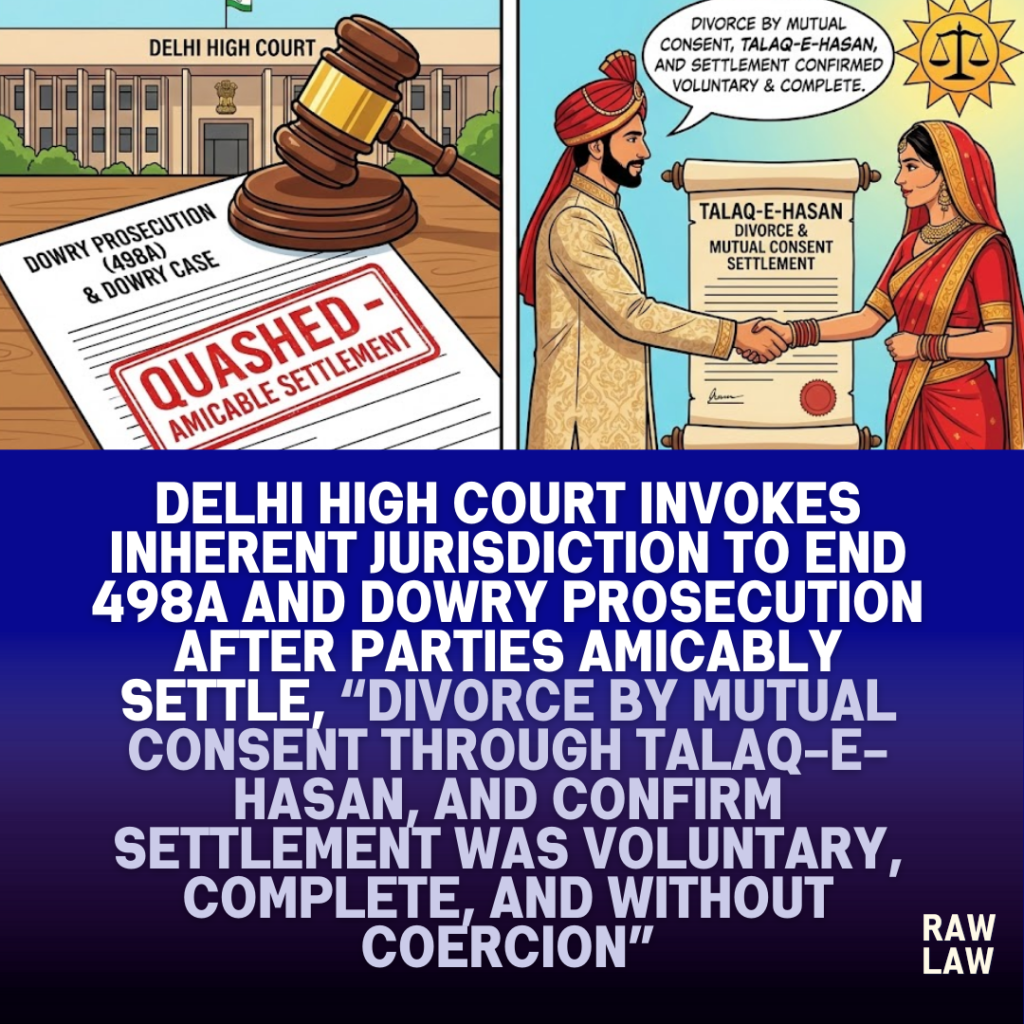
The Delhi High Court quashed an FIR registered for offences under Sections 498A and 406 IPC and Section 4 of the Dowry Prohibition Act after noting that the matrimonial dispute between the parties had been amicably settled. Justice Ravinder Dudeja held that where spouses have voluntarily resolved their differences, obtained divorce by mutual consent, and settled all financial and custodial issues without coercion, continuation of criminal proceedings would amount to abuse of the process of law. Relying on consistent Supreme Court jurisprudence, the Court reiterated that criminal cases arising out of matrimonial discord deserve to be put to a quietus once settlement is reached. Accordingly, the FIR and all consequential proceedings were quashed in the interest of justice.
Court’s decision
The Delhi High Court allowed the petition and quashed FIR No. 0538/2018 dated 31 December 2018 registered at PS Seelampur under Sections 498A/406/34 IPC and Section 4 of the Dowry Prohibition Act, along with all consequential proceedings. The Court held that continuation of criminal prosecution would serve no purpose once the parties had amicably settled their disputes.
Facts
The marriage between Petitioner No.1 and Respondent No.2 was solemnised on 17 September 2016 as per Muslim rites, and one child was born from the wedlock. Due to temperamental differences, the parties started living separately in October 2017. Respondent No.2 subsequently lodged an FIR alleging dowry-related cruelty and misappropriation of stridhan. During pendency of proceedings, the parties resolved their disputes before the Delhi Mediation Centre and executed a settlement agreement and divorce deed. Divorce by mutual consent was completed through Talaq-e-hasan, and the entire settlement amount of ₹1,50,000 was paid.
Issues
Whether the High Court should exercise its inherent jurisdiction under Section 528 of the Bharatiya Nagarik Suraksha Sanhita to quash a non-compoundable FIR arising out of matrimonial disputes when the parties have amicably settled their differences and confirmed the settlement to be voluntary.
Petitioners’ arguments
The petitioners submitted that all matrimonial disputes had been amicably resolved through mediation and a written settlement. It was argued that divorce by mutual consent had already been completed, the agreed settlement amount had been paid in full, and child custody issues had been mutually resolved. Continuation of criminal proceedings, it was urged, would amount to abuse of the process of law.
Respondent’s arguments
Respondent No.2 appeared in person and confirmed before the Court that the settlement was voluntary, without force or coercion, and that she had received the entire settlement amount. She stated that she had no objection to quashing of the FIR. The State also did not oppose the petition in view of the settlement.
Analysis of the law
The Court examined the scope of inherent powers of the High Court to quash criminal proceedings in matrimonial disputes. It reiterated that although offences under Section 498A IPC are non-compoundable, the High Court can quash such proceedings to secure the ends of justice where parties have genuinely settled their disputes. The Court emphasised that the object of criminal law is not to perpetuate bitterness once the underlying dispute has been resolved.
Precedent analysis
The Court relied on Supreme Court decisions in Gian Singh v. State of Punjab, Jitendra Raghuvanshi v. Babita Raghuvanshi, and B.S. Joshi v. State of Haryana, which recognise that criminal proceedings arising out of matrimonial discord should be quashed when parties reach an amicable settlement, as such disputes are predominantly private in nature.
Court’s reasoning
Justice Ravinder Dudeja noted that the parties were present before the Court, duly identified, and unequivocally affirmed the settlement. The Court found that the settlement covered all aspects, including divorce, financial claims, and custody of the minor child. In such circumstances, continuation of criminal proceedings would neither serve the interests of justice nor advance the object of penal law.
Conclusion
The High Court concluded that the FIR and all proceedings emanating therefrom deserved to be quashed. The petition was allowed, and all pending applications were disposed of.
Implications
This judgment reinforces the consistent judicial approach that matrimonial disputes should not be kept alive through criminal litigation once parties have voluntarily settled. It provides clarity on the exercise of inherent powers under the new BNSS framework in family-related criminal cases.
Case law references
- Gian Singh v. State of Punjab – Quashing permissible in non-compoundable matrimonial offences after settlement. Applied.
- Jitendra Raghuvanshi v. Babita Raghuvanshi – Encouraged amicable resolution of marital disputes. Relied upon.
- B.S. Joshi v. State of Haryana – Matrimonial prosecutions can be quashed to prevent abuse of process. Followed.
FAQs
1. Can FIRs under Section 498A IPC be quashed after settlement?
Yes. High Courts can quash such FIRs if the settlement is genuine and voluntary.
2. Does divorce by mutual consent affect criminal proceedings?
Yes. It is a relevant factor supporting quashing when all disputes are settled.
3. What is the role of the complainant’s consent?
The complainant’s voluntary consent is crucial for quashing in matrimonial cases.