Delhi High Court Orders Attorney to Pay ₹1.01 Crore Retained From Land Sale; Holds GPA Transfers No Ownership and Rejects ₹72-Lakh Loan Defence

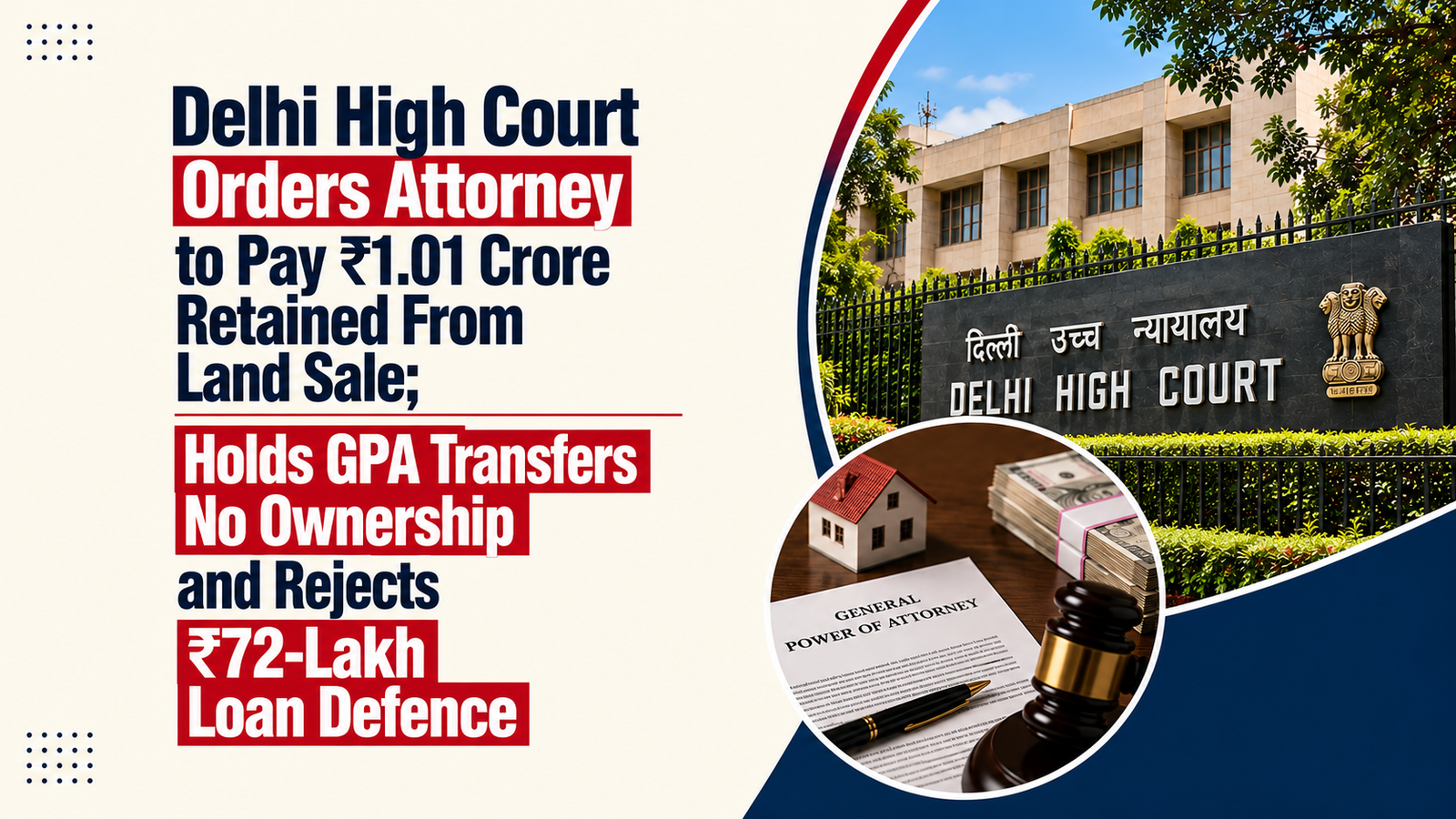
Delhi High Court Upholds ₹1.01-Crore Recovery Against GPA Holder Who Sold Co-Owner’s Land; Rules Power of Attorney Does Not Transfer Property Title
Facts
The appeal was filed by Bhisham Mehta under Section 96 CPC against the judgment and decree dated 7 February 2020 passed by the Additional District Judge. The Trial Court had decreed the respondents’ suit under Order XII Rule 6 CPC for ₹1,01,78,074 with interest at 8% per annum from 11 April 2011 until realisation.
The respondents were the three daughters and legal heirs of Smt. Kusum Mehta, who died intestate on 25 December 2013.
In 1985, Kusum Mehta and her three sisters-in-law purchased 26 bighas of agricultural land in Village Paprawat, Tehsil Najafgarh, New Delhi, through four registered sale deeds. The property was mutated jointly in their names, giving Kusum Mehta a one-fourth undivided share.
In April 2012, Kusum discovered that ₹71,99,801 had been credited to her bank account. On inquiry, she allegedly learnt that Bhisham Mehta, her deceased husband’s brother, had sold the entire property—including her one-fourth share—as her attorney under a registered GPA dated 7 April 1995.
The property had been sold to M/s Agile Properties Limited for ₹6,95,11,500 by registered sale deed dated 11 April 2011. Kusum’s one-fourth share of the consideration amounted to ₹1,73,77,875, but only ₹71,99,801 was transferred to her, leaving ₹1,01,78,074 unpaid.
After Kusum’s death, her daughters instituted a recovery suit for the unpaid balance with interest.
The appellant resisted the suit by claiming that he and his wife had actually funded the original purchase; that the GPA had effectively transferred rights in the property to him; and that the ₹72 lakh paid to Kusum was not sale consideration but an interest-free friendly loan.
Issues
The principal issues were:
- Whether the appellant’s admissions were sufficiently clear, unequivocal and unconditional to justify a decree under Order XII Rule 6 CPC.
- Whether the 1985 and 1995 General Powers of Attorney transferred ownership or any proprietary interest in Kusum Mehta’s share to the appellant.
- Whether the ₹71.99 lakh transferred to Kusum was part-payment of her share of the sale consideration or an independent friendly loan.
- Whether the appellant, as an agent who received sale consideration on behalf of Kusum, was legally bound to remit the entire amount attributable to her share.
- Whether the pending counterclaim for ₹72 lakh prevented the Trial Court from passing a decree on admissions.
- Whether the recovery suit was barred by the three-year limitation period.
Appellant’s Arguments
The appellant argued that there was no clear, unconditional or unequivocal admission capable of supporting a decree under Order XII Rule 6 CPC. He contended that the Trial Court had selectively read his reply dated 23 November 2013 to a police complaint while ignoring his clarification that the ₹72 lakh payment was not made pursuant to any obligation.
He further argued that his counterclaim seeking recovery of ₹72 lakh as a friendly loan remained pending. According to him, the original suit could not have been decreed independently without deciding the counterclaim.
His substantive property argument was that the GPAs dated 29 March 1985 and 7 April 1995 were irrevocable and included a power to “gift” the property. He claimed that this effectively transferred all right and interest to him and extinguished Kusum’s ownership.
Finally, he argued that the suit was time-barred because it had been instituted more than three years after the sale deed dated 11 April 2011.
Respondents’ Arguments
The respondents maintained that their mother was indisputably one of the four registered owners of the property and held a one-fourth undivided share.
They contended that the GPA merely authorized the appellant to manage and deal with Kusum’s property because she lived in Siliguri while the property was situated in Delhi. It was neither supported by consideration nor coupled with an interest and therefore did not transfer ownership.
They further pointed out that the appellant had deposited virtually identical amounts of ₹72 lakh into the accounts of all three co-owners during March 2012. According to them, this made the claim that Kusum alone had received an independent friendly loan inherently unbelievable.
Kusum had also declared ₹71,99,801 in her income-tax return as long-term capital gains arising from part sale consideration and paid tax accordingly.
Analysis of the Law
Registered Documents and Contrary Oral Pleas
The Court treated the registered sale deed dated 11 April 2011 as the foundational document.
In that deed, Kusum Mehta was expressly described as one of the four “vendors”, an “absolute owner/bhumidar”, and one of the owners of the “self-acquired property.” The appellant himself executed the deed only as her General Attorney and received the sale consideration in that representative capacity.
The Court held that a registered instrument speaks for itself. General and unsupported assertions contrary to its recitals cannot displace its terms in view of Sections 91 and 92 of the Indian Evidence Act, corresponding to Sections 94 and 95 of the Bharatiya Sakshya Adhiniyam, 2023.
GPA Does Not Transfer Ownership
The Court categorically rejected the argument that an irrevocable GPA containing a power to gift transferred ownership.
A GPA is fundamentally an instrument of agency, not an instrument conveying right, title or interest in immovable property.
Even an irrevocable GPA does not, by itself, transfer title to the attorney.
Agent’s Duty to Account
Once the appellant admitted that he had acted as Kusum’s agent and received consideration on her behalf, Section 218 of the Indian Contract Act, 1872 applied.
An agent is legally bound to pay the principal all sums received on the principal’s account.
The appellant had received the entire ₹6.95 crore sale consideration for the four vendors. Kusum’s one-fourth entitlement was ₹1,73,77,875, of which only ₹71,99,801 was remitted. He was therefore bound to pay the remaining ₹1,01,78,074 to her legal heirs.
Precedent Analysis
Suraj Lamp & Industries Pvt. Ltd. v. State of Haryana, (2012) 1 SCC 656
This was the principal Supreme Court precedent applied on the GPA issue.
The Court relied upon Suraj Lamp for the settled proposition that so-called “GPA sales” do not convey title and do not constitute a legally recognised transfer of ownership in immovable property.
Therefore, the GPAs executed in favour of Bhisham Mehta merely authorised him to act for Kusum; they did not make him the owner of her one-fourth share.
The judgment does not substantially analyse any other reported precedent. Its remaining conclusions principally flow from the statutory principles governing documentary evidence, agency and judgments on admissions.
Court’s Reasoning
The Court found that the appellant’s own registered sale deed destroyed his ownership defence.
Having himself described Kusum as an absolute owner and vendor and having executed the transaction merely as her attorney, he could not subsequently contend that she had no ownership and that he was the real owner.
The Court similarly found the ₹72-lakh loan theory untenable.
The appellant had admitted before the police that after the property transaction he deposited ₹72 lakh each into the accounts of Kusum Mehta, Nirmal Mehta and Renu Mehta. There was no mention in that contemporaneous reply that these payments represented loans.
The Court considered it inconceivable that all three women would independently seek identical interest-free loans of ₹72 lakh at essentially the same time and on identical oral arrangements. The rational explanation was that these were payments towards each co-owner’s share of the sale proceeds.
The loan theory was further undermined by Kusum’s income-tax return treating the money as capital gains and by the appellant’s complete absence of documentary proof of any loan—no acknowledgement, correspondence, account-book entry or income-tax disclosure. His pleadings were also inconsistent as to whether the alleged loan was paid by cheque or RTGS.
The Court consequently described the friendly-loan case as a “moonshine defence” incapable of preventing a decree under Order XII Rule 6 CPC. The appellant’s admissions were clear, unambiguous and unequivocal.
Counterclaim
The pending counterclaim did not prevent the decree because it had been separately registered as an independent suit and arose from a distinct alleged cause of action—the supposed friendly loan.
Its pendency therefore did not bar the Court from decreeing the respondents’ recovery claim on admissions.
Limitation
The Court also rejected the limitation defence.
The cause of action did not arise merely on 11 April 2011, when the appellant secretly executed the sale deed. Kusum had no knowledge of the transaction at that stage.
Her cause of action arose when she learnt of the sale and retention of her balance consideration in April 2012, after ₹71,99,801 was credited to her account on 30 March 2012.
Since the suit was instituted on 15 April 2014, it was comfortably within three years from the date of knowledge.
Conclusion
The Delhi High Court found no infirmity in the Trial Court’s judgment and decree dated 7 February 2020.
It upheld the finding that Kusum Mehta owned a one-fourth undivided share in the property; the GPA did not transfer ownership to the appellant; the appellant had acted merely as her agent; and he was statutorily obliged to remit the sale proceeds received on her behalf.
The Court further upheld the rejection of the ₹72-lakh friendly-loan defence and found the respondents’ recovery suit to be within limitation.
Accordingly, the High Court dismissed the Regular First Appeal and disposed of the pending applications, thereby affirming the decree for ₹1,01,78,074 with interest at 8% per annum from 11 April 2011 until realisation.
Case Details
Case: Bhisham Mehta v. Mrs. Gita Vig & Ors.
Court: High Court of Delhi at New Delhi
Case Number: RFA 645/2022 with CM APPL. 53984-53986/2022
Judge: Justice Neena Bansal Krishna
Date: 31 August 2026
Result: Appeal dismissed; decree for ₹1,01,78,074 with 8% annual interest from 11 April 2011 until realisation upheld in favour of Kusum Mehta’s legal heirs.