

Court’s decision
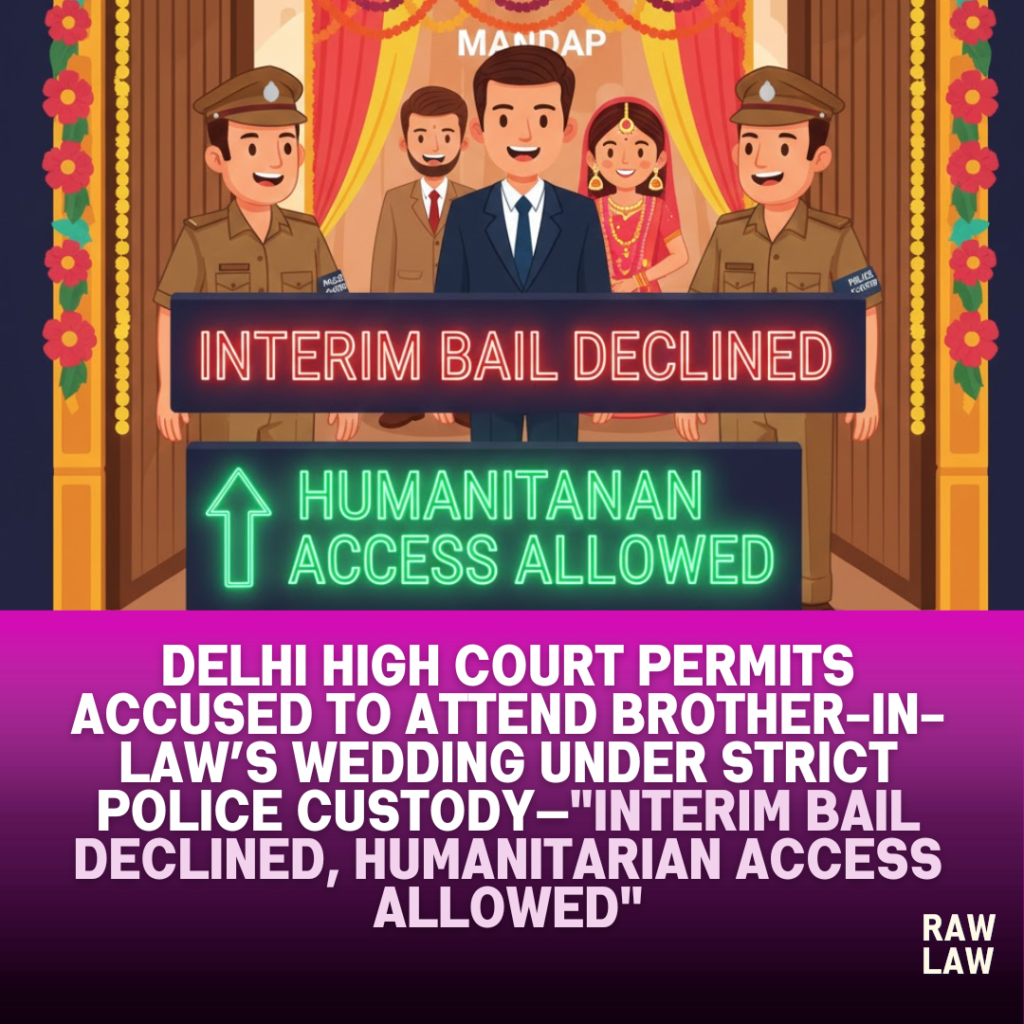
The Delhi High Court declined to grant interim bail to an accused facing serious charges under the Bharatiya Nyaya Sanhita and the Arms Act, but allowed a limited humanitarian arrangement. The Court directed that the accused be taken from jail to the venue of his brother-in-law’s marriage under strict police custody for a narrowly defined time window and returned to custody immediately thereafter. Emphasising security concerns and the gravity of allegations, the Court balanced personal circumstances with public safety by refusing release while permitting attendance under escort. The bail application was disposed of with binding directions to the police and jail authorities.
Facts
The accused moved an application seeking interim bail in connection with an FIR registered at a Delhi police station for offences under Sections 221, 132 and 109(1) of the Bharatiya Nyaya Sanhita, along with Sections 25, 27, 54 and 59 of the Arms Act. The immediate cause for seeking interim relief was a family function: the marriage of his wife’s brother scheduled for the evening of 4 February 2026 at a venue in Faridabad. The applicant requested temporary liberty to attend the ceremony, citing personal and familial obligations. The prosecution opposed interim bail, pointing to the nature of the offences and the accused’s alleged involvement.
Issues
The principal issue before the Court was whether interim bail should be granted to an accused charged with serious criminal and arms-related offences solely to attend a close family wedding. A subsidiary issue was whether, even if bail were refused, the Court could fashion an alternative arrangement that accommodates humanitarian considerations without compromising custody and security.
Petitioner’s arguments
The applicant urged that the request was limited in scope and duration, confined to attending the wedding of a close family member. It was submitted that denial of any opportunity to attend such a significant family event would cause undue personal hardship. The applicant did not press for unconditional release but sought the Court’s indulgence for temporary liberty, assuring adherence to any conditions imposed. The emphasis was on the exceptional and one-time nature of the request rather than a reassessment of the merits of the criminal case.
Respondent’s arguments
The State strongly opposed the grant of interim bail, highlighting the seriousness of the alleged offences, including those under the Arms Act. The prosecution argued that releasing the accused, even temporarily, could pose risks and undermine the administration of justice. However, recognising the limited nature of the request and the consensual position that emerged during hearing, the State joined the applicant in suggesting an alternative: that the accused be escorted in custody to the marriage venue and brought back immediately after the समारोह, thereby avoiding release on bail.
Analysis of the law
Interim bail is a discretionary relief, particularly stringent where allegations involve serious offences affecting public order or safety. Courts have consistently held that personal reasons, though relevant, cannot by themselves outweigh concerns arising from the gravity of charges. At the same time, constitutional courts retain the power to mould relief in a manner that balances individual dignity with societal interest. Custodial parole-like arrangements, where the accused remains under continuous guard, have been recognised as a lawful alternative when outright bail is not warranted. The present case squarely invoked this balancing exercise.
Precedent analysis
Although no specific precedents were cited in the short oral order, the approach reflects established judicial practice in bail jurisprudence. Courts have, in appropriate cases, permitted escorted attendance at funerals, marriages, or last rites without granting interim bail, particularly where security concerns prevail. The present order follows this line by denying liberty but allowing controlled access under custody, thereby aligning with prior judicial trends on humanitarian exceptions.
Court’s reasoning
The Court noted the State’s objection to interim bail in light of the nature of the crime. Accepting that release was not justified, it nevertheless took into account the consensual request from both sides to permit the accused’s presence at the wedding under custody. The Court therefore directed that on 4 February 2026, between 5:00 pm and 7:00 pm, the accused be taken from jail by personnel of the Third Battalion to the specified marriage venue in Faridabad. It ordered strict adherence to timings and mandated that after attending the ceremony, the accused be returned to jail. Copies of the order were directed to be sent to the concerned Deputy Commissioner of Police and the Jail Superintendent to ensure compliance.
Conclusion
The Delhi High Court declined interim bail but carved out a narrow humanitarian window by permitting escorted attendance at a family wedding. The order underscores that while personal circumstances may merit consideration, they do not automatically justify temporary release in serious criminal cases. Instead, courts may adopt custodial solutions that preserve both compassion and control. The bail application was accordingly disposed of without costs.
Implications
This ruling reiterates the cautious approach courts adopt in interim bail applications involving grave offences. It reassures investigating agencies that custody will not be lightly disturbed, while also signalling that courts remain sensitive to exceptional personal situations. For accused persons, the order illustrates that even when bail is denied, limited humanitarian accommodations may be possible under strict supervision. For practitioners, it highlights the utility of consensual, narrowly tailored alternatives to interim bail in appropriate cases.
Case law reference
- Humanitarian access under custody: Courts may allow escorted attendance at significant family events without granting interim bail, ensuring continuous custody.
- Application in present case: The Court applied this principle to deny interim bail but permit attendance under police guard for a fixed duration.
FAQs
Q1. Can an accused attend a family wedding while in jail?
Yes, courts may permit escorted attendance under police custody in exceptional cases, even if interim bail is denied.
Q2. Does attending a wedding require grant of interim bail?
No. Courts can refuse interim bail yet allow temporary attendance under custody to balance humanitarian concerns and security.
Q3. What factors influence such relief?
The nature of offences, security risks, duration of request, and the feasibility of custodial supervision are key considerations.


