


Court’s decision
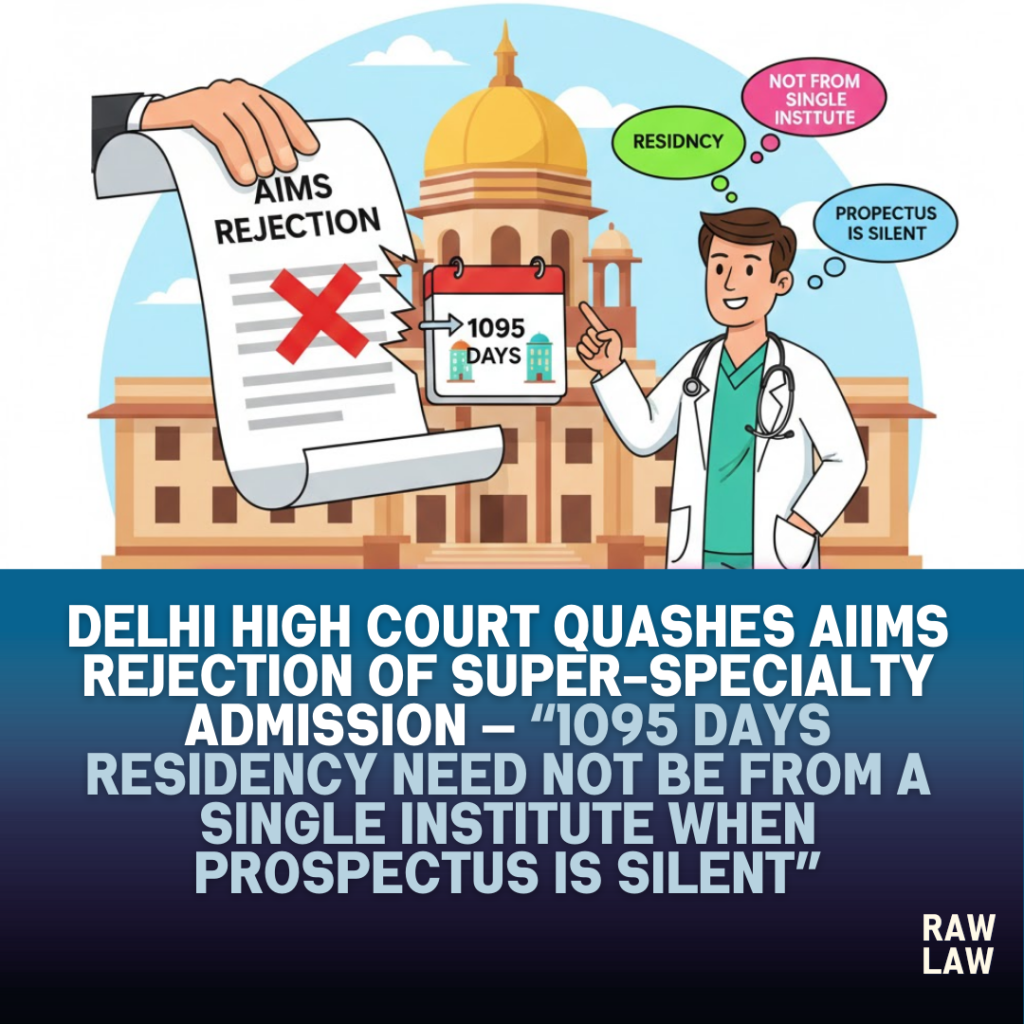
The Delhi High Court set aside the rejection of a candidate’s admission to the DM Critical Care Medicine programme at the All India Institute of Medical Sciences, holding that completion of the mandatory 1095 days of postgraduate residency need not be from a single institute when the prospectus does not expressly mandate so. The Court ruled that AIIMS acted arbitrarily by importing an unwritten eligibility condition at the final stage of admission, thereby violating principles of fairness, non-arbitrariness, and merit-based selection.
Facts
The petitioner, a medical graduate, completed his MBBS in 2021 and thereafter pursued MD (Anaesthesiology) through the national counselling process conducted during the COVID-19 pandemic. Owing to rescheduled examinations, overlapping counselling rounds, and institutional reshuffling, the petitioner undertook postgraduate residency training at three different NMC-recognised medical colleges. He completed 15 days at the first institute, 54 days at the second, and 1026 days at the third, cumulatively exceeding the prescribed three-year tenure.
Based on this cumulative training, the concerned university awarded him an MD degree in Anaesthesiology, certifying completion of more than 1095 days of residency in accordance with applicable regulations. The petitioner subsequently qualified the Institute of National Importance Super-Specialty entrance examination, secured a high all-India rank, and was provisionally selected for admission to the DM Critical Care Medicine programme at AIIMS for the January 2026 session.
Issues
The central issue before the Court was whether the eligibility condition under the AIIMS prospectus requiring completion of “3 years (1095 days)” of postgraduate tenure could be interpreted to mean that such tenure must be completed in a single institution, despite the absence of any express stipulation to that effect. Ancillary issues included the extent of judicial interference in academic matters, the permissibility of adding eligibility conditions by interpretation, and whether rejection at the final stage violated principles of natural justice and legitimate expectation.
Petitioner’s arguments
The petitioner argued that the impugned rejection was arbitrary, unreasonable, and contrary to the express language of the prospectus. It was contended that neither the prospectus nor the Post-Graduate Medical Education Regulations prescribed that residency must be completed in one continuous stretch at a single institute. The petitioner emphasized that his transitions were strictly in accordance with authorised counselling rounds during an unprecedented pandemic period and were not attributable to any fault on his part.
It was further submitted that once a competent university and medical college, both recognised by the regulator, had certified completion of the requisite tenure and awarded the MD degree, AIIMS could not go behind the degree to re-evaluate academic sufficiency. The late-stage cancellation, without prior notice or hearing, was assailed as violative of Articles 14 and 16 of the Constitution and the doctrine of legitimate expectation.
Respondent’s arguments
AIIMS contended that it retained discretion under the prospectus to determine eligibility and that academic standards could not be compromised by permitting fragmented training across multiple institutions. It was argued that super-specialty medical courses are skill-based and require continuous, uniform training under one institutional framework to ensure minimum competence.
The respondent further submitted that courts should exercise restraint in academic matters and defer to expert bodies on questions of eligibility. Reliance was placed on prior judicial precedents where courts had declined to interfere with AIIMS’ interpretation of mandatory training requirements. AIIMS maintained that the petitioner’s candidature was provisional and liable to cancellation upon scrutiny.
Analysis of the law
The Court undertook a detailed examination of the scope of judicial review in academic matters, reiterating that while courts ordinarily defer to expert bodies on questions of educational policy, such deference does not extend to arbitrary or ultra vires actions. Eligibility conditions affecting access to higher education must be clear, explicit, and uniformly applied.
The Court noted that Clause 4.3.2 of the prospectus merely required completion of the requisite qualification, degree, and tenure of three years by the cut-off date. There was no indication, express or implied, that the training must be continuous or confined to a single institution. Any such requirement, the Court held, could not be read into the clause by interpretative fiat.
Precedent analysis
The Court examined Supreme Court jurisprudence cautioning against judicial interference in academic standards, including decisions emphasizing deference to expert bodies. At the same time, it relied on constitutional principles mandating non-arbitrariness and fairness in state action. A coordinate bench decision concerning AIIMS’ interpretation of training tenure was carefully distinguished on facts, noting that the earlier case dealt with attempts to shorten mandatory training periods, whereas the present case involved full completion of the prescribed duration.
The Court also invoked precedents underscoring that merit-based selection should not be defeated by technical or mechanical interpretations, particularly where authorities had multiple opportunities to raise objections but failed to do so until the final stage.
Court’s reasoning
The High Court found that the petitioner had, in fact, completed more than the mandatory 1095 days of postgraduate training in the same discipline at recognised institutions. The degree-granting university and medical college had accepted this cumulative training as compliant with regulatory norms, and the certificate had not been questioned or invalidated by the regulator.
Crucially, the Court observed that AIIMS had accepted the petitioner’s application, allowed him to appear in the examination, did not include his name in the list of ineligible candidates, and declared him successful. Raising an objection only at the stage of admission was held to be unfair and contrary to principles of natural justice. The Court concluded that importing an unwritten condition of “single-institute training” amounted to arbitrariness and could not withstand judicial scrutiny.
Conclusion
The Delhi High Court held that completion of 1095 days of postgraduate residency, even if fragmented across multiple recognised institutions due to authorised counselling reshuffles, satisfies the eligibility requirement under the AIIMS prospectus. The rejection of the petitioner’s candidature was quashed, and the writ petition was allowed. The Court reaffirmed that merit and fairness must prevail over technicalities, particularly in matters affecting higher medical education.
Implications
This judgment has significant implications for postgraduate and super-specialty medical admissions across India. It clarifies that where prospectuses and regulations are silent, institutions cannot impose additional eligibility conditions through interpretation. The ruling strengthens the rights of candidates affected by counselling reshuffles and systemic disruptions, particularly those arising during extraordinary circumstances such as the COVID-19 pandemic. It also serves as a reminder to premier institutions that transparency and certainty in eligibility norms are essential to uphold constitutional guarantees of equality and fairness.
Case law references
- Judicial restraint in academic matters
Held: Courts ordinarily defer to expert bodies on academic standards but will intervene where decisions are arbitrary or ultra vires.
Applied: Used to scrutinise AIIMS’ interpretation of eligibility. - Legitimate expectation in admission processes
Held: Authorities cannot defeat legitimate expectations by introducing new conditions at the final stage.
Applied: Supported quashing of late-stage rejection. - Merit over technicalities principle
Held: Merit-based selection should not be overridden by mechanical interpretations of procedural norms.
Applied: Reinforced relief granted to the petitioner.
FAQs
Q1. Can AIIMS require postgraduate residency to be from a single institute if the prospectus is silent?
No. Eligibility conditions must be expressly stated. Courts will not permit institutions to add unwritten requirements by interpretation.
Q2. Is cumulative residency from multiple recognised colleges valid for super-specialty admission?
Yes, if the prospectus only prescribes a total duration and the training is completed at recognised institutions in accordance with counselling norms.
Q3. Can a candidate be declared ineligible at the final stage of admission?
Courts frown upon such late-stage cancellations, especially when authorities had earlier opportunities to scrutinise eligibility.