


Court’s decision
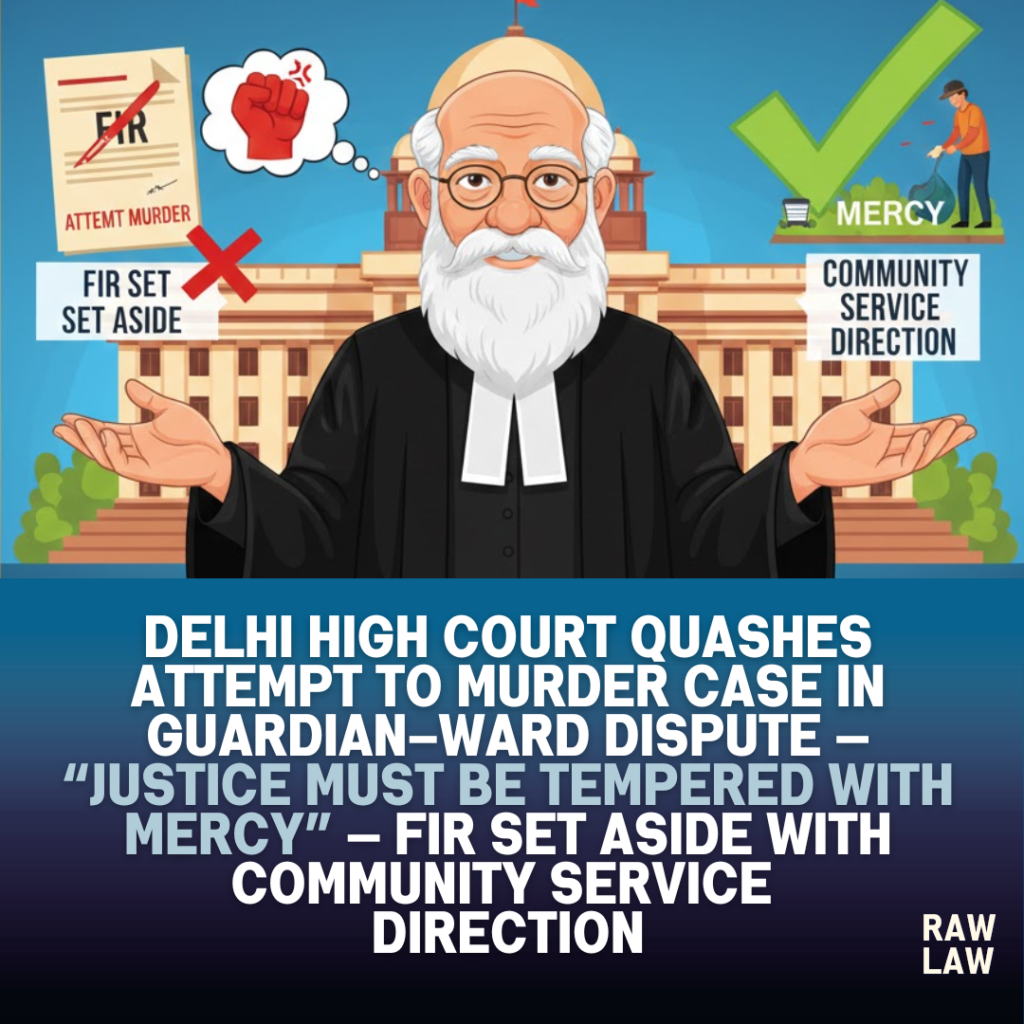
The Delhi High Court quashed an attempt to murder prosecution arising from a deeply personal guardian–ward conflict, holding that continuation of criminal proceedings would amount to a travesty of justice in light of a genuine settlement. Exercising inherent powers under Section 528 of the Bharatiya Nagarik Suraksha Sanhita, corresponding to Section 482 of the Code of Criminal Procedure, the Court set aside the FIR registered under Section 308 of the Indian Penal Code and the charge framed under Section 307. However, balancing mercy with accountability, the Court directed the petitioner to perform structured community service at a city hospital.
The ruling underscores that even serious non-compoundable offences like attempt to murder can be quashed when the dispute is overwhelmingly private, the possibility of conviction appears remote, and the victim unequivocally supports the settlement.
Facts
The petitioner, an orphan raised under a guardianship arrangement, had been placed in the care of the complainant and her late husband pursuant to a court order under the Guardians and Wards Act. The guardianship continued until the petitioner attained majority in 2013, though she continued residing with the family thereafter.
An incident in February 2019 led to the registration of an FIR in March 2019 alleging that the petitioner assaulted the complainant with a wooden cross and a knife, causing injuries. Although the medical report characterized the injuries as simple, the prosecution ultimately framed a charge under Section 307 of the Penal Code.
The trial commenced and evidence was recorded. During cross-examination in December 2024, the complainant expressed willingness to settle. Subsequently, the parties executed a Memorandum of Understanding in August 2025, recording forgiveness, withdrawal of claims, and resolution of civil disputes earlier settled before the Lok Adalat.
Issues
The central legal issue was whether the High Court should exercise its inherent powers to quash criminal proceedings for a non-compoundable and serious offence like attempt to murder, after charges had been framed and trial had commenced, on the basis of a private compromise between the accused and the complainant.
The Court was also required to consider whether the case fell within the category of heinous crimes impacting society at large, which ordinarily cannot be quashed, or whether it bore the characteristics of a predominantly private and familial dispute warranting judicial intervention in the interest of justice.
A related issue concerned the legal status of the relationship between the parties, particularly whether the petitioner was legally adopted or merely under guardianship.
Petitioner’s arguments
The petitioner argued that the dispute was essentially a family conflict arising within a guardian–ward relationship akin to that of a mother and daughter. It was submitted that the complainant had repeatedly and unequivocally affirmed her desire to withdraw from prosecution, including during cross-examination, in affidavits, and in personal interaction with the Court. The petitioner emphasized that civil disputes had already been amicably settled, that she had apologized for her conduct, and that continuation of criminal proceedings would serve no useful purpose. It was contended that the injuries were categorized as simple, diminishing the likelihood of conviction under Section 307, and that the case fell within the category of personal disputes where inherent powers could be exercised.
Respondent’s arguments
The State opposed the petition, arguing that the charge under Section 307 of the Penal Code related to a grave and serious offence. It was submitted that prosecution evidence had commenced and the complainant had supported the prosecution case during testimony. The State contended that attempt to murder is ordinarily treated as a crime against society, not merely against an individual, and that allowing quashing at an advanced stage of trial could undermine deterrence and public interest. The prosecution urged caution in exercising inherent powers in cases involving allegations of serious bodily harm and use of a weapon.
Analysis of the law
The Court reiterated the settled principles governing quashing of non-compoundable offences on the basis of compromise. The inherent powers under Section 482 of the Code of Criminal Procedure, now reflected in Section 528 of the Bharatiya Nagarik Suraksha Sanhita, are distinct from statutory compounding under Section 320.
Relying on Supreme Court jurisprudence, the Court noted that heinous and serious offences of mental depravity generally cannot be quashed merely because parties have settled. However, criminal cases with overwhelmingly civil or personal flavour — including family disputes — stand on a different footing.
Importantly, the Court emphasized that mere invocation of Section 307 does not automatically bar quashing. The High Court must assess the nature of injuries, medical evidence, possibility of conviction, stage of trial, and whether continuation would amount to abuse of process.
Precedent analysis
The Court relied extensively on Gian Singh v. State of Punjab, which recognized the High Court’s power to quash non-compoundable offences where necessary to secure the ends of justice. The judgment clarified that while heinous crimes ordinarily cannot be quashed, disputes with predominantly civil or personal character may justify intervention.
The Court also applied Narinder Singh v. State of Punjab, which laid down structured guidelines for quashing proceedings involving Section 307. That decision permits High Courts to examine the nature of injuries and the likelihood of conviction before deciding whether to accept a compromise.
Further reliance was placed on State of Madhya Pradesh v. Laxmi Narayan and Naushey Ali v. State of Uttar Pradesh, both of which reaffirmed that Section 307 prosecutions may be quashed in appropriate circumstances after careful judicial scrutiny.
In the present case, the Court found that the injuries were medically categorized as simple, the dispute was familial, and the complainant’s forgiveness was consistent and unequivocal.
Court’s reasoning
The Court described the relationship between the parties as socially and emotionally akin to that of a mother and daughter, though not legally one of adoption. It noted that the complainant had initially described the matter as a “family dispute” and had refrained from immediate police action.
The complainant, a retired teacher, had repeatedly affirmed her forgiveness — during civil proceedings in 2022, in cross-examination in 2024, in the Memorandum of Understanding in 2025, and again in affidavits and personal interaction in 2026.
The Court held that compelling continuation of prosecution despite such forgiveness would be unjust. Invoking the celebrated “quality of mercy” passage from Shakespeare, the judge observed that justice must sometimes be tempered with mercy. In the peculiar facts, societal interest in conviction was outweighed by the deeply personal nature of the dispute and the improbability of conviction.
To ensure accountability, however, the Court directed the petitioner to complete thirty sessions of community service at St. Stephen’s Hospital within four months and to file a compliance certificate.
Conclusion
The Delhi High Court quashed the FIR and all consequential criminal proceedings, including the charge under Section 307, on the ground of a bona fide settlement in a guardian–ward dispute. The Court clarified that the petitioner had never been legally adopted and had no inheritance rights in the complainant’s property.
While allowing the petition, the Court imposed a community service obligation as a restorative measure. The ruling reflects a balanced exercise of inherent powers, harmonizing compassion with responsibility.
Implications
This ruling strengthens jurisprudence on quashing of attempt to murder cases under Section 307 when the dispute is overwhelmingly private and the victim supports compromise. It reiterates that High Courts must examine the substance of allegations rather than mechanically deny relief because of the statutory label.
The decision also signals judicial openness to restorative justice tools like community service in criminal settlements. For family disputes escalating into serious criminal charges, the judgment provides a roadmap for evaluating whether prosecution serves justice or merely prolongs trauma.
The case will likely influence future petitions under Section 528 of the Bharatiya Nagarik Suraksha Sanhita involving compromise in serious offences.
Case law references
- Gian Singh v. State of Punjab (2012)
Held that High Courts may quash non-compoundable offences under inherent powers to secure ends of justice, particularly in disputes of predominantly civil or personal nature. Applied here to justify examining the private character of the dispute. - Narinder Singh v. State of Punjab (2014)
Laid down structured guidelines for quashing Section 307 cases, emphasizing assessment of injury nature and likelihood of conviction. The High Court followed these parameters to evaluate medical evidence and stage of trial. - State of Madhya Pradesh v. Laxmi Narayan (2019)
Reaffirmed cautious exercise of inherent powers in serious offences while allowing quashing in appropriate factual settings. Relied upon to reinforce judicial discretion. - Naushey Ali v. State of Uttar Pradesh (2025)
Applied earlier principles to quash a Section 307 prosecution post-settlement. Cited to demonstrate contemporary affirmation of compromise-based quashing in suitable cases.
FAQs
1. Can attempt to murder cases under Section 307 be quashed after settlement?
Yes, High Courts can quash attempt to murder cases under inherent powers if the dispute is predominantly private, injuries are not grave, the possibility of conviction is remote, and the victim genuinely supports the compromise.
2. Does the stage of trial affect quashing of criminal proceedings?
Yes. Courts consider whether investigation is ongoing, charges are framed, or evidence is complete. Early settlements are treated more liberally, but even post-charge cases may be quashed after careful scrutiny.
3. What is the difference between adoption and guardianship under Indian law?
Adoption creates a permanent legal parent-child relationship with inheritance rights. Guardianship under the Guardians and Wards Act confers custodial responsibility until majority but does not create inheritance rights unless separately provided.