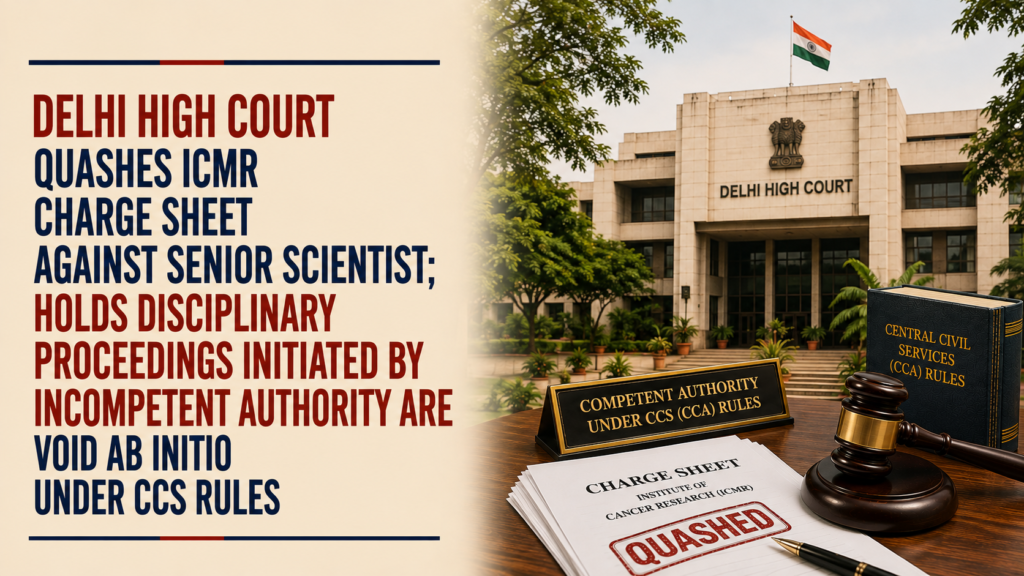
Delhi High Court Quashes ICMR Charge Sheet Against Senior Scientist; Holds Disciplinary Proceedings Initiated by Incompetent Authority Are Void Ab Initio Under CCS Rules

Charge Sheet Issued Without Competent Disciplinary Authority Is Void Ab Initio, Holds Delhi High Court
Facts
Dr. Bela Shah, a Senior Deputy Director General in the Indian Council of Medical Research (ICMR), was appointed in 1998 with the approval of the Executive Committee (EC). In April 2015, she was served with a charge sheet alleging misconduct in relation to approval of transfer of a NOIDA plot to the ICPO–ICMR Cooperative Group Housing Society. The charge sheet was signed by the Senior Deputy Director General and Chief Vigilance Officer and conveyed the decision of the Director General to institute disciplinary proceedings.
Dr. Shah challenged the charge sheet before the Central Administrative Tribunal (CAT), contending principally that it had been issued by an incompetent disciplinary authority. The Tribunal dismissed her Original Application, holding that the Director General was competent to initiate proceedings. Aggrieved, she filed the present writ petition before the Delhi High Court.
Issues
- Whether the Director General of ICMR was the competent disciplinary authority to institute disciplinary proceedings against the petitioner.
- Whether the charge sheet was liable to be quashed for having been issued by an incompetent authority.
- Whether the Court could interfere with the charge sheet at the threshold before completion of disciplinary proceedings.
Petitioner’s Arguments
The petitioner argued that:
- At the time of her appointment, the Executive Committee was the appointing and disciplinary authority for her post.
- Under Rule 2(a) of the CCS (CCA) Rules, where different appointing authorities exist at different points of time, the higher authority is treated as the appointing authority.
- Neither the Director General nor the Senior DDG could substitute the Executive Committee unless valid delegation had been made.
- Since the Executive Committee never delegated its disciplinary powers to the Director General, the charge sheet was without jurisdiction.
- Reliance was placed on Om Prakash Gupta Swadheen v. Union of India, Krishna Kumar, Union of India v. R.P. Tiwari, GNCTD v. Udal Singh, and the DoPT Office Memorandum dated 13 July 1981.
Respondents’ Arguments
ICMR contended that:
- Although the charge sheet was signed by the Senior DDG/CVO, it merely communicated the Director General’s decision.
- At the time disciplinary proceedings were initiated, the Director General was the competent disciplinary authority.
- Courts ordinarily should not interfere at the stage of issuance of a charge sheet.
- The petitioner could raise all her defences during the disciplinary inquiry.
- Reliance was placed on Pyare Lal Sharma v. Jammu & Kashmir Industries Ltd. and Dr. S.L. Agarwal v. General Manager, Hindustan Steel Ltd.
Analysis of the Law
The Court examined:
- Rules 2(a), 12, 13 and 14 of the CCS (CCA) Rules, 1965.
- Article 311(1) of the Constitution.
- The distinction between the authority competent to initiate disciplinary proceedings and the authority competent to impose punishment.
- The legal meaning of “appointing authority” under Rule 2(a).
The Court observed that Rule 13(2) specifically requires disciplinary proceedings to be instituted by the competent disciplinary authority, and Rule 14 requires that authority to draw up, or cause to be drawn up, the charge sheet. These provisions make the identity of the competent authority jurisdictionally significant.
Precedent Analysis
The Court relied upon:
- Om Prakash Gupta Swadheen v. Union of India (1976)
- Krishna Kumar v. Divisional Assistant Electrical Engineer
- State of Jharkhand v. Rukma Kesh Mishra (2025)
- Union of India v. R.P. Tiwari
- GNCTD v. Udal Singh
The Court distinguished:
- Pyare Lal Sharma, since there had been a valid delegation of power in that case.
- Dr. S.L. Agarwal, as it did not deal with the present issue.
The Court particularly relied upon Om Prakash Gupta, which held that where different appointing authorities exist, the higher authority governs. It also considered Rukma Kesh Mishra, which recognised that a disciplinary authority may “cause” a charge sheet to be drawn up through a delegate, but only where valid delegation exists.
Court’s Reasoning
The Court held that the Tribunal erred in restricting itself to the competence issue while assuming that serious charges necessarily required inquiry. It clarified that courts can interfere at the charge-sheet stage where, even accepting the allegations as true, the proceedings suffer from jurisdictional defects.
Applying Rule 2(a) of the CCS (CCA) Rules and the Supreme Court’s decision in Om Prakash Gupta, the Court concluded that the Executive Committee, being the higher appointing authority, remained the competent disciplinary authority.
Although the Director General could have acted as a delegate of the Executive Committee, there was no material showing any delegation of disciplinary powers by the Executive Committee. Consequently, the Director General lacked authority to institute disciplinary proceedings against the petitioner. Since the charge sheet itself had been issued by an incompetent authority, the disciplinary proceedings were void from their inception.
Conclusion
The Delhi High Court held that the charge sheet had been issued by an authority lacking jurisdiction under the CCS (CCA) Rules. Since the Executive Committee was the competent disciplinary authority and had not delegated its powers to the Director General, the disciplinary proceedings were vitiated ab initio. The Court therefore quashed both the Tribunal’s order and the charge sheet itself.
Case Details
Case: Dr. Bela Shah v. Indian Council of Medical Research & Ors.
Court: Delhi High Court
Case No.: W.P.(C) 9366/2022
Bench: Justice C. Hari Shankar and Justice Om Prakash Shukla
Date of Judgment: 4 August 2026
Result: Writ petition allowed; CAT order set aside; charge sheet dated 27/30 April 2015 quashed as having been issued by an incompetent disciplinary authority under the CCS (CCA) Rules.