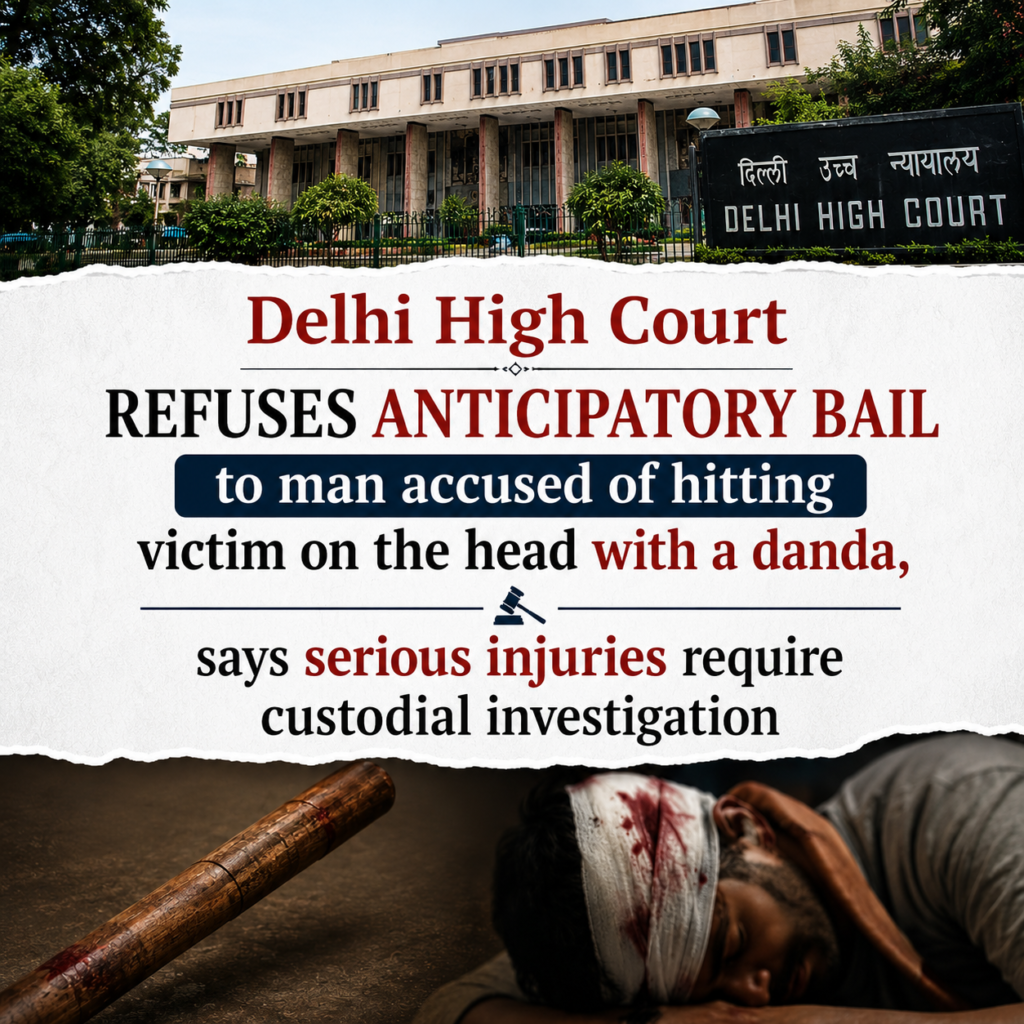
Delhi High Court Refuses Anticipatory Bail to Man Accused of Hitting Victim on the Head with a Danda, Says Serious Injuries Require Custodial Investigation

Delhi High Court Refuses Anticipatory Bail to Assault Accused, Says Danda Blow Exposed Skull Bone and Injured Lost Consciousness
Facts
The petitioner, Abhishek, filed an anticipatory bail application before the Delhi High Court in FIR No. 136 of 2026 registered at Police Station Nangloi.
The FIR was registered for offences under Sections 110 and 3(5) of the Bharatiya Nyaya Sanhita.
The allegation against the petitioner was that on 2 April 2026, due to previous enmity, he and his associates assaulted the injured/first informant with fists, kicks and a danda.
The injured specifically named the petitioner as one of the assailants. He alleged that the petitioner gave danda blows on his head and neck, due to which he fell down, after which all the assailants fled.
The MLC prepared at Sanjay Gandhi Memorial Hospital recorded multiple injuries, including a lacerated wound over the mid-parietal region with bone visibility. The MLC also recorded that the injured had lost consciousness.
The petitioner sought protection from arrest by way of anticipatory bail.
Issues
- Whether the petitioner was entitled to anticipatory bail in a case involving alleged assault with a danda on the head and neck.
- Whether the injuries disclosed in the MLC supported the seriousness of the allegations.
- Whether the petitioner’s claim that he himself was attacked could justify grant of anticipatory bail.
- Whether custodial interrogation was required for recovery of the danda allegedly used in the offence.
Petitioner’s Arguments
The petitioner argued that he was not involved in the alleged incident.
He submitted that, in fact, he himself was attacked by some motorcycle-borne persons and had lodged a police complaint regarding that incident.
He further contended that there was no assault on any vital part of the injured’s body.
The petitioner also argued that only a wooden stick was allegedly used and that no purpose would be served by sending him to jail.
Respondent’s Arguments
The State strongly opposed the anticipatory bail application.
The APP, assisted by the Investigating Officer, argued that the injuries caused to the injured complainant were serious in nature.
The State submitted that the petitioner had been specifically named in the FIR as an assailant.
It was further argued that the petitioner was not cooperating in the investigation, particularly for recovery of the danda allegedly used by him.
Analysis of the Law
The Court considered the nature of allegations, the medical evidence, the requirement of investigation and the distinction between regular bail and anticipatory bail.
The Court observed that this was not a regular bail application after arrest, but an anticipatory bail application seeking protection from arrest at the investigation stage.
The Court held that where the allegations disclose a serious assault with a danda on the head and neck, resulting in exposure of skull bone and loss of consciousness, such conduct cannot be treated lightly.
The Court also noted that recovery of the weapon was still pending and the petitioner was allegedly not cooperating in that recovery.
Precedent Analysis
The judgment does not discuss or rely upon any reported precedent.
The decision was based on the facts of the case, particularly the specific naming of the petitioner in the FIR, the seriousness of injuries recorded in the MLC, the pending recovery of the danda, and the nature of anticipatory bail jurisdiction.
Court’s Reasoning
The Court noted that the petitioner had been specifically named as an assailant in the FIR.
The Court rejected the petitioner’s contention that no vital part of the injured’s body was assaulted. It held that this submission was contrary to the MLC, which showed a lacerated wound over the mid-parietal region with bone visibility and loss of consciousness.
The Court also rejected the attempt to minimise the weapon as “only a wooden stick”. It observed that the weapon was a danda and was allegedly used with such force that the skull bone of the injured was exposed.
The Court further found the petitioner’s counter-version doubtful. The petitioner had lodged a police complaint on 3 April 2026, one day after the present incident, alleging that he had been attacked. However, his counsel admitted that the petitioner had not undergone any medical examination or treatment in any government or private hospital after the alleged assault on him.
The Court also noted that the danda allegedly used by the petitioner had not yet been recovered and that, according to the Investigating Officer, the petitioner was not cooperating with the recovery.
The Court held that granting anticipatory bail in such a case would send a wrong message to society, especially to the youth, that one can assault another person with impunity and still obtain bail from the Court.
Conclusion
The Delhi High Court dismissed the anticipatory bail application filed by Abhishek.
The Court held that the petitioner was specifically named in the FIR, the injuries were serious, the injured had lost consciousness, and the skull bone was visible due to the assault.
The Court further held that the danda allegedly used in the offence was yet to be recovered and that the petitioner was not cooperating with the investigation.
Accordingly, the Court found that it was not a fit case for grant of anticipatory bail.
Case Details
Case: Abhishek v. The State NCT of Delhi
Court: Delhi High Court
Case Number: BAIL APPLN. 2237 of 2026
Judge: Justice Girish Kathpalia
Date: 07 July 2026
Result: Anticipatory bail application dismissed.