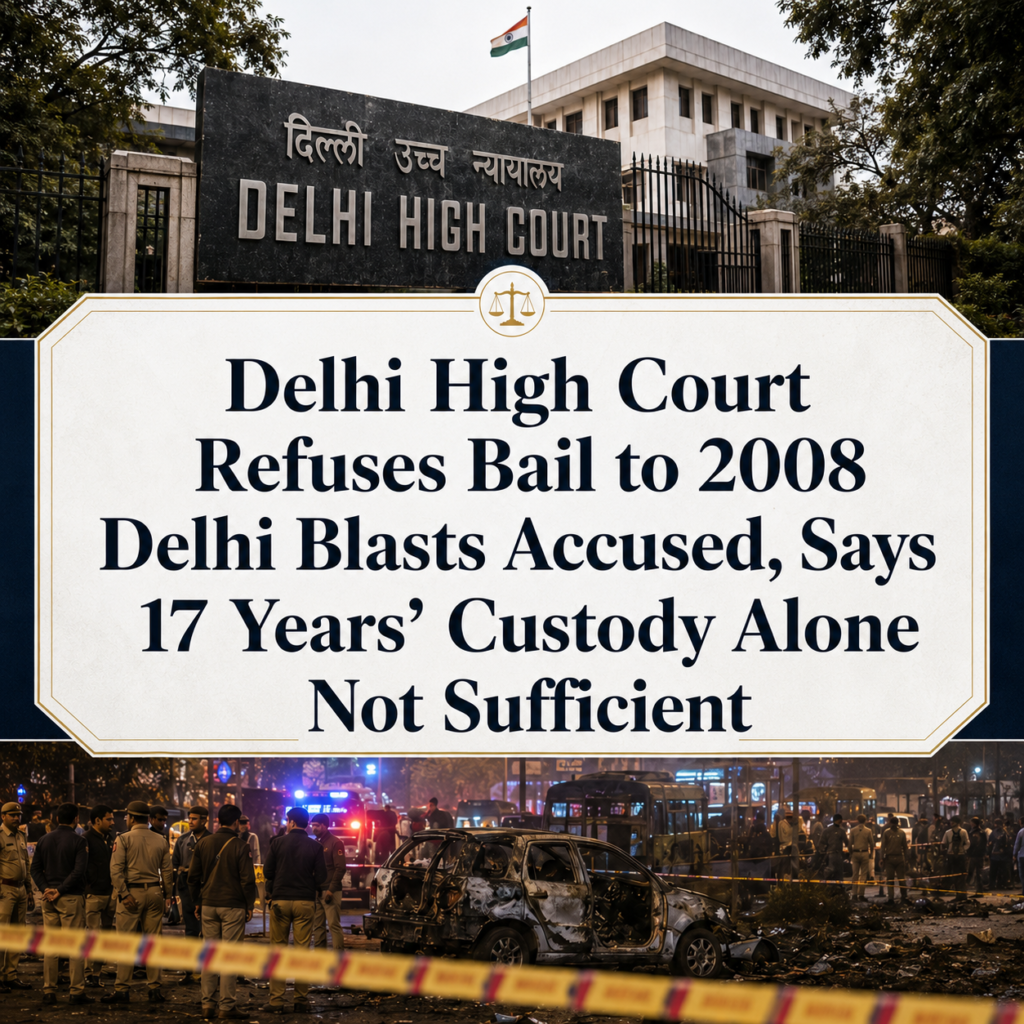
Delhi High Court Refuses Bail to Mansoor Asghar Peerbhoy in 2008 Delhi Serial Blasts Case, Holds 17 Years’ Custody Alone Not Enough When Trial Is Near Conclusion
Facts
The appellant, Mansoor Asghar Peerbhoy, filed an appeal under Section 21 of the National Investigation Agency Act, 2008, challenging the order dated 19 July 2025 passed by the Additional Sessions Judge-02, Patiala House Courts, New Delhi.
By the impugned order, the Trial Court dismissed his third bail application in Sessions Case No. 8726 of 2016, arising out of FIR No. 166 of 2008 registered at Police Station Karol Bagh, Special Cell.
The case relates to the serial bomb blasts that occurred in Delhi on 13 September 2008 at Karol Bagh, Greater Kailash-I and Connaught Place. Three live bombs were also recovered from Central Park, near Regal Cinema and Children’s Park, India Gate. The blasts resulted in the death of 26 persons and injuries to 135 persons.
Minutes before the blasts, an email titled “MESSAGE OF DEATH” was sent from the email address al_arbi_delhi@yahoo.com to various media houses in India and abroad. The email claimed responsibility on behalf of the terrorist organisation “Indian Mujahideen”.
The email also carried attachments, including a PDF document titled “EYE FOR AN EYE, THE DUST WILL NEVER SETTLE DOWN”, which claimed responsibility for the blasts and described Indian Mujahideen as a “homegrown jihadi militia”.
The prosecution alleged that the appellant was heading the media cell of Indian Mujahideen along with co-accused Mubin Kadar Shaikh. It was alleged that the appellant and co-accused had hacked the Wi-Fi network of M/s Kamran Power Controls Pvt. Ltd., Chembur, Mumbai, and used it to send the email shortly before the blasts.
The appellant was initially arrested in connection with the Mumbai case relating to the transmission of the email and was later formally arrested in FIR No. 166 of 2008 on 9 March 2009.
Charges were framed against him for offences under Sections 121, 121-A, 122, 123, 302, 307, 323, 427 and 120-B IPC, Sections 3, 4 and 5 of the Explosive Substances Act, Sections 16, 18, 20 and 23 of the UAPA, and Section 66 of the Information Technology Act.
The appellant’s first and second bail applications were dismissed. His earlier challenge before the Delhi High Court was also dismissed on 29 April 2024. The Supreme Court later declined to interfere but granted liberty to apply for bail if the trial did not conclude within six months. On that basis, the appellant filed the third bail application, which was again rejected by the Trial Court.
Issues
- Whether the appellant was entitled to bail after approximately 17 years of incarceration as an undertrial.
- Whether Section 43D(5) of the UAPA applied to the case despite the offence being of 2008 and the provision being amended later.
- Whether the material on record disclosed a prima facie case against the appellant.
- Whether the appellant could claim parity with co-accused who had been granted bail.
- Whether prolonged incarceration outweighed the gravity of allegations, the role attributed to the appellant and the fact that the trial was near completion.
Petitioner’s Arguments
The appellant argued that he had been falsely implicated and that there was no direct evidence connecting him with the transmission of the email.
He submitted that the prosecution’s theory of hacking the Wi-Fi network of M/s Kamran Power Controls Pvt. Ltd. was not supported by reliable evidence. He relied on the testimony of prosecution witnesses to argue that the alleged hacking was not properly proved.
He further contended that he had undertaken a hacking course because he was sponsored by his employer, Yahoo, and not because of any terrorist organisation or co-accused.
The appellant also attacked the forensic evidence, arguing that the forensic laboratory lacked proper tools and that the examination of the electronic devices was unreliable.
He submitted that any alleged admission made during police investigation was inadmissible in evidence.
The appellant argued that Section 43D(5) of the UAPA, in its amended form, could not be applied because the alleged offence occurred before the amendment came into force.
He also sought parity with co-accused Mohd. Hakim, who had been granted bail.
The appellant further pointed out that he had been acquitted in the Ahmedabad serial blast case and had been granted bail by the Bombay High Court in a related case concerning the alleged sending of the email.
Lastly, he argued that he had been in custody for about 17 years and that continued incarceration as an undertrial violated his right to life and personal liberty under Article 21 of the Constitution.
Respondent’s Arguments
The State opposed bail and argued that the case involved serial bomb blasts of the gravest nature, resulting in 26 deaths and 135 injuries.
It submitted that the appellant was an active member of Indian Mujahideen and was heading its media cell with other co-accused.
The State argued that the appellant and co-accused Mubin Kadar Shaikh had purchased the laptop used to send the terror email. The computer shop owner, PW-231, had identified both of them as the persons who purchased the laptop.
The State relied on recovery of electronic devices, including a Wi-Fi hotspot finder, radio frequency signal detector, Seagate hard disk and spy hidden camera locator from the appellant.
It was further argued that the appellant had specialised knowledge of cyber security and hacking techniques, and this technical expertise was used to execute the conspiracy.
The State submitted that forensic examination revealed the presence of file-erasing and disk-wiping software such as HEX “00” and STELLAR WIPE on recovered electronic devices. According to the prosecution, these tools were used to erase or destroy digital evidence.
The State also relied on recovery of PDF documents from the laptops, including the same document attached to the email sent shortly before the blasts.
It was argued that the trial was at its final stage. Out of 305 prosecution witnesses, evidence of 303 witnesses had already been completed and only two witnesses remained. Therefore, releasing the appellant at this stage could affect the trial.
Analysis of the Law
The Delhi High Court held that the bar under Section 43D(5) of the UAPA applied to the case.
The Court rejected the appellant’s argument that the amended provision could not apply because the offence was committed before the amendment. It held that provisions relating to bail are procedural in nature and can apply to pending cases.
The Court relied on the earlier bail proceedings, where the same argument had already been considered, and also referred to the principle that once charges under UAPA have been framed and prima facie material exists, the statutory bar under Section 43D(5) operates.
The Court reiterated that under Section 43D(5), bail cannot be granted if, on perusal of the case diary or charge-sheet, the Court finds reasonable grounds for believing that the accusations are prima facie true.
The Court clarified that at the stage of bail, it is not required to conduct a mini-trial or undertake a detailed appreciation of evidence. The Court is required to examine the material on broad probabilities.
On prolonged incarceration, the Court accepted that constitutional courts retain power to grant bail where continued detention violates Article 21. However, it held that long custody is not the only factor. The Court must consider the nature of the offence, gravity of allegations, role attributed to the accused, stage of trial, possibility of delay, and public interest.
Precedent Analysis
The Court relied on National Investigation Agency v. Zahoor Ahmad Shah Watali, where the Supreme Court held that at the bail stage under UAPA, the Court must examine whether the accusations are prima facie true on the basis of broad probabilities and need not conduct a detailed evaluation of evidence.
The Court also referred to Gurwinder Singh v. State of Punjab and Shaikh Javed Iqbal v. State of Uttar Pradesh, which followed the UAPA bail principles laid down in Watali.
The Court considered Prasanta Kumar Sarkar v. Ashish Chatterjee and State of U.P. v. Amarmani Tripathi for the general principles governing bail, including prima facie case, gravity of offence, severity of punishment, risk of absconding, likelihood of influencing witnesses, and risk of justice being defeated.
The Court considered Union of India v. K.A. Najeeb, where the Supreme Court held that constitutional courts can grant bail despite UAPA restrictions where trial is unlikely to conclude within a reasonable time and incarceration has become constitutionally unjustifiable.
However, the Court distinguished K.A. Najeeb on facts. In that case, the trial was nowhere near completion and many witnesses remained. In the present case, the trial was at its fag end and only two witnesses remained.
The Court also considered Syed Iftikhar Andrabi v. NIA, where the Supreme Court reaffirmed the continuing force of K.A. Najeeb, and Tasleem Ahmed v. State, where the issue of prolonged incarceration under special statutes was referred to a larger Bench.
The Court held that even though Article 21 remains relevant, the facts of the present case did not justify bail because of the gravity of the offence, prima facie material, the appellant’s alleged central role, and the near completion of trial.
Court’s Reasoning
The Court held that the serial blasts of 13 September 2008 were not ordinary offences. They were synchronised terrorist attacks carried out at multiple locations in Delhi, with an email claiming responsibility being sent minutes before the blasts.
The Court found that the prosecution material prima facie showed the appellant’s involvement in the transmission of the email. The material included the PDF document attached to the email, file-erasing software found on electronic devices, identification of the appellant by the computer shop owner as one of the purchasers of the laptop, hacking of the Wi-Fi network of M/s Kamran Power Controls Pvt. Ltd., and recovery of electronic devices from the appellant.
The Court held that the appellant’s alleged role was not peripheral. According to the prosecution, he occupied a significant position in the media cell of Indian Mujahideen and used his technical expertise in furtherance of the conspiracy.
The Court rejected parity with co-accused Mohd. Hakim. It noted that Mohd. Hakim’s role was limited to carrying cycle ball bearings allegedly used in IEDs, whereas the appellant’s alleged role related to the technological and media aspect of the conspiracy and transmission of the terror email.
The Court also held that the appellant’s acquittal in another case and bail in a connected Mumbai case did not automatically entitle him to bail in the present Delhi serial blasts case.
On prolonged custody, the Court acknowledged that the appellant had remained in custody for a considerable period. However, it held that the trial was now at its final stage and releasing him at this juncture could adversely affect the ongoing proceedings.
The Court further observed that while considering bail, the Court must consider not only the appellant’s right to life and liberty, but also the possible impact of release on the right to life and safety of ordinary citizens, given the nature of the alleged offences.
Conclusion
The Delhi High Court dismissed the appeal and refused bail to Mansoor Asghar Peerbhoy.
The Court held that the material on record disclosed a prima facie case against the appellant and that the bar under Section 43D(5) of the UAPA applied.
The Court further held that although the appellant had been in custody for about 17 years, prolonged incarceration alone was not sufficient to grant bail in the facts of the case, especially when the allegations involved serial bomb blasts, 26 deaths, 135 injuries, and the trial was almost complete.
The Court directed that the observations made in the bail order would not affect the final adjudication of the trial.
The Trial Court was directed to proceed and conclude the trial within eight months, as directed by the Supreme Court.
Case Details
Case: Mansoor Asghar Peerbhoy v. State Govt. of NCT of Delhi
Court: Delhi High Court
Case Number: CRL.A. 1461 of 2025 & CRL.M.A. 31308 of 2025
Judge: Justice Prathiba M. Singh and Justice Madhu Jain
Date: 07 July 2026
Result: Appeal dismissed; third bail application rejected; Trial Court directed to conclude trial within eight months as per Supreme Court direction.