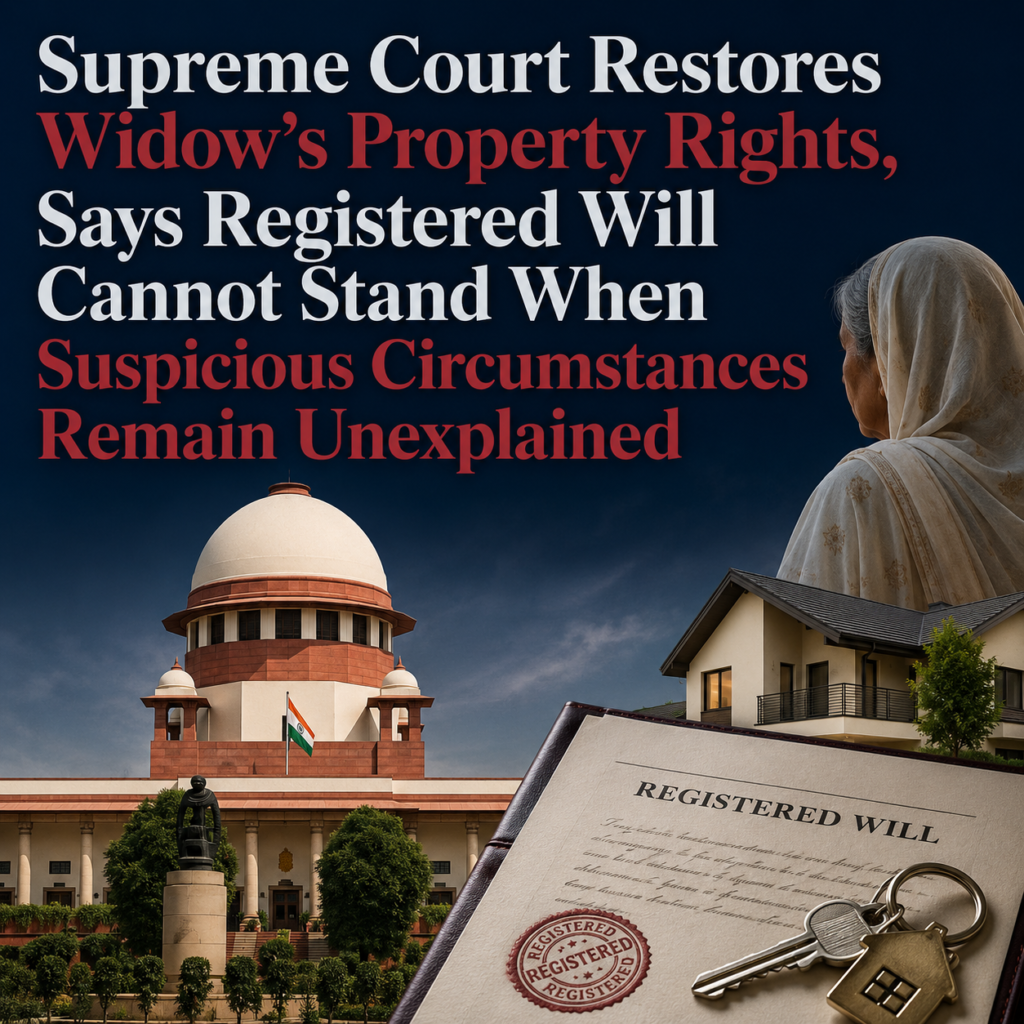
Supreme Court Restores Widow’s Property Rights, Says Registered Will Cannot Stand When Suspicious Circumstances Remain Unexplained

Supreme Court Restores Widow’s Property Rights, Holds Registered Will Can Be Rejected if Suspicious Circumstances Are Not Explained
Facts
The dispute concerned property originally owned by Chhajju Ram, an illiterate agriculturist who died issueless in 1992.
His widow, Bhambo Devi, filed a civil suit claiming that she was the sole owner and in possession of the property as the only surviving Class I heir of Chhajju Ram. She alleged that the defendants had got the revenue records mutated in their favour on the basis of a forged Will dated 6 November 1974.
The defendants claimed that Chhajju Ram had executed a registered Will in their favour out of love and affection and because they had allegedly served him and his wife. They also claimed that the plaintiff knew about the Will and had not objected at the time of mutation.
The Trial Court rejected the Will, found the plaintiff to be owner in possession, and decreed the suit. The First Appellate Court affirmed the decree. However, the Himachal Pradesh High Court, in second appeal, reversed the concurrent findings and dismissed the suit, holding that the Will had been proved through an attesting witness.
The legal representative of the plaintiff, Sardari Lal, challenged the High Court’s judgment before the Supreme Court.
Issues
- Whether the plaintiff’s pleadings were defective or self-contradictory because she pleaded that the Will was forged and also alleged fraud, undue influence and importunity.
- Whether non-examination of the plaintiff or any factual witness on her behalf was enough to dismiss the suit.
- Whether the Will was surrounded by suspicious circumstances.
- Whether the propounders of the Will had explained those suspicious circumstances to the satisfaction of the Court’s judicial conscience.
- Whether the High Court exceeded its jurisdiction under Section 100 of the Code of Civil Procedure by interfering with concurrent findings of fact recorded by the Trial Court and First Appellate Court.
Petitioner’s Arguments
The appellant argued that the basic facts were not disputed: Chhajju Ram was the owner of the property, he died issueless, and his widow was the sole Class I heir if there was no valid Will.
It was submitted that once these facts were admitted, the plaintiff was not required to lead further evidence to prove them.
The appellant argued that the burden of proving the Will was entirely on the defendants who propounded it. The Will was not an ordinary document; it had to satisfy the conscience of the Court.
The appellant pointed out several suspicious circumstances, including that the Will excluded the wife without any genuine reason, the beneficiaries were not close relatives, the alleged reason that they had served the testator was doubtful, and there were unexplained cuttings on the registration endorsement at the back of the Will.
It was further argued that whether suspicious circumstances existed and whether they were explained were questions of fact. Therefore, the High Court could not interfere with the concurrent factual findings in a second appeal under Section 100 CPC.
Respondent’s Arguments
The respondents argued that the Will was a registered document and had been proved through an attesting witness.
They submitted that the law does not require both attesting witnesses to be examined. Since one attesting witness had proved execution, the Will should not have been rejected.
They also argued that the plaintiff did not examine herself or any factual witness and failed to prove fraud, undue influence or coercion.
According to the respondents, disinheritance of the wife by itself was not enough to reject a validly executed Will.
They further submitted that the cuttings on the back of the Will were not material because there were no cuttings on the main body of the Will.
Analysis of the Law
The Supreme Court reiterated that proving a Will is not limited to proving signature, thumb impression or attestation.
A Will must satisfy two levels of proof. First, its execution must comply with Section 63 of the Indian Succession Act and Section 68 of the Evidence Act. Second, where suspicious circumstances exist, the propounder must remove those suspicions and satisfy the judicial conscience of the Court.
The Court clarified that a plaintiff can take alternative pleas. Therefore, pleading that the Will was bogus and also pleading fraud or undue influence did not amount to an admission that the Will was executed.
The Court further held that admitted facts need not be proved. Since the defendants had not disputed that Bhambo Devi was the widow and sole Class I heir of Chhajju Ram in the absence of a valid Will, non-examination of the plaintiff was not fatal.
Precedent Analysis
The Supreme Court relied on H. Venkatachala Iyengar v. B.N. Thimmajamma, Rani Purnima Debi v. Kumar Khagendra Narayan Deb, and Shivakumar v. Sharanabasappa to restate the principles governing proof of Wills.
The Court held that suspicious circumstances may include unnatural exclusion of natural heirs, doubtful recitals, unfair disposition, doubtful execution, or circumstances suggesting that the Will may not reflect the free will of the testator.
The Court also relied on Jaswant Kaur v. Amrit Kaur to emphasize that when a Will is surrounded by suspicion, the matter becomes one of the Court’s conscience, and the propounder must give a cogent explanation.
On second appeal jurisdiction, the Court held that findings on suspicious circumstances are normally findings of fact. A High Court may interfere only where the findings are perverse, irrational, based on imaginary suspicions, or affected by an error of law.
Court’s Reasoning
The Supreme Court found that the Trial Court and First Appellate Court had rightly treated the Will as suspicious.
First, Chhajju Ram’s wife was his only Class I heir and had lived with him and cared for him. Excluding her in favour of persons who were not close relatives was an abnormal disposition requiring a convincing explanation.
Second, the Will stated that the wife had sufficient jewellery and cash, but no details were given. The Court found that such a vague recital could not justify excluding the widow.
Third, the Will stated that the beneficiaries were nephews of the testator and had served him and his wife. However, the evidence did not establish that they were close relatives or that they were actually serving the testator in the manner claimed.
Fourth, one beneficiary was a student when the Will was allegedly executed, while the other was in service. This made the claim that they were rendering substantial service to the testator doubtful.
Fifth, the testator was an illiterate agriculturist who executed documents by thumb impression. In such circumstances, incorrect recitals and suspicious endorsements required closer scrutiny.
Sixth, the registration endorsement at the back of the Will contained unexplained cuttings. The name of another person, “Laxmi Kant,” appeared to have been cut and replaced with “Chhajju Ram,” and those cuttings were not initialled by the Sub-Registrar. This created serious doubt about who had presented the Will for registration.
The Supreme Court held that registration of a Will does not automatically remove suspicion. Where suspicious circumstances exist, registration alone cannot prove that the testator executed the Will with free will and full understanding.
The Court concluded that the High Court wrongly treated proof by one attesting witness as sufficient and failed to respect the concurrent factual findings of the Trial Court and First Appellate Court.
Conclusion
The Supreme Court allowed the appeal.
It held that the Will was rightly discarded by the Trial Court and the First Appellate Court because the suspicious circumstances surrounding it were not explained by the defendants.
The Court held that the High Court exceeded its jurisdiction under Section 100 CPC by interfering with well-reasoned concurrent findings of fact.
Accordingly, the High Court’s judgment was set aside, and the decree passed by the Trial Court, as affirmed by the First Appellate Court, was restored.
Case Details
Case: Sardari Lal v. Bishan Dass & Ors.
Court: Supreme Court of India
Case Number: Civil Appeal No. 10990 of 2016
Judge: Justice Manoj Misra and Justice K. V. Viswanathan
Date: 6 July 2026
Result: Appeal allowed; High Court judgment set aside; Trial Court decree declaring the plaintiff owner in possession restored.