Delhi High Court Refuses Quashing of Supertech Homebuyer Cheating Case; Holds Director Liability Cannot Be Automatic but Prima Facie Role and Subvention Allegations Require Trial Scrutiny

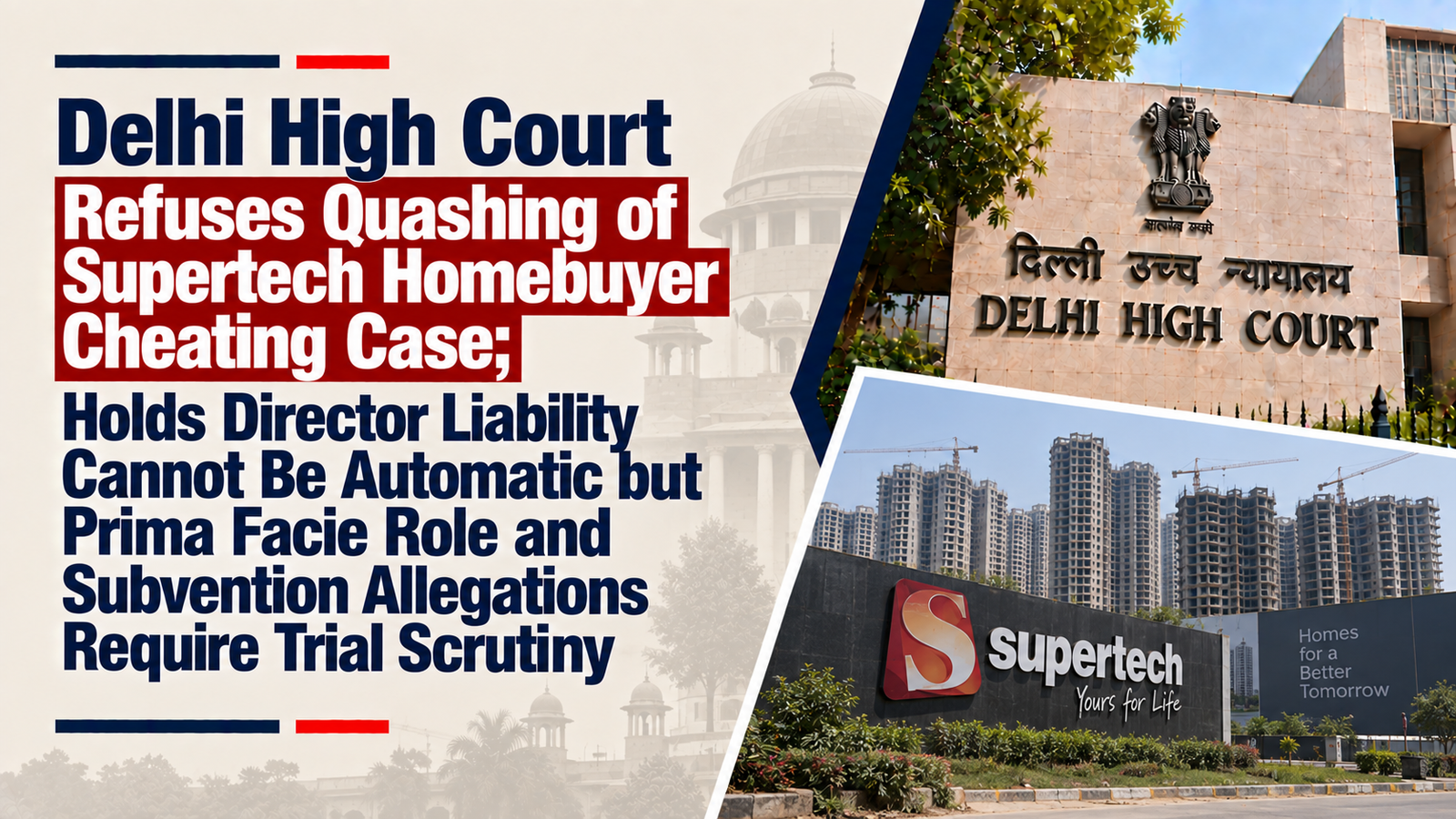
Delhi High Court Rejects Supertech Directors’ Plea to Treat Homebuyers’ Subvention-Scheme Dispute as Purely Civil
Facts
The Delhi High Court decided three connected petitions filed by Sangita Arora, Mohit Arora and Ram Kishor Arora under Section 528 of the Bharatiya Nagarik Suraksha Sanhita, 2023. They sought quashing of proceedings arising from FIR No. 105/2020, Police Station Economic Offences Wing, as well as the Trial Court’s cognizance and summoning order dated 22 March 2025 and the revisional order dated 30 March 2026 affirming it.
The prosecution arose from complaints by homebuyers concerning M/s Supertech Limited’s “Hill Town” residential project at Sector-2, Sohna, Haryana, launched under a subvention scheme. Under the alleged arrangement, purchasers were to initially pay 10% of the sale consideration while the developer would service the pre-EMIs for an agreed period until possession.
Homebuyers alleged that:
- possession was not delivered within the promised period;
- Supertech stopped paying the pre-EMIs;
- substantial sums had been collected from purchasers;
- the project remained incomplete; and
- there were allegations regarding diversion or utilisation of project funds.
The FIR was registered on 18 August 2020. Following investigation, a charge-sheet was filed alleging offences under Sections 406, 420 and 120B IPC against the company and its directors/office-bearers. The Trial Court took cognizance and summoned the accused on 22 March 2025.
The petitioners’ criminal revisions were dismissed by the Additional Sessions Judge on 30 March 2026, leading to the present quashing petitions.
Issues
The principal questions before the High Court were:
- Whether directors of a company could be prosecuted merely because of their designation without specific material showing individual participation.
- Whether the allegations against the Supertech directors disclosed sufficient prima facie material to justify continuation of prosecution.
- Whether the dispute was essentially contractual/civil in nature and therefore unsuitable for criminal prosecution.
- Whether offences under Sections 406 and 420 IPC could simultaneously form part of the charge-sheet despite their distinct ingredients.
- Whether a prima facie case of criminal conspiracy under Section 120B IPC existed without direct evidence of an express agreement.
- Whether the Trial Court’s summoning order was liable to be quashed as cryptic or lacking application of mind.
- Whether the revisional order suffered from patent illegality, jurisdictional error or manifest perversity.
Petitioners’ Arguments
The petitioners argued that a Director cannot incur automatic criminal liability for offences allegedly committed by a company.
Particular emphasis was placed on Sangita Arora’s case. She contended that she was essentially a homemaker, had no technical expertise in real estate, did not participate in day-to-day operations and had been inducted as Director principally because of her marital relationship with one of the promoters/directors.
Reliance was placed on Sunil Bharti Mittal v. CBI and Maksud Saiyed v. State of Gujarat for the proposition that, absent a statutory provision creating vicarious criminal liability, a director cannot be prosecuted merely because of the office held.
The petitioners further argued that:
- there was no entrustment to Sangita Arora to attract Section 406 IPC;
- there was no representation or dishonest intention attributable to her at inception to attract Section 420 IPC;
- failure to deliver possession and pay pre-EMIs was essentially a contractual dispute;
- Sections 406 and 420 operate on distinct factual foundations;
- no agreement constituting conspiracy under Section 120B was shown; and
- the cognizance/summoning order did not identify their individual roles.
State’s Arguments
The State opposed quashing and contended that the investigation disclosed a prima facie case under Sections 406, 420 and 120B IPC.
It stated that the principal complainant had entered the subvention scheme on representations that:
- he would initially bear only 10% of the price;
- Supertech would service the pre-EMIs; and
- possession would be delivered within approximately 36 months.
The complainant allegedly paid ₹62,62,109 to the company, but Supertech stopped servicing his pre-EMIs after September 2018 and construction allegedly stalled.
The investigation also received 38 complaints relating to the same project, with an approximate aggregate alleged loss of ₹22.80 crore. Settlement documents were stated to have been furnished concerning only eight victims.
Regarding Sangita Arora specifically, the State asserted that she:
- was a Director from 7 December 1995 until 1 September 2018;
- held approximately 34% shareholding;
- filed company balance sheets;
- attended Board meetings; and
- was an authorised signatory to the company’s bank account.
The prosecution also asserted that she participated in management and day-to-day affairs.
Analysis of the Law
1. No Automatic Criminal Liability Merely Because Someone Is a Director
The High Court expressly accepted the legal proposition advanced by the petitioners that designation as a Director, by itself, cannot create criminal liability.
Relying on the principles in Sunil Bharti Mittal and Maksud Saiyed, the Court held that the law does not recognise automatic criminal liability merely because a person holds a directorial position. There must be material indicating individual involvement.
This is an important qualification: the Court did not reject the general legal principle relied upon by the directors.
It rejected its application to the facts at the quashing stage.
Prima Facie Material Against Sangita Arora
The Court found that the prosecution case against Sangita Arora was not based solely on her designation.
The investigative material asserted:
- approximately 34% shareholding;
- prolonged directorship;
- filing of balance sheets;
- participation in Board meetings;
- authorised signatory status for company bank accounts; and
- participation in management and day-to-day affairs.
Whether those circumstances ultimately prove her criminal liability remained an open question.
But they were sufficient to prevent the Court from concluding, at the Section 528 stage, that there was absolutely no material connecting her to the company’s affairs.
The Court therefore distinguished a case of pure vicarious prosecution based merely on designation from a case where additional participation material has been collected.
Civil Dispute Versus Criminal Offence
The Court accepted the settled proposition that mere breach of contract does not constitute cheating.
For Section 420 IPC, dishonest or fraudulent intention must exist at the inception of the transaction. A purely contractual dispute cannot be converted into a criminal case merely because one party subsequently fails to perform.
However, the allegations here were not confined merely to delayed possession.
The prosecution alleged that:
- the project was marketed under a subvention scheme;
- homebuyers were induced to make investments based on particular representations;
- Supertech undertook to service pre-EMIs;
- substantial amounts were collected;
- the company later stopped making pre-EMI payments;
- construction remained incomplete; and
- several other buyers reported similar allegations.
The Court held that the existence or absence of dishonest intention from inception required evidence and therefore could not conclusively be determined in quashing proceedings.
Sections 406 and 420 IPC Can Be Examined at Trial
The petitioners relied on Delhi Race Club (1940) Ltd. v. State of Uttar Pradesh to emphasize the conceptual distinction between:
- cheating, based upon dishonest inducement at inception; and
- criminal breach of trust, based upon entrustment followed by dishonest misappropriation.
The High Court accepted that the offences have distinct ingredients.
But it held that Delhi Race Club does not establish a rule that a charge-sheet must automatically be quashed whenever both Sections 406 and 420 are invoked.
The precise nature of the transactions, entrustment, inducement and roles of individual accused could be examined by the Trial Court.
Criminal Conspiracy Under Section 120B IPC
The petitioners argued that there was no direct evidence showing an agreement among the accused to commit an illegal act.
The Court rejected this as a ground for threshold quashing.
It held that conspiracy is ordinarily inferred from:
- conduct of the parties; and
- surrounding circumstances.
Direct evidence of an express agreement or “meeting of minds” is rarely available.
Whether the evidence ultimately establishes such a meeting of minds must therefore ordinarily be determined at trial rather than conclusively in Section 528 proceedings.
Summoning Order Need Not Be a Mini-Trial
The High Court reiterated that summoning an accused is a serious judicial act and a Magistrate must apply his or her mind to the material on record.
However, relying on the principles underlying Pepsi Foods Ltd., it held that a cognizance or summoning order need not:
- discuss every document;
- answer every defence;
- analyse the evidence in exhaustive detail; or
- record findings resembling a trial judgment.
At the summoning stage, the Court only has to reach a prima facie opinion that sufficient grounds exist for proceeding.
Scope of Section 528 BNSS
The High Court emphasised that inherent jurisdiction under Section 528 BNSS is not a substitute for trial.
At this stage, the Court is not required to determine whether the prosecution will ultimately prove its case beyond reasonable doubt.
It must only examine whether:
- prima facie material exists;
- the proceedings disclose an obvious abuse of process;
- the impugned orders contain patent illegality;
- jurisdictional error exists; or
- manifest perversity is demonstrated.
Defences concerning individual roles, financial transactions and explanations for non-completion of the project required evidentiary adjudication and could not appropriately be resolved through a detailed mini-trial in quashing jurisdiction.
Precedent Analysis
Sunil Bharti Mittal v. Central Bureau of Investigation
The Court accepted its principle that a director cannot automatically be prosecuted for an offence committed by a company merely because of his or her office.
However, the precedent did not help the petitioners where the prosecution relied upon additional evidence allegedly connecting individual directors to the relevant affairs.
Maksud Saiyed v. State of Gujarat
Applied alongside Sunil Bharti Mittal to distinguish genuine individual-role allegations from impermissible automatic vicarious liability.
V.Y. Jose v. State of Gujarat / Sushil Sethi v. State of Arunachal Pradesh
These authorities support the proposition that breach of contract alone does not amount to cheating and dishonest intention must exist when the transaction begins.
The High Court accepted the proposition but held that whether such initial dishonest intention existed in the Supertech transactions required evidentiary examination.
Delhi Race Club (1940) Ltd. v. State of Uttar Pradesh
Applied to recognise the distinction between Sections 406 and 420 IPC, but not as creating an automatic threshold bar against prosecution where both offences are invoked.
Pepsi Foods Ltd. v. Special Judicial Magistrate
Recognised that summoning is a serious act requiring application of mind, but it does not require the Magistrate to conduct an exhaustive evaluation or mini-trial.
Amit Kapoor v. Ramesh Chander
Relied upon by the petitioners concerning revisional jurisdiction. The High Court nevertheless found no jurisdictional defect, patent illegality or manifest perversity in the revisional order requiring interference.
Court’s Reasoning
The Court’s reasoning turned upon the distinction between ultimate proof and prima facie material.
It did not hold that the petitioners were guilty of cheating, breach of trust or conspiracy.
Rather, it found that the record was not so devoid of material that the prosecution could be terminated without trial.
In particular:
- criminal liability could not be imposed merely because someone was a Director;
- but the prosecution asserted additional material showing participation;
- the allegations went beyond simple delayed possession;
- several homebuyers had made similar allegations;
- the subvention structure, collection of funds and discontinued pre-EMIs required evidentiary examination;
- the coexistence of Sections 406 and 420 did not itself invalidate prosecution;
- conspiracy could be inferred circumstantially; and
- individual roles and financial transactions were trial matters.
The threshold for quashing was therefore not satisfied.
Conclusion
The Delhi High Court held that the record disclosed a prima facie case warranting continuation of the criminal proceedings.
It found no:
- jurisdictional defect;
- patent illegality; or
- manifest perversity
in either the Trial Court’s order dated 22 March 2025 or the Revisional Court’s order dated 30 March 2026.
Accordingly, all three petitions were dismissed, pending applications were disposed of, and any interim protection was vacated.
The Court expressly clarified that its observations were confined to the quashing proceedings and would not prejudice the petitioners on merits before the Trial Court.
Case Details
Lead Case: Sangita Arora v. State of NCT Delhi & Anr.
Connected Petitioners: Mohit Arora and Ram Kishor Arora
Court: Delhi High Court
Case Numbers: CRL.M.C. 4722/2026, CRL.M.C. 4723/2026 and CRL.M.C. 4724/2026
Judge: Justice Madhu Jain
Reserved On: 19 August 2026
Pronounced On: 8 September 2026
FIR: FIR No. 105/2020, Police Station Economic Offences Wing
Project: Hill Town, Sector-2, Sohna, Haryana
Offences: Sections 406, 420 and 120B IPC
Provision Invoked for Quashing: Section 528, Bharatiya Nagarik Suraksha Sanhita, 2023
Result: All three quashing petitions dismissed; cognizance and summoning orders upheld; interim protection vacated; Trial Court proceedings to continue, with merits left open.