


Court’s decision
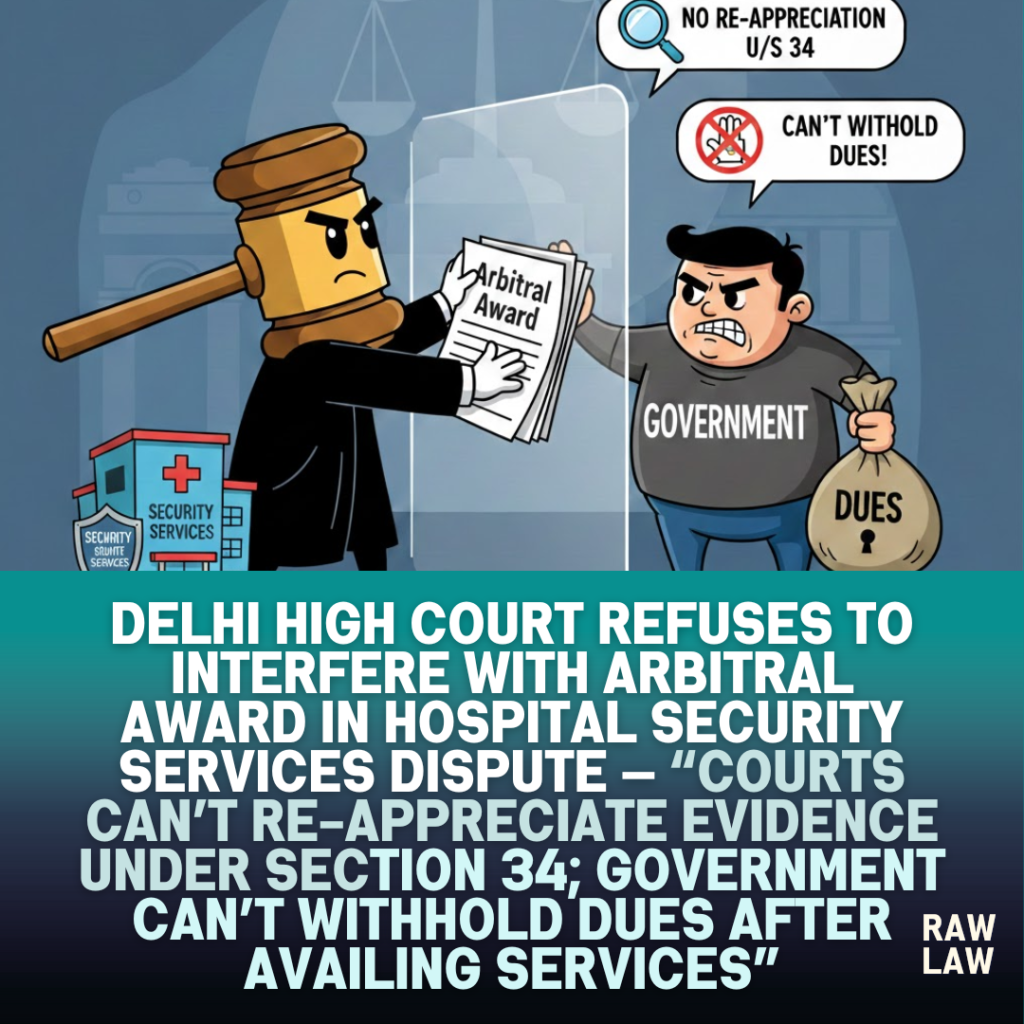
The Delhi High Court dismissed a petition filed by the Government of NCT of Delhi and a government hospital seeking to set aside an arbitral award in favour of a private security services provider, holding that the award was based on a plausible appreciation of evidence and contractual terms and did not suffer from patent illegality or violation of public policy. Reiterating the narrow scope of interference under Section 34 of the Arbitration and Conciliation Act, the Court ruled that once services are admittedly availed, the State cannot indefinitely withhold payment by raising procedural objections. The arbitral award was upheld in full.
Court’s decision
Justice Jasmeet Singh held that the arbitral tribunal had examined the agreement, correspondence, bills, statutory challans, and voluminous records placed on record and arrived at a reasoned conclusion. The Court found that the petitioners were effectively seeking a re-trial on facts, which is impermissible under Section 34. Holding that the arbitral findings were neither perverse nor contrary to the contract, the Court dismissed the petition and all pending applications.
Facts
The dispute arose out of a contract awarded by a government hospital in Delhi for providing security services through trained manpower. The contractor was engaged to deploy 130 security guards and three supervisors under an agreement executed in April 2011. Although the original contract period was two years, it was extended repeatedly until December 2014 due to the essential nature of hospital security services.
During the subsistence of the contract, disputes emerged regarding release of payments. The hospital alleged that the contractor had failed to submit complete documentation relating to wage disbursement, provident fund, employees’ state insurance contributions, police verification, and other statutory compliances. On this basis, substantial payments were withheld. The contractor invoked arbitration and sought recovery of pending bills and refund of security deposit. The sole arbitrator allowed the claims, leading to the present Section 34 challenge.
Issues
The principal issue before the High Court was whether the arbitral award allowing the contractor’s claims for unpaid bills and refund of security deposit could be set aside under Section 34 of the Arbitration and Conciliation Act on the grounds of patent illegality, perversity, or violation of public policy. A connected issue was whether alleged procedural lapses in documentation entitled the government to withhold payment despite admittedly availing security services over several years.
Petitioners’ arguments
The government authorities argued that the arbitral award was irrational, perverse, and contrary to the express terms of the contract. It was contended that the contractor failed to comply with mandatory clauses requiring police verification of staff, maintenance of deployment registers countersigned by hospital officials, submission of shift-wise deployment details, and proof of wage disbursement through cheque or electronic transfer.
The petitioners alleged serious discrepancies in provident fund and ESI challans, claiming that consolidated challans were submitted which did not establish that statutory dues were paid for personnel deployed at the hospital. It was further argued that the arbitrator wrongly shifted the burden of proof on the government, ignored material discrepancies, and treated disputed documents as admitted without formal proof, thereby rendering the award patently illegal and opposed to public policy.
Respondent’s arguments
The contractor opposed the petition, submitting that it had continuously deployed the requisite number of security personnel and supervisors throughout the contract period and that this fact was never disputed. It was argued that all relevant documents, including bills, deployment records, and statutory challans, were placed before the arbitrator in multiple volumes and examined in detail.
The respondent contended that minor or alleged procedural irregularities could not justify complete non-payment after the hospital had enjoyed uninterrupted security services for years. Emphasising the limited scope of Section 34, the contractor submitted that the petition was a thinly veiled attempt to re-argue facts and delay payment of lawfully awarded dues.
Analysis of the law
The Court analysed the settled principles governing interference with arbitral awards under Section 34. It reiterated that courts do not sit in appeal over arbitral findings and cannot re-appreciate evidence or substitute their own view merely because another interpretation is possible. Interference is permissible only when the award is patently illegal, contrary to fundamental policy of Indian law, or shocks the conscience of the court.
The Court also emphasised that the arbitral tribunal is the master of the quality and quantity of evidence. Even alleged errors in appreciation of documents or factual conclusions do not warrant interference unless the findings are completely unsupported by evidence or violate the contract.
Precedent analysis
Relying on authoritative Supreme Court precedent, the Court reaffirmed that arbitral awards cannot be set aside for alleged misappreciation of evidence or erroneous factual findings. It reiterated that even if the court may have taken a different view on the same material, that by itself does not justify interference. The judgment aligns with settled law cautioning courts against converting Section 34 proceedings into appellate review, especially in commercial disputes involving government contracts.
Court’s reasoning
On facts, the Court noted that there was no dispute that the contractor provided security services as per the contract and that the hospital continued to take benefit of such services without terminating the agreement. The arbitrator had examined the contractual clauses, correspondence, bills, and statutory documents and concluded that the contractor substantially complied with its obligations.
The Court held that alleged procedural lapses or isolated discrepancies could not absolve the petitioners of liability to pay for services availed. It found the arbitral findings to be reasonable and plausible and rejected the contention that the arbitrator travelled beyond the contract or ignored material evidence. The Court also observed that withholding payments adversely affected security personnel dependent on timely wages.
Conclusion
The Delhi High Court dismissed the Section 34 petition, holding that the arbitral award did not suffer from patent illegality, perversity, or violation of public policy. The Court upheld the award granting payment of pending bills, refund of security deposit, and interest to the contractor. All pending applications were also dismissed.
Implications
This ruling reinforces judicial restraint in arbitration matters and sends a clear signal to government authorities that they cannot withhold contractual payments after enjoying services by raising procedural objections at a belated stage. It strengthens confidence in arbitration as an effective dispute resolution mechanism, particularly in government contracts, and underscores that Section 34 is not a forum for re-litigating facts or evidence.
Case law references
- Scope of Section 34 review: Courts cannot re-appreciate evidence or act as appellate authorities over arbitral awards. Applied to dismiss the challenge.
- Public policy and patent illegality: Only awards violating fundamental legal principles or shocking the conscience can be set aside. Applied to uphold the award.
- Payment for services availed: A party that has enjoyed contractual services cannot withhold payment on technical grounds. Applied to reject the government’s defence.
FAQs
1. Can a court reassess evidence in a Section 34 challenge?
No. Courts have a very limited role and cannot re-appreciate evidence or substitute their own factual conclusions.
2. Can government bodies withhold payment citing procedural non-compliance?
Not after availing services. Minor or disputed procedural lapses do not justify complete non-payment for services rendered.
3. When will an arbitral award be set aside as patently illegal?
Only when it violates fundamental policy of law, public policy, or is so unreasonable that it shocks the conscience of the court.