


1. Court’s decision
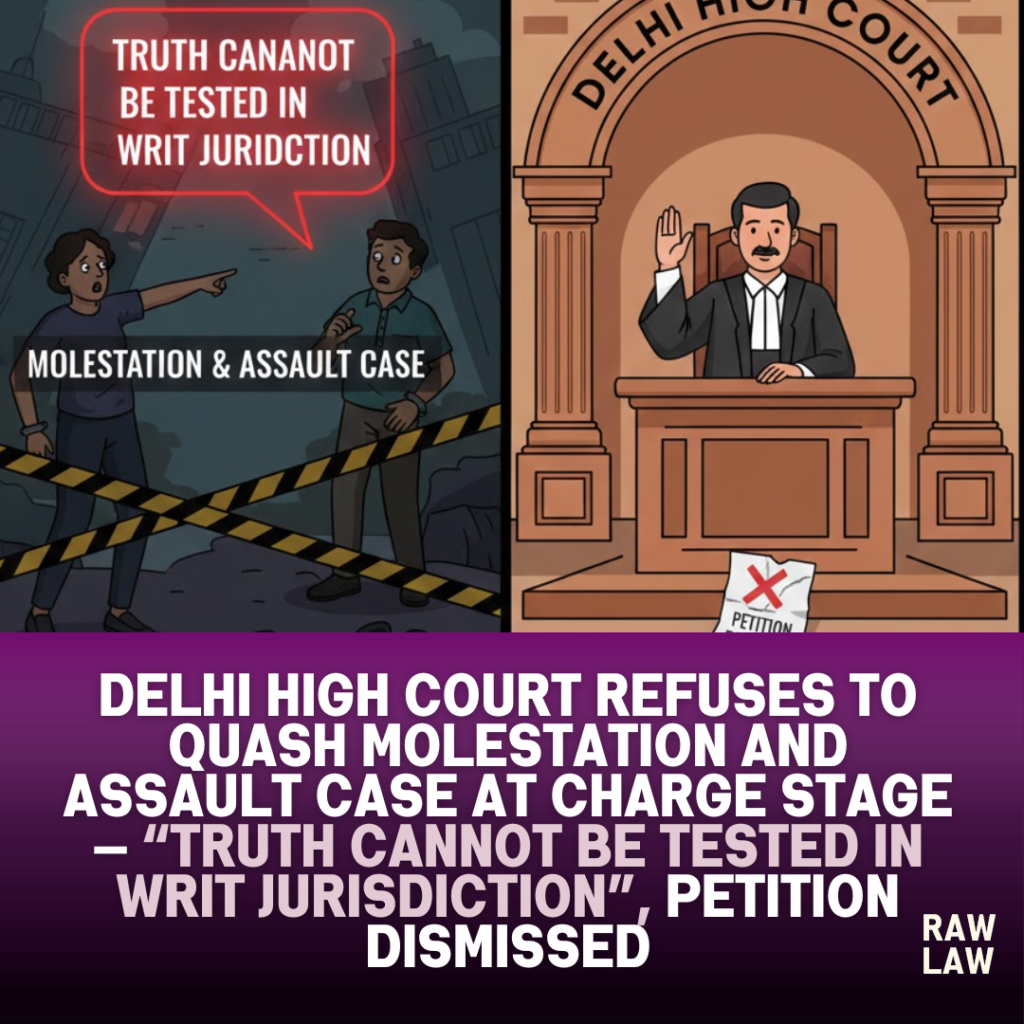
The Delhi High Court dismissed a writ petition seeking quashing of a police case registered for offences relating to outraging modesty, sexual harassment-type conduct, threats and assault under the Bharatiya Nyaya Sanhita, read with group liability provisions, along with consequential proceedings. The Court held that the complaint contained specific and detailed allegations, the investigation had produced corroborative material including medical records and seizure of torn clothing, and the case had already progressed to the stage of framing of charges. The Court ruled that the petitioners’ defences—delay, absence of independent witnesses, absence of camera footage, and disputes about presence—are matters for trial and cannot justify quashing at the threshold.
2. Facts
The petitioners were related couples and a relative, living in the same locality, against whom the complainant lodged a complaint alleging a pattern of harassment over about one year. The complainant alleged that on a specific day in October 2024, the petitioners used sexist and offensive language, threatened her, misbehaved with her and her sister, touched the sister’s chest inappropriately, and tore the complainant’s clothing. The police registered a case the next day, prepared a site plan, seized the torn garment, and recorded the complainant’s statement under the Bharatiya Nagarik Suraksha Sanhita. The medical opinion recorded the injuries as simple.
3. Issues
The principal issue was whether the High Court should quash the police case in exercise of writ jurisdiction when the complaint narrated conduct amounting to outraging modesty and assault, and when the investigation had already culminated in a charge-sheet with the case pending at the stage of framing charges. A related issue was whether alleged one-day delay, asserted absence of culpable intent, and procedural criticisms (no independent witnesses, no camera footage, no weapon recovery) could, by themselves, bring the case within the limited categories where courts prevent abuse of process by terminating criminal proceedings at inception.
4. Petitioner’s arguments
The petitioners argued that the complaint itself did not disclose the essential intention required for the offence of outraging modesty, and that the allegations were vague and uncertain. They contended that some petitioners did not reside at the address mentioned and were not present at the time of the alleged incident. They also pointed to a one-day delay between the alleged incident and registration of the police case, claiming it created doubt about the occurrence. Additionally, they asserted that the prosecution relied on interested witnesses, that there was no camera recording of the incident, and no recovery of any weapon, and urged that the case fell within the principles permitting quashing to prevent abuse of process.
5. Respondent’s arguments
The State opposed quashing, stating that investigation steps had been completed: a site plan was prepared, the complainant’s torn garment was seized, her statement was recorded, and the case was charge-sheeted and pending at the stage of framing charges. The complainant, through counsel, argued that the complaint was detailed and described the alleged humiliation, threats, assault and acts affecting her modesty and dignity, and submitted that the truthfulness of these allegations cannot be tested in a writ petition. The respondents maintained that the petitioners’ objections are defences to be raised before the trial court during charge arguments or trial, not grounds for immediate termination.
6. Analysis of the law
The High Court treated quashing as an exceptional remedy, especially when the criminal process has moved beyond registration and investigation to a filed charge-sheet. At this stage, courts typically examine whether the complaint and material disclose a prima facie offence, not whether conviction is likely. For offences involving outraging modesty, the law focuses on whether the acts were done with the intention to outrage modesty, or knowledge that they are likely to do so—an assessment that often depends on context, conduct, words used, and surrounding circumstances. The Court also noted that questions of witness credibility, absence of independent witnesses, and evidentiary gaps (like missing footage) are classic trial matters.
7. Precedent analysis
The petitioners invoked Supreme Court guidance on modesty offences, relying on the principle that where criminal force is used against a woman, the act must be intended to outrage modesty or be done with knowledge that modesty is likely to be outraged. The Court noted this framework while evaluating whether the complaint disclosed the offence. The petitioners also relied on the well-known categories for quashing and abuse of process control set out by the Supreme Court, which allow courts to terminate proceedings where allegations do not constitute an offence or where prosecution is manifestly mala fide. The High Court, however, found the present case did not fall within those categories because the complaint was specific, supported by investigation material, and the matter was already at the charge stage.
8. Court’s reasoning
The Court noted that the complainant’s complaint described the alleged harassment and the October 2024 incident “in great detail,” including sexist abuse, threats, physical misbehaviour, inappropriate touching, and tearing of clothing. It held that such allegations, on their face, made out offences concerning outraging modesty, offensive conduct towards a woman, threats and assault. On delay, the Court rejected the one-day gap as a quashing ground because medical records were prepared on the day of the incident, which the Court treated as corroborative. On “interested witnesses,” it held that in incidents of this nature, victims and family members are the natural witnesses, and their testimony cannot be discarded at the threshold merely because they are related. Lack of camera footage and weapon recovery was also held insufficient to discredit the occurrence at this stage, especially when the injuries were simple and the narrative was supported by statements and seizure of torn clothing.
9. Conclusion
The Delhi High Court concluded that none of the grounds urged by the petitioners justified quashing. It held that the petitioners’ objections were defences that can be raised before the trial court at the stage of charge or during trial, and that a writ court cannot conduct a mini-trial to test truthfulness of allegations. Since the charge-sheet had already been filed and the matter was pending at the stage of framing charges, the Court declined to short-circuit the criminal process. The petition and pending applications were dismissed.
10. Implications
The ruling reinforces a recurring criminal law principle: once a case is charge-sheeted and supported by basic corroborative material like medical records and seizure memos, courts are slow to quash merely because the accused disputes facts, challenges witnesses as “interested,” or highlights missing camera footage. For offences involving dignity and modesty, the decision shows that detailed narration of conduct—especially allegations like inappropriate touching and tearing of clothing—will usually be treated as sufficient to proceed to trial. For litigants, the order underscores that delay of a day, without more, rarely proves mala fides; and that disputes about presence, intent, and credibility are typically determined through evidence at trial rather than in writ jurisdiction.
Case law references
1) Supreme Court: State of Punjab v. Major Singh (Air 1967 Supreme Court 63)
- What it held: For offences involving outraging a woman’s modesty, the act must be done intending to outrage modesty, or with knowledge that it is likely to do so.
- How applied: The Court treated the complainant’s detailed allegations—sexist abuse, inappropriate touching, and tearing of clothes—as disclosing the necessary ingredients at the prima facie stage, making quashing inappropriate.
2) Supreme Court: State of Haryana v. Bhajan Lal (1992 Supplement (1) Supreme Court Cases 335)
- What it held: Lays down illustrative categories where extraordinary powers may be used to prevent abuse of process and secure justice, including cases where allegations do not disclose any offence.
- How applied: The Court held the case did not fall within those categories because the complaint disclosed offences and the investigation yielded supporting material, with the case pending at the charge stage.
FAQs
1) Can the High Court quash an offence alleging outraging modesty before trial?
Yes, but only in exceptional cases. This decision shows that when the complaint contains specific allegations and investigation yields supporting material, the High Court is unlikely to quash, especially after the charge-sheet is filed.
2) Is one-day delay in registering a criminal case enough to quash the case?
Usually not. The Court held that a one-day delay must be explained during trial and cannot, by itself, justify quashing, particularly when medical records from the incident date support the complaint.
3) Can a case be quashed because there are no independent witnesses or no camera footage?
Not automatically. The Court held victims and their family members are natural witnesses in such incidents, and absence of camera footage does not negate the allegations at the threshold; credibility is assessed at trial.