


Court’s decision
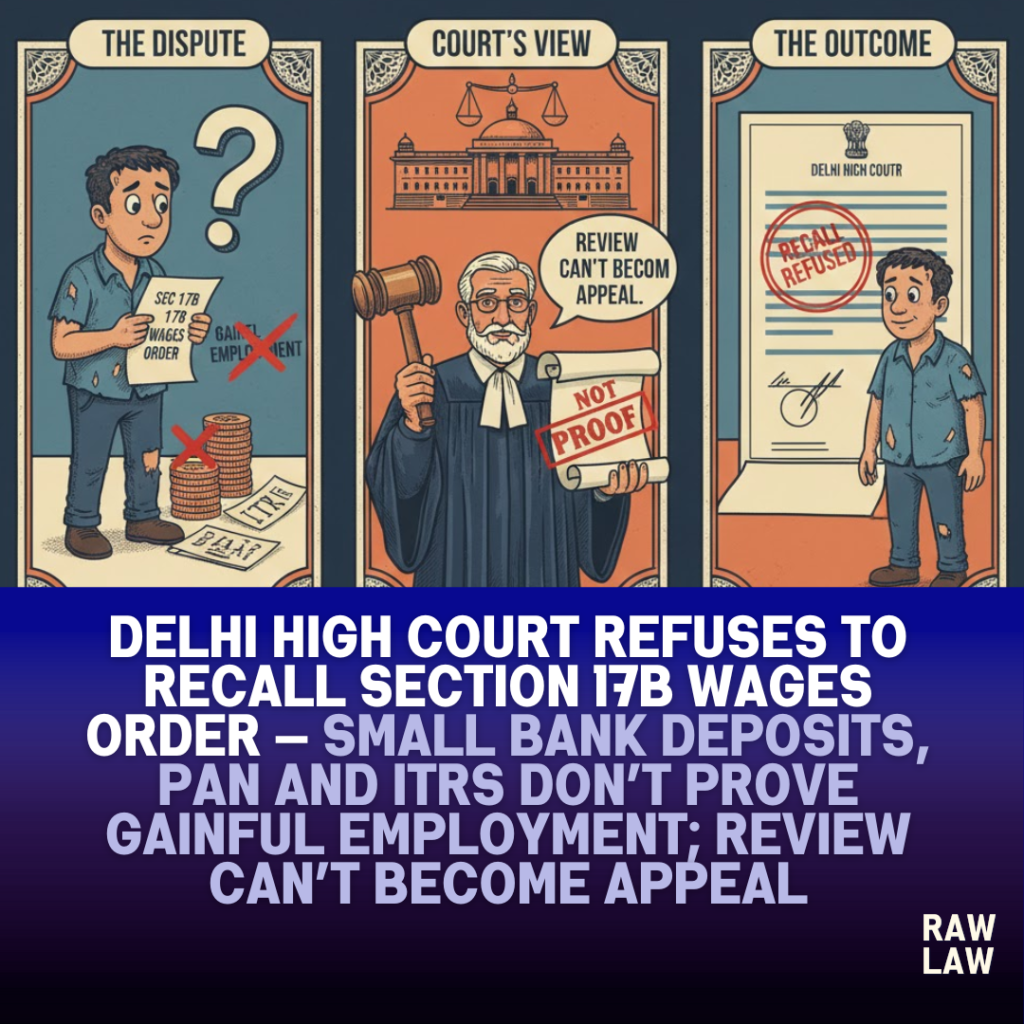
The Delhi High Court dismissed a management’s review petition seeking recall of an order granting Section 17B wages to a workman, holding that modest bank deposits, possession of a PAN, and filing of income-tax returns do not establish “gainful employment” within the meaning of the proviso to Section 17B of the Industrial Disputes Act. The Court ruled that review jurisdiction is extremely limited and cannot be invoked to re-argue merits or introduce an appellate re-appreciation of evidence — no error apparent on the face of record; Section 17B relief sustained.
Court’s decision
Justice Renu Bhatnagar rejected the management’s application under Order XLVII Rule 1 CPC seeking review of the 16 September 2004 order directing payment of last drawn wages/minimum wages to the workman during pendency of the writ. The Court held that even assuming ambiguity in earlier observations about bank entries, the material on record did not dislodge the statutory entitlement under Section 17B, and the review petition was, in substance, an appeal in disguise.
Facts
The petitioner-management, a private limited company engaged in manufacture of automobile and tractor parts, employed the respondent workman as a Turner since 1984. In October 1997, the workman was transferred from Kirti Nagar, Delhi to the petitioner’s factory at Dundahera, Gurgaon. The workman objected, raised an industrial dispute, and the matter was referred to adjudication.
By an award dated 13 August 2002, the Industrial Tribunal held the transfer illegal, observing that the workman could not reasonably be expected to join at Gurgaon, and directed payment of wages for the intervening period with continuity of service. Challenging the award, the management filed a writ petition before the Delhi High Court.
During pendency, the workman applied for relief under Section 17B of the Industrial Disputes Act, supported by an affidavit stating that he remained unemployed. By order dated 16 September 2004, the High Court allowed the application, holding that bank deposits and possession of a mobile phone/landline did not establish gainful employment, and directed payment of last drawn wages or minimum wages, whichever was higher.
The management thereafter filed the present review application seeking recall of the Section 17B order.
Issues
The principal issues were whether the management had demonstrated an “error apparent on the face of the record” warranting review of the Section 17B order, and whether subsequent material relating to bank deposits, PAN, and income-tax returns could establish gainful employment sufficient to deny Section 17B wages.
Petitioner’s arguments
The management argued that the Court had proceeded on an incorrect factual premise in observing that the workman had only two deposits of ₹2,000 each, whereas the passbook reflected multiple deposits aggregating about ₹25,000 over three months. It further contended that after the Section 17B order, it discovered that the workman possessed a PAN and had filed income-tax returns declaring gross receipts of around ₹4.7 lakh, allegedly showing that he was running a proprietary business.
It was submitted that this constituted “new and important evidence” not within the petitioner’s knowledge earlier and that Section 17B, meant to ensure bare subsistence, could not be invoked by a workman who was demonstrably earning. The management also sought initiation of proceedings under Section 340 CrPC against the workman.
Respondent’s arguments
The workman opposed the review, contending that the application was not maintainable and amounted to an appeal in disguise. He argued that review lies only for patent errors apparent on the face of the record and not for re-assessment of evidence.
On merits, it was submitted that any small-scale activity undertaken was only to assist the family business for survival after illegal transfer and did not amount to employment in an establishment. Reliance was placed on Delhi High Court precedent to submit that transient or subsistence-level activity does not bar Section 17B relief.
Analysis of the law
The Court reiterated settled principles governing review jurisdiction: it is confined to correcting patent, self-evident errors and cannot be used to substitute a different view or re-argue the case. Mere possibility of another view or introduction of grounds appropriate for appeal does not justify review.
On Section 17B, the Court reaffirmed that the statutory test is whether the workman is “employed in any establishment and receiving adequate remuneration.” The existence of bank transactions, PAN, or income-tax filings is not determinative unless they demonstrate regular, gainful employment. The provision is welfare-oriented and must be construed to secure subsistence during pendency of challenges to labour awards.
Precedent analysis
The Court relied on Supreme Court authority holding that survival-level assistance in a family enterprise or income merely to keep “body and soul together” cannot be equated with gainful employment. It also followed coordinate bench precedent clarifying that review jurisdiction cannot be expanded to rehear the matter or correct alleged errors requiring detailed examination. These principles were applied to reject the management’s attempt to reopen the Section 17B order.
Court’s reasoning
The Court noted a limited ambiguity in the earlier order regarding the description of bank deposits, but held that even upon fresh examination, the deposits reflected modest sums that did not evidence regular employment. The Court found no material showing that the workman was employed in any establishment or receiving adequate remuneration.
Regarding PAN and income-tax returns, the Court observed that the relevant documents had been withdrawn from record earlier and, in any event, mere filing of returns or existence of PAN does not establish gainful employment. At best, the material showed subsistence-level activity.
Crucially, the Court held that none of the grounds raised disclosed an error apparent on the face of the record; the review petition sought a re-appreciation of evidence impermissible in review.
Conclusion
The Delhi High Court dismissed the review application, upheld the Section 17B order dated 16 September 2004, and directed that the main writ petition be listed before the regular roster. The Court declined to recall the wages direction or initiate perjury proceedings.
Implications
This judgment reinforces two important principles in labour and procedural law. First, Section 17B protection cannot be denied on tenuous indicators like small bank deposits, PAN, or marginal income-tax disclosures that do not establish gainful employment. Second, review jurisdiction remains strictly circumscribed; employers cannot reopen Section 17B orders by repackaging appellate arguments as “errors apparent.” The ruling strengthens the subsistence-oriented purpose of Section 17B and promotes finality in interim labour reliefs.
Case law references
- Review jurisdiction under Order XLVII CPC: Limited to patent errors; cannot substitute appellate scrutiny. Applied to dismiss review.
- Rajinder Kumar Kindra v. Delhi Administration: Survival-level family assistance is not gainful employment. Applied to uphold Section 17B relief.
- Section 17B ID Act jurisprudence: Employer must prove employment in an establishment with adequate remuneration to deny relief. Applied against management.
FAQs
1. Can small bank deposits defeat Section 17B wages?
No. Unless they show regular employment with adequate remuneration, deposits alone are insufficient.
2. Does having a PAN or filing income-tax returns amount to gainful employment?
No. These factors by themselves do not prove employment in an establishment.
3. When can a court review a Section 17B order?
Only when there is a clear error apparent on the face of the record, not to re-argue merits.