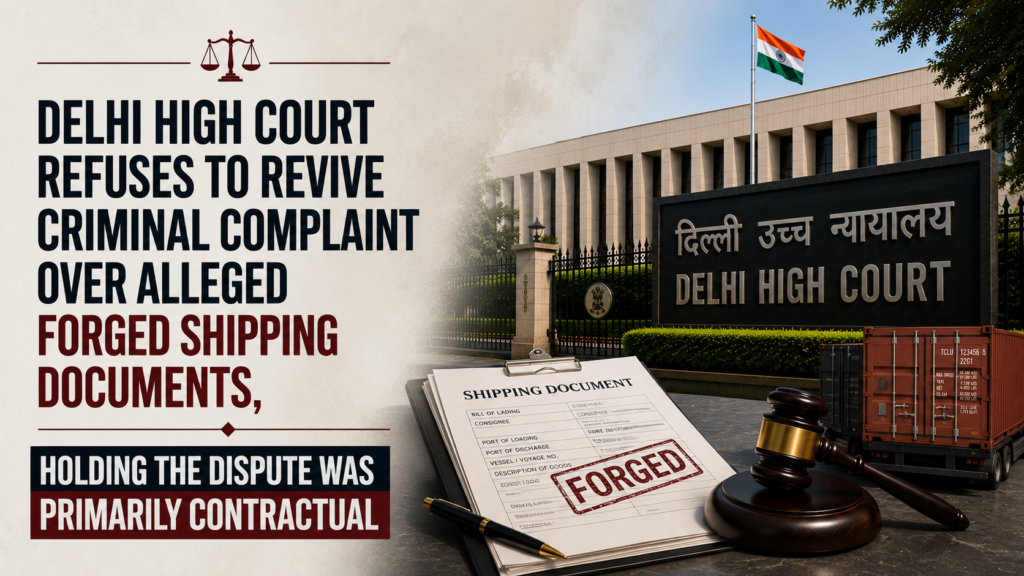
Delhi High Court Refuses to Revive Criminal Complaint Over Alleged Forged Shipping Documents, Holding the Dispute Was Primarily Contractual

Claim of Forged Shipping Documents Held Essentially Commercial Dispute; Delhi High Court Dismisses Criminal Petition
Facts
The petitioner, M/s Rosmarine Shipping Pvt. Ltd., filed a petition under Section 482 CrPC challenging concurrent orders of the Metropolitan Magistrate and the Additional Sessions Judge dismissing its complaint under Section 200 CrPC.
The dispute arose from a commercial arrangement entered into in 2005 between the petitioner, a freight forwarding company, and M/s Clutch Auto Ltd. for transportation of used machinery from the United States to India.
According to the petitioner:
- it was entitled to 9% commission on the FOB value of the shipment in addition to transportation charges;
- the respondents subsequently relied upon a communication dated 28 September 2005, allegedly issued by an official of the American supplier, showing the value of the machinery at USD 1,50,000;
- the said communication was forged and was used before Customs authorities to reduce the FOB value, thereby depriving the petitioner of higher commission.
The petitioner relied upon:
- a handwriting expert’s opinion;
- customs records;
- banking evidence; and
- subsequent correspondence allegedly disproving the authenticity of the disputed communication.
After the Magistrate dismissed the complaint despite pre-summoning evidence, and the Revisional Court affirmed that decision, the petitioner approached the Delhi High Court.
Issues
The High Court considered:
- Whether the complaint disclosed sufficient grounds for summoning the respondents for offences of cheating, forgery and criminal breach of trust.
- Whether the Magistrate correctly exercised powers under Sections 200 and 203 CrPC while dismissing the complaint.
- Whether the Revisional Court committed any jurisdictional error in affirming the Magistrate’s order.
- Whether the dispute was essentially civil or disclosed a prima facie criminal offence.
Petitioner’s Arguments
The petitioner argued that:
- the respondents had forged the communication dated 28 September 2005 purportedly issued by the American supplier;
- the forged document was used before Customs authorities;
- the forgery caused wrongful loss to the petitioner by reducing the commission payable under the commercial arrangement;
- the handwriting expert, customs official and bank official examined during pre-summoning evidence sufficiently established a prima facie criminal case;
- the complaint was not filed for recovery of money but for prosecuting offences of cheating, forgery and criminal breach of trust.
It was further submitted that at the stage of summoning, the Magistrate was only required to determine whether sufficient grounds existed for proceeding and not to undertake a detailed evaluation of evidence.
Respondents’ Arguments
The respondents contended that:
- the complaint was filed nearly five years after the transaction without any satisfactory explanation for the delay;
- the allegation of forgery rested substantially on a handwriting expert’s opinion comparing disputed signatures with scanned copies;
- the alleged foreign official whose signatures were said to have been forged was never examined;
- the petitioner had already received commission calculated on the declared FOB value;
- the dispute essentially concerned entitlement to additional contractual commission.
Accordingly, the respondents argued that no criminal offence was disclosed and that the complaint had rightly been dismissed.
Analysis of the Law
Scope of Sections 200 and 203 CrPC
The Court reiterated that at the stage of considering a private complaint, the Magistrate is only required to determine whether sufficient grounds exist for proceeding.
The Magistrate is not expected to conduct a meticulous appreciation of evidence.
However, where the material fails to disclose a prima facie criminal offence, dismissal under Section 203 CrPC is justified.
Limited Scope of Revisional and Inherent Jurisdiction
The Court observed that the Revisional Court examines only:
- legality;
- propriety; and
- jurisdictional correctness
of the Magistrate’s order.
Similarly, while exercising jurisdiction under Section 482 CrPC, the High Court does not substitute its own opinion merely because another view is possible.
Interference is warranted only where the impugned orders suffer from patent illegality, perversity or jurisdictional error.
Delay in Initiating Criminal Proceedings
The alleged transaction took place in 2005, whereas the criminal complaint was instituted only in 2010.
The Court noted that:
- no satisfactory explanation was offered for the substantial delay;
- the petitioner also failed to specify when it first acquired knowledge of the alleged forgery.
This unexplained delay weakened the credibility of the criminal allegations.
Dispute Was Essentially Commercial
The High Court observed that the core controversy related to:
- valuation of the shipment;
- interpretation of the contractual arrangement;
- entitlement to additional commission.
The Magistrate had already examined the handwriting expert’s opinion and other pre-summoning evidence before concluding that no prima facie criminal case was made out.
The High Court agreed that the dispute essentially arose out of a commercial contract and did not warrant criminal prosecution on the material produced.
Precedent Analysis
Rekha Sharad Ushir v. Saptashrungi Mahila Nagari Sahkari Patsansta Ltd. (2025)
The Court relied upon the Supreme Court’s recent decision reiterating that a complainant who suppresses material facts or documents cannot be permitted to set criminal law in motion.
The judgment reaffirmed that criminal proceedings initiated without full and fair disclosure amount to abuse of the judicial process.
S.W. Palanitkar v. State of Bihar
The petitioner relied upon this decision to argue that the Magistrate should only examine whether a prima facie case exists at the pre-summoning stage.
The High Court accepted the legal principle but held that, even applying that standard, the material placed on record did not justify issuance of process.
Nirmaljit Singh Hoon v. State of West Bengal
The Court recognised the settled principle that detailed appreciation of evidence is unnecessary at the summoning stage.
However, where the complaint itself fails to disclose sufficient grounds for proceeding, dismissal under Section 203 CrPC remains justified.
Court’s Reasoning
The High Court found no error in the concurrent findings of the Magistrate and the Revisional Court.
It observed that:
- the complaint was instituted after considerable unexplained delay;
- the principal controversy related to calculation of commission under a commercial agreement;
- the alleged forgery had not been prima facie established by the material produced;
- the Magistrate had carefully examined the pre-summoning evidence before refusing to issue process.
Since no patent illegality or perversity was demonstrated, interference under Section 482 CrPC was unwarranted.
Conclusion
The Delhi High Court dismissed the petition.
It upheld:
- the Metropolitan Magistrate’s order dismissing the complaint under Section 200 CrPC; and
- the Revisional Court’s judgment affirming that dismissal.
The Court held that the dispute primarily arose from contractual claims regarding commission and that the petitioner failed to establish sufficient grounds for initiating criminal prosecution.
Key Takeaways
- Criminal law cannot ordinarily be invoked to resolve disputes arising purely from commercial contracts.
- At the pre-summoning stage, the Magistrate need only determine whether sufficient grounds exist for proceeding.
- A complaint may be dismissed under Section 203 CrPC where the material fails to disclose a prima facie criminal offence.
- High Courts exercising jurisdiction under Section 482 CrPC ordinarily do not interfere with concurrent findings unless patent illegality or perversity is shown.
- Unexplained delay in initiating criminal proceedings may weaken the credibility of allegations.
Case Details
Case: M/s Rosmarine Shipping Pvt. Ltd. v. M/s Clutch Auto Ltd. & Ors.
Court: Delhi High Court
Case Number: CRL.M.C. 5408/2014
Judge: Justice Madhu Jain
Reserved On: 20 July 2026
Date of Decision: 24 July 2026
Result: Petition dismissed. The High Court upheld the dismissal of the complaint under Section 200 CrPC, holding that no prima facie criminal offence was disclosed and that the dispute was essentially contractual in nature.