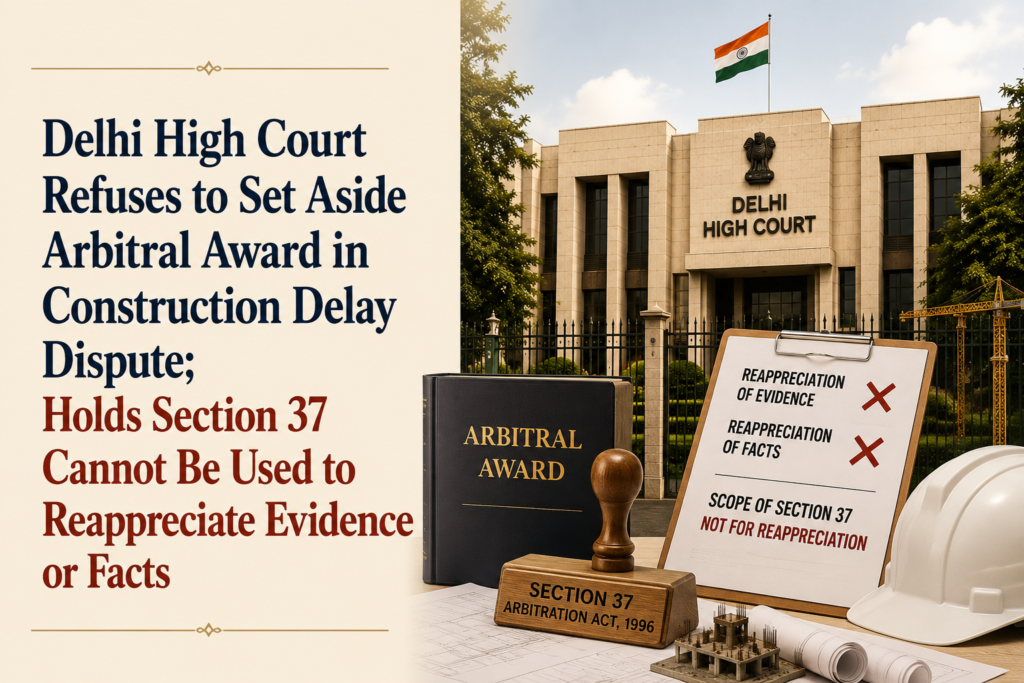
Delhi High Court Refuses to Set Aside Arbitral Award in Construction Delay Dispute; Holds Section 37 Cannot Be Used to Reappreciate Evidence or Facts

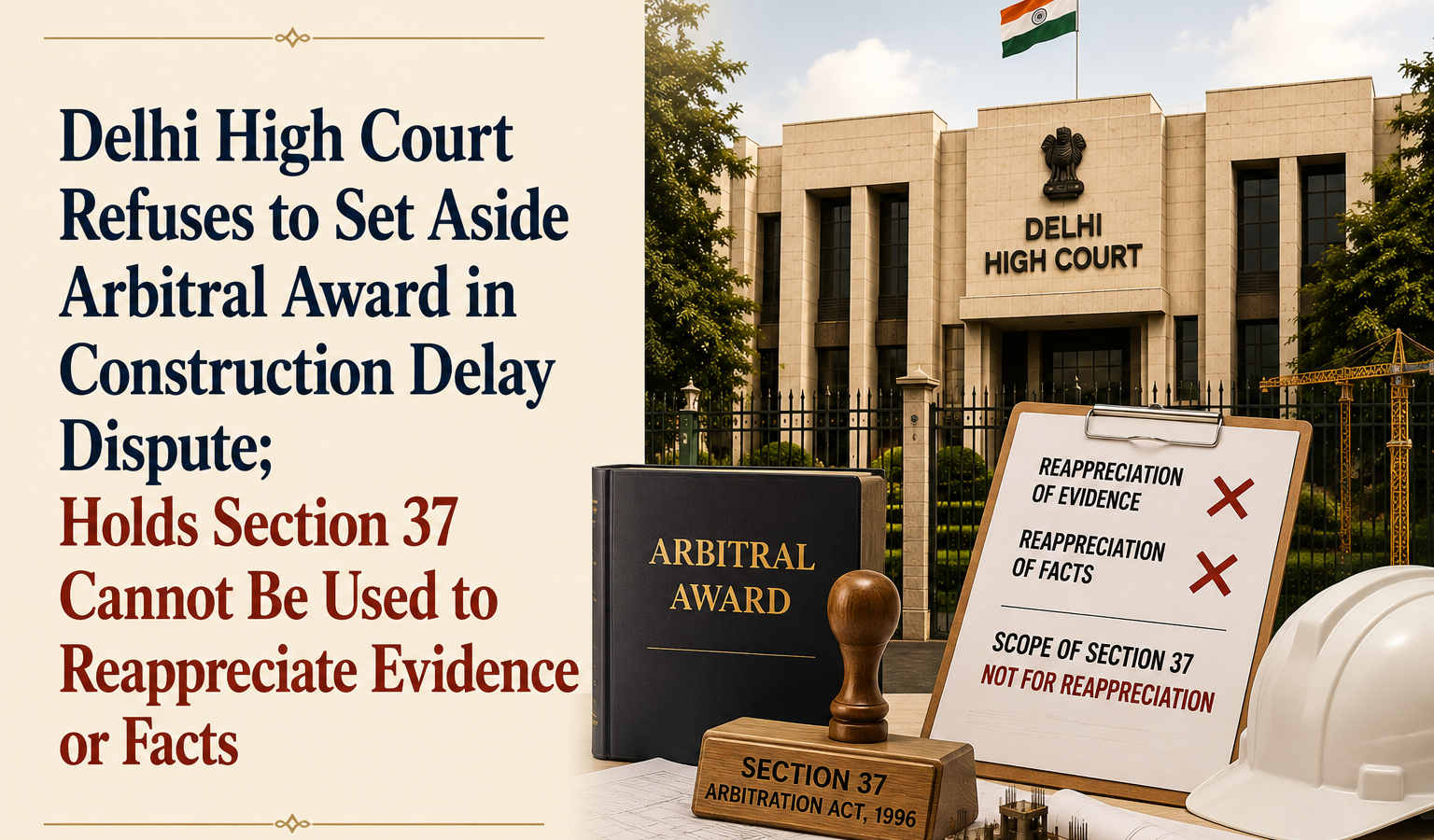
Delhi High Court Holds Contractor Failed to Prove Employer Caused Project Delay; Declines to Interfere with Arbitral Award
Facts
The appellant, a contractor, was awarded a contract by Netaji Subhas University of Technology (formerly NSIT) for construction of the Student Centre at its Dwarka campus for a contract value of ₹64,44,290 plus GST. The work was to be completed within six months but was actually completed after a delay of 761 days. The contractor alleged that the delay resulted from the University’s failure to provide a hindrance-free site, delayed drawings, trees, an HT cable, pending electrical works by another agency and repeated changes in specifications. The University contended that although certain initial hindrances existed, they were removed within a reasonable time and the prolonged delay was attributable to the contractor’s failure to deploy adequate manpower and resources. Arbitration was invoked, but the Sole Arbitrator rejected all claims raised by the contractor as well as the University’s counterclaim. The Commercial Court dismissed the contractor’s challenge under Section 34, leading to the present appeal under Section 37 of the Arbitration and Conciliation Act, 1996.
Issues
- Whether the Commercial Court erred in refusing to set aside the arbitral award under Section 34 of the Arbitration and Conciliation Act, 1996.
- Whether the arbitral award suffered from patent illegality or perversity by holding the contractor responsible for the delay.
- Whether the High Court could reappreciate evidence and factual findings while exercising appellate jurisdiction under Section 37.
Petitioner’s (Appellant’s) Arguments
The contractor argued that the Arbitrator failed to properly appreciate the documentary evidence demonstrating that the University itself was responsible for the delay. It was submitted that delayed drawings, repeated revisions, obstruction caused by trees and an HT cable, pending electrical work by another agency and changes in the scope of work prevented timely completion. The contractor further contended that the Arbitrator failed to record adequate reasons while rejecting its claims and that the Commercial Court also failed to examine these errors under Section 34. It was argued that the award suffered from patent illegality and conflicted with the public policy of India, entitling the contractor to damages for delay.
Respondent’s Arguments
The University supported the arbitral award and submitted that the appeal merely sought a fresh appreciation of evidence, which is impermissible under Sections 34 and 37 of the Arbitration and Conciliation Act. It argued that the contractor failed to identify any specific material evidence allegedly ignored by the Arbitrator. According to the University, the Arbitrator had thoroughly considered the evidence and reasonably concluded that the contractor failed to deploy sufficient manpower and resources for timely completion. Since the findings were based on evidence and represented a plausible view, no judicial interference was warranted.
Analysis of the Law
The High Court reiterated that proceedings under Sections 34 and 37 of the Arbitration and Conciliation Act are supervisory and not appellate in nature. Courts cannot reassess evidence, reinterpret contractual terms or substitute their own factual conclusions merely because another view is possible. Interference is confined to situations where the award suffers from patent illegality, perversity, jurisdictional error or conflicts with the fundamental policy of Indian law.
The Court further observed that Section 37 confers an even narrower scope of interference than Section 34. The appellate court is only required to determine whether the Commercial Court acted within the limits prescribed under Section 34 and cannot itself undertake a merits review of the arbitral dispute.
Precedent Analysis
The Court relied upon:
- Punjab State Civil Supplies Corporation Ltd. v. Sanman Rice Mills (2024 SCC OnLine SC 2632), wherein the Supreme Court held that appellate jurisdiction under Section 37 is extremely limited and does not permit reappreciation of evidence or reconsideration of factual findings returned by an arbitral tribunal.
- OPG Power Generation Pvt. Ltd. v. Enexio Power Cooling Solution India Pvt. Ltd. (2024 SCC OnLine SC 2600), relied upon by the Commercial Court for the proposition that well-reasoned arbitral awards based upon appreciation of evidence should not be interfered with merely because another view is possible.
Court’s Reasoning
The High Court found that the Arbitrator had independently examined every allegation regarding trees, delayed drawings, the HT cable, pending electrical work and other alleged hindrances. The Arbitrator concluded that although certain initial obstacles existed, they were removed within a reasonable time and did not explain the prolonged delay of more than two years. The contractor also failed to establish any causal connection between the alleged hindrances and the overall delay.
The Court rejected the argument that extensions of time granted by the University automatically established liability for delay, observing that extension of time under a construction contract does not necessarily entitle the contractor to monetary compensation. The Court also noted that although the contractor alleged that certain documents had been ignored, no such documents were specifically identified before either the Commercial Court or the High Court.
Since the Arbitrator’s conclusions were based on appreciation of evidence and represented a plausible view, the Court held that neither the Commercial Court nor the High Court could interfere merely because another interpretation of the evidence was possible.
Conclusion
The Delhi High Court dismissed the appeal and upheld both the Commercial Court’s judgment and the arbitral award. It held that the contractor failed to establish any patent illegality, perversity or jurisdictional error warranting interference under Sections 34 or 37 of the Arbitration and Conciliation Act. The Court reaffirmed that findings of fact recorded by an arbitral tribunal cannot be reopened through reappreciation of evidence in appellate proceedings.
Case Details
Case: Nitin Kumar Sharma v. Netaji Subhas University of Technology (NSIT)
Court: High Court of Delhi
Case Number: FAO (COMM) 82/2026
Judge: Hon’ble Mr. Justice Vivek Chaudhary and Hon’ble Ms. Justice Renu Bhatnagar
Date: 05 August 2026
Result: Appeal dismissed; Commercial Court’s order under Section 34 affirmed and arbitral award upheld